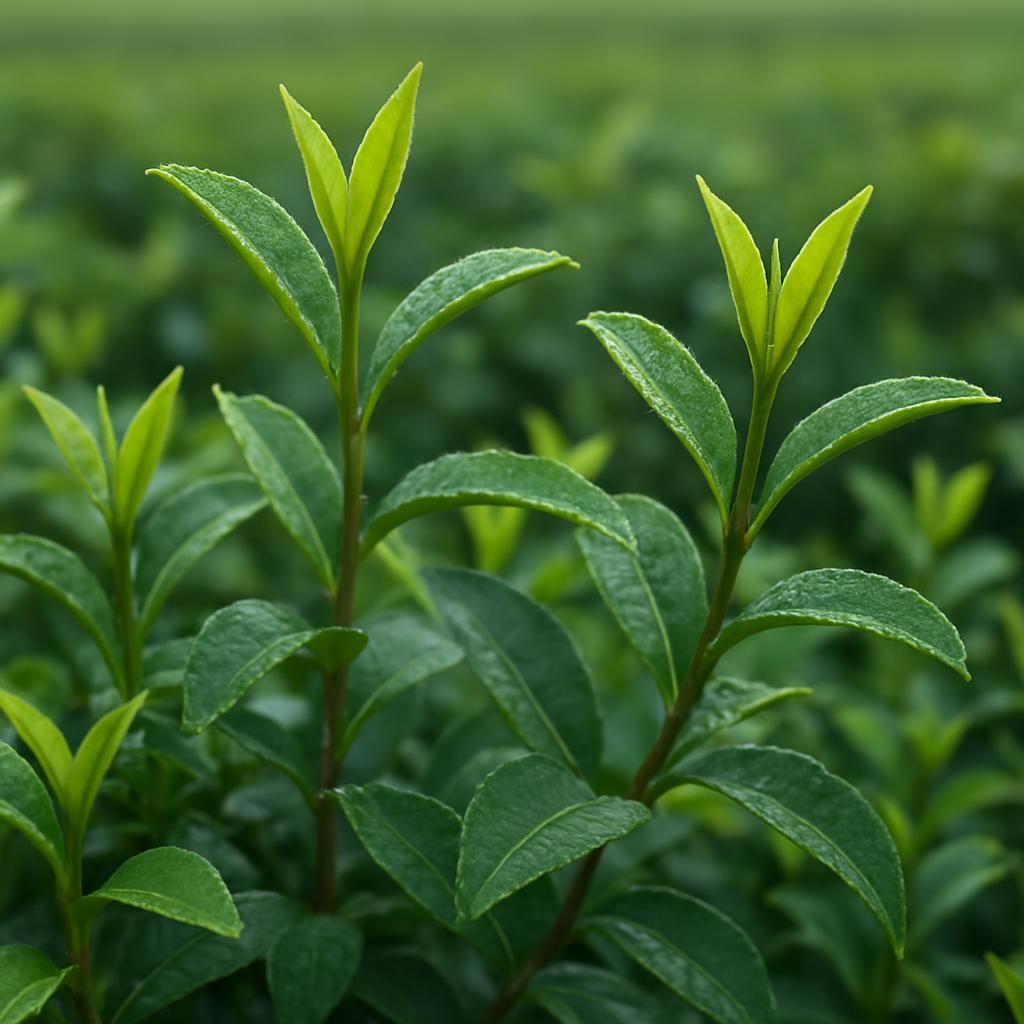
Introduction to Tea (Camellia sinensis - Sinensis)
Tea (Camellia sinensis var. sinensis) is the source of the world’s most consumed beverage after water. Native to the cool, misty highlands of China, this variety produces smaller, more cold-hardy leaves than the Assam type and is favored for high-quality green and oolong teas. Commercial plantings thrive between 1,000 and 2,500 m elevation where consistent rainfall, acidic soils, and cool nights concentrate flavor compounds. The crop requires 4–7 years to reach first commercial harvest, but once established can remain productive for 50–100 years with proper pruning and soil management.
Botanical Profile of Tea (Camellia sinensis - Sinensis)
Camellia sinensis var. sinensis is an evergreen woody shrub in the Theaceae family. Mature plants reach 1.5–2 m when pruned for plucking but can grow 5–10 m if left unpruned. Leaves are dark green, glossy, and elliptic with serrated margins; new flushes are bright green and covered in fine silvery hairs. Small, fragrant white flowers appear in autumn, each with 5–7 petals and numerous yellow stamens. Seeds are contained in woody capsules that split at maturity. The plant forms a deep taproot and extensive lateral feeder roots that are highly sensitive to waterlogging.
Soil, pH, and Climate Requirements for Tea (Camellia sinensis - Sinensis)
Tea demands well-drained, deep, acidic soils rich in organic matter. The following table summarizes optimal growing conditions:
| Parameter | Ideal Range | Notes |
|---|---|---|
| Soil pH | 4.5–5.5 | Below 4.0 causes aluminum toxicity |
| Soil Texture | Loamy to sandy loam | Avoid heavy clay; improve drainage |
| Organic Matter | 3–5 % | Maintain with annual compost or mulch |
| Elevation | 1,000–2,500 m | Higher altitudes improve quality |
| Annual Rainfall | 1,500–3,000 mm | Even distribution preferred |
| Temperature Range | 10–30 °C (optimum 18–25 °C) | Frost below –5 °C damages young shoots |
| Relative Humidity | 70–90 % | Essential for quality flush |
| Sunlight | 4–6 hours direct sun | Partial shade beneficial in hot climates |
Step-by-Step Planting & Propagation
- Site Selection: Choose a north- or east-facing slope with good air drainage and protection from strong winds.
- Soil Preparation: Test pH and incorporate 20–30 t/ha well-rotted cattle manure plus 2 t/ha rock phosphate six months before planting.
- Propagation: Use semi-hardwood cuttings 8–10 cm long taken from healthy mother bushes in early spring. Dip in 0.3 % IBA and root in a 1:1 peat-perlite mix under 80 % shade and high humidity.
- Nursery Phase: Maintain 25–28 °C and 85 % humidity; roots form in 8–12 weeks. Harden off for 4 weeks before field transplanting.
- Field Planting: Space plants 1.2 m × 1.2 m (7,000 plants/ha) or 1.5 m × 0.75 m in hedgerow systems. Plant at the same depth as the nursery bag; water immediately.
- Initial Shade: Provide temporary shade cloth or interplant with Gliricidia for the first 12–18 months.
Care & Maintenance regimes for Tea (Camellia sinensis - Sinensis)
Young bushes require careful attention during the first three years. The table below outlines the annual schedule:
| Operation | Year 1 | Year 2 | Year 3+ (Mature) |
|---|---|---|---|
| Watering | 10–15 L/plant/week | 15–20 L/plant/week | 25–30 mm/week; drip irrigation preferred |
| Fertilizer | 20 g NPK 15-15-15/plant monthly | 40 g NPK 15-15-15 + 10 g MgO quarterly | 150 kg N, 30 kg P₂O₅, 60 kg K₂O/ha/year split in 4 applications |
| Pruning | Formative prune at 30 cm | Cut back to 40 cm | Skiffing every 3–4 years; heavy prune every 15–20 years |
| Mulching | 10 cm organic mulch | Renew annually | Maintain 8–10 cm layer |
| Weeding | Hand weeding monthly | Spot spray glyphosate | Mow or slash between rows |
Pests, Diseases & Organic Management
Major insect pests include Tea Mosquito Bug, Aphids, Thrips, and Red Spider Mite. Common diseases are Blister Blight caused by Exobasidium vexans, Root Rot from Phytophthora, and Anthracnose. Implement integrated management: remove and destroy infected shoots, maintain 70 % shade during monsoon, apply neem oil (0.5 %) every 14 days for sucking insects, and drench soil with Trichoderma harzianum at 5 kg/ha twice yearly. Monitor with yellow sticky traps and pheromone lures for early detection.
Harvesting, Curing & Optimal Storage
Pluck two leaves and a bud when shoots reach the “two-and-a-bud” stage. Harvest every 7–10 days in peak season. For premium green tea, steam or pan-fire leaves within 2 hours of harvest to inactivate polyphenol oxidase. Black tea undergoes withering (18–20 h at 25–30 °C), rolling, full fermentation (2–4 h at 28 °C, 95 % RH), and drying at 90–100 °C to 3 % moisture. Store finished tea in airtight, light-proof containers at 15–20 °C and <60 % RH. Properly cured tea retains flavor for 12–18 months.
Companion Planting for Tea (Camellia sinensis - Sinensis)
Interplant nitrogen-fixing Gliricidia or Pigeon pea at field edges to supply 40–60 kg N/ha/year and provide windbreaks. Sow Clover or Hairy vetch as living mulch between rows to suppress weeds and improve soil structure. Marigold and Nasturtium deter nematodes and aphids. Avoid planting Tomato or Potato nearby as they share susceptibility to Phytophthora. Rotate cover crops every three years to maintain biodiversity and reduce pest buildup.