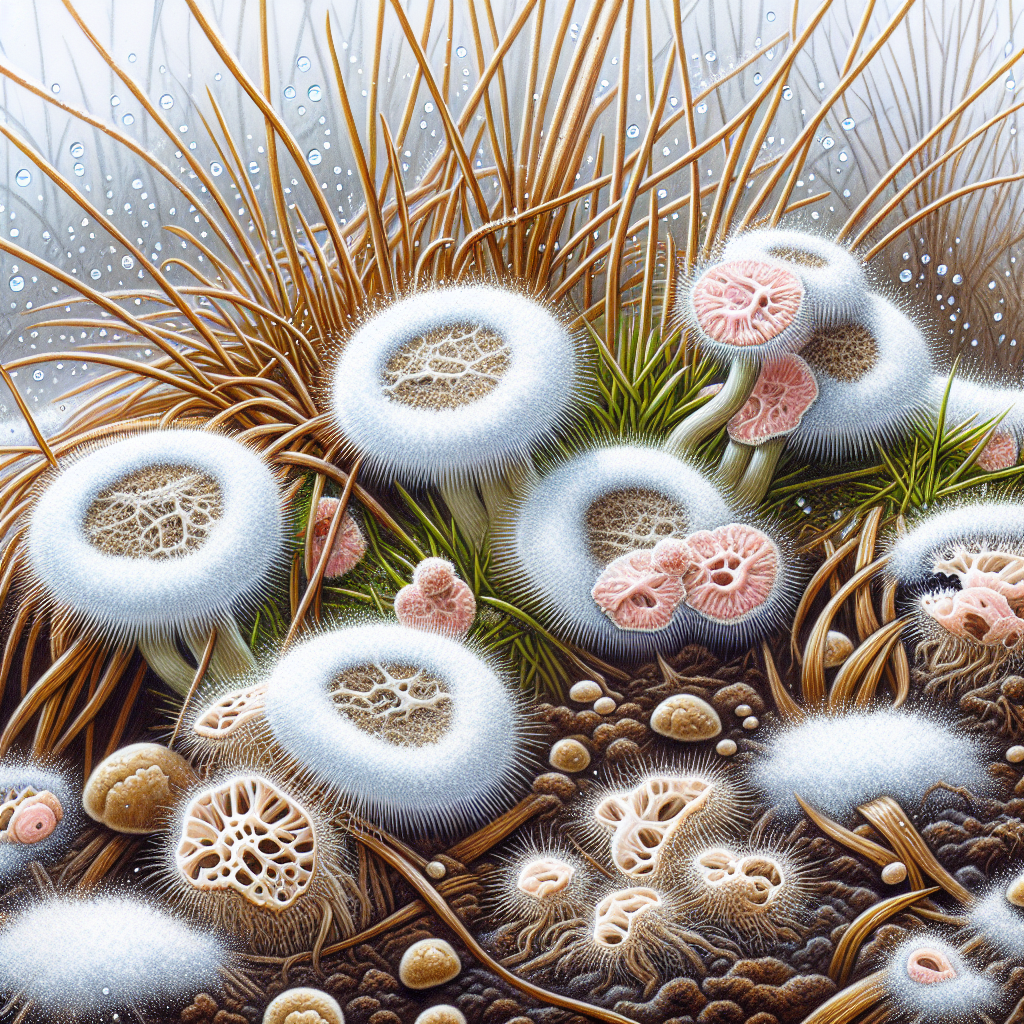
Introduction to snow mold
Snow mold is a group of low-temperature fungal diseases that primarily affect cool-season turfgrasses, winter cereals, and forage crops in regions with prolonged snow cover. Caused by pathogens such as Microdochium nivale (pink snow mold), Typhula incarnata and Typhula ishikariensis (gray snow mold), and Sclerotinia borealis (snow scald), this disease thrives under insulating snow that maintains cool, moist conditions near 0°C (32°F). It leads to blighted patches that appear in early spring as snow recedes, often covering large areas of lawns, golf courses, and agricultural fields.
First recognized in the early 20th century in northern Europe and North America, snow mold causes billions in economic losses annually to the turf industry and grain production. In turfgrass, it manifests as circular patches up to several meters wide with white mycelium transitioning to tan or pink felts. In crops like winter rye and oats, it results in matted, rotted foliage and reduced tillering, compromising yields by 20-100% in severe outbreaks. Understanding snow mold is crucial for growers in USDA zones 3-7 where snow persists for 3+ months. Early diagnosis and integrated management can minimize damage, preserving plant health and productivity. This guide provides definitive diagnostic criteria, lifecycle details, and proven organic and chemical strategies for control.
Identifying Symptoms & Damage
Snow mold symptoms emerge post-snowmelt, distinguishing it from drought stress or fusarium blights. Gray snow mold (Typhula spp.) produces abundant white-to-gray mycelium forming a web-like mat over blighted grass, with small, tan sclerotia (0.5-2 mm) resembling mustard seeds embedded in killed tissues. Affected areas appear sunken, straw-colored dead patches 1-10 feet in diameter, often merging into larger blights.
Pink snow mold (Microdochium nivale) shows salmon-pink to cinnamon-brown mycelium, lacking sclerotia, with a sharp margin between healthy and dead turf. In advanced stages, leaves exhibit orange fruiting bodies (apothecia) under magnification. Damage includes root rot in prolonged infections, reducing regrowth vigor. On cereals like wheat, infected tillers mat together with white-gray felts, blackened bases, and barren heads.
Snow scald (Sclerotinia borealis) features black, flask-shaped sclerotia (2-10 mm) on leaf sheaths, causing irregular brown lesions extending into crowns. Differentiate via lab tests: Typhula grows at 0-10°C, Microdochium at 5-15°C. Yield losses in forage grasses reach 50%, while turf requires full renovation in severe cases. Scout post-thaw, probing for mycelium and sclerotia; wet tissues confirm active infection versus dry winterkill.
Lifecycle and Progression of snow mold
Snow mold fungi are psychrophilic (cold-loving), surviving as sclerotia or mycelium in soil, thatch, or plant debris for years. In fall, as temperatures drop below 10°C (50°F), dormant propagules germinate under moist conditions, colonizing senescing tissues before snow cover. Prolonged snow (90+ days) creates an ideal microclimate: 0-2°C, high humidity >90%, and darkness, allowing mycelial growth at rates up to 1 cm/day.
Primary infection occurs at leaf tips, progressing basipetally to crowns and roots over winter. Sclerotia form in spring as mycelium desiccates, maturing in 2-4 weeks before germinating next fall with sufficient moisture (>20 mm). Microdochium nivale spreads via conidia in meltwater, enabling secondary cycles in cool, wet springs. Disease progression accelerates with freeze-thaw cycles, producing ice lenses that wick moisture to crowns. Full cycle: dormancy (summer), activation (fall), rampant growth (winter), sporulation/sclerotia (spring), quiescence (summer). Interrupt at snowmelt for control.
Environmental Triggers & Risk Factors
Snow mold epidemics require three factors: susceptible host, virulent pathogen, and conducive environment. Key triggers include prolonged snow cover (>100 days) insulating soil at 0-5°C, with slow melt prolonging leaf wetness. Poor drainage, compacted soils, and high thatch (>0.5 inch) retain moisture, elevating risk 3-5x. Late fall fertilization with excess N (>1 lb/1000 sq ft) promotes succulent growth prone to infection.
Shade from trees reduces air circulation, trapping humidity; ice sheets from freezing rain seal oxygen exclusion. In crops, continuous wheat or barley monoculture builds inoculum. Acidic soils (pH <6.0) favor Microdochium, while neutral pH suits Typhula. Climate change extends marginal risk zones southward. Assess site: snow drifting, low-lying areas, or heavy dew increase incidence 40%. Mitigate with airflow and de-thatching.
Organic Control & Treatment Plans
Organic management emphasizes cultural disruption of the snow mold triangle. Rake and remove thatch annually to <0.5 inch, improving aeration and drying. Fall applications of compost tea or humic acids (5 gal/A) boost microbial antagonists. For active infections, apply potassium bicarbonate (3-5 oz/1000 sq ft) or potassium salts of fatty acids at snowmelt, repeating biweekly for 4 weeks. Efficacy reaches 60-80% on pink snow mold.
Biologicals like Trichoderma virens or Coniothyrium minitans (2-4 lb/A) colonize debris, outcompeting pathogens; apply pre-snow. Strengthen turf with fall potassium (1 lb K2O/1000 sq ft) sans N. On small scales, topdress with calcined clay post-melt to desiccate mycelium. Integrate with resistant cultivars like '4N' fescues. For crops, burn residues or deep plow (>6 inch) to bury sclerotia. Monitor with baiting traps; treat at first mycelium. Organic success: 70% reduction via vigilance. Read more on Soil Health Mastery: 5 Proven Strategies for Small Farms to Build Fertile Ground Without Breaking the Bank.
Preventing snow mold in the Future
Prevention hinges on cultural resilience. Select resistant varieties: fine fescues (e.g., creeping red fescue), perennial ryegrass hybrids, or winter-hardy cereals like winter rye. Mow at 2.5-3.5 inches fall height, avoiding growth past 50% N requirement. Fertilize balanced: 0.5 lb N/1000 sq ft early fall, 1 lb K post-harvest. Aerate compacted sites annually, fracturing ice-prone layers.
Promote airflow: prune overhanging limbs, avoid plastic winter covers. For high-risk lawns, erect snow fences to prevent drifts >18 inches. Time irrigation to dry foliage pre-freeze. Crop rotations with clover or brassicas dilute inoculum. Fungicide preventives like propiconazole (2-4 oz/A) pre-snow offer 90% control; rotate modes. Annual scouting and IPM sustains stands. Long-term: soil pH 6.5-7.0, organic matter 4-6%.
Crops Most Affected by snow mold
Turfgrasses dominate losses: annual bluegrass (80% susceptible), bentgrasses, fine fescues (moderate), Kentucky bluegrass (resistant). Winter cereals suffer heavily: wheat (20-50% yield loss), barley, oats, rye. Forages like alfalfa and redtop grass show crown rots. In northern plains, winter wheat fields exhibit 30% stand reduction. Cool-season lawns in Canada/Midwest report 10-20% acreage affected yearly. Ornamental grasses and overwintered quinoa face risks. Prioritize monitoring in these.