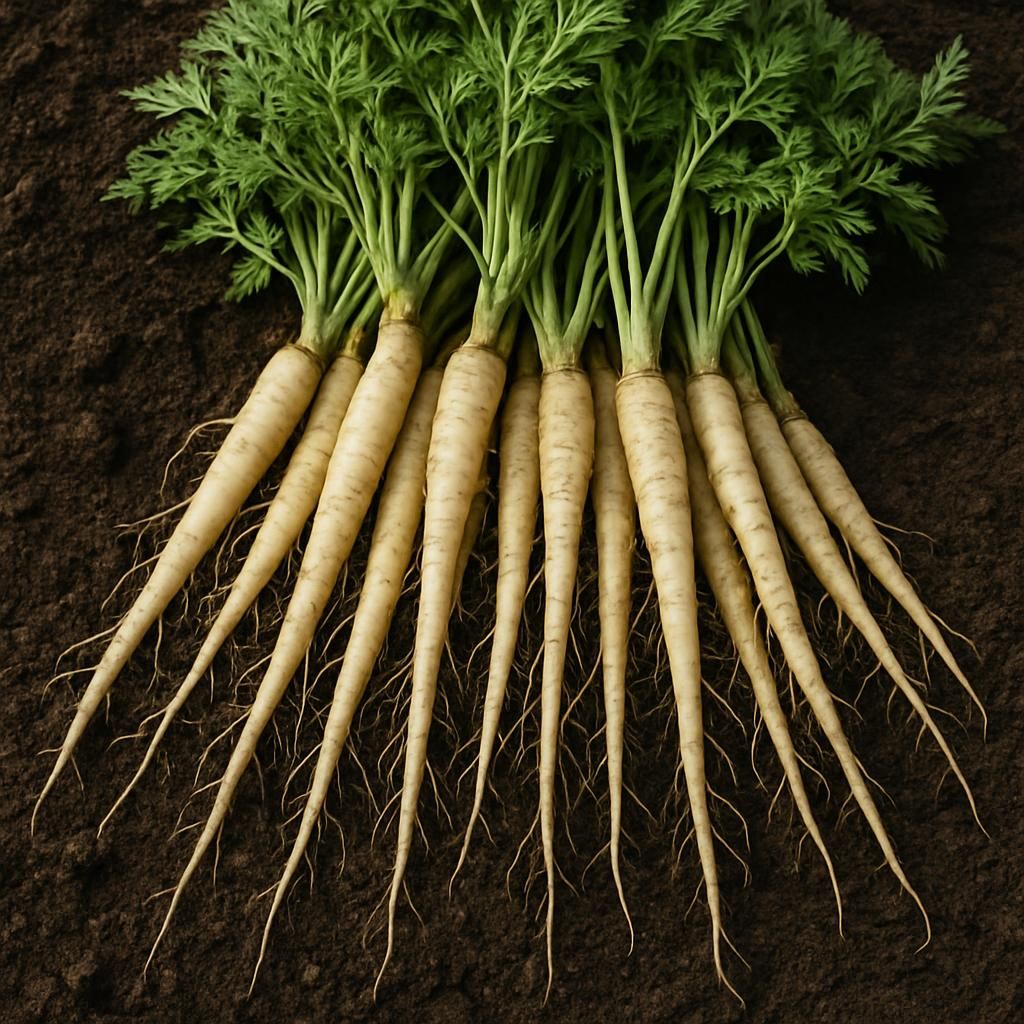
Introduction to Skirret (Sium sisarum)
Skirret (Sium sisarum) is an ancient European root vegetable that produces clusters of slender, sweet white roots with a distinct nutty-parsnip flavor. Once a staple in medieval gardens, it fell out of favor after the introduction of the potato but is now experiencing renewed interest among chefs and regenerative farmers seeking resilient, low-input crops. Its ability to thrive in heavy, moist soils where many root crops struggle makes it particularly valuable for small-scale sustainable agriculture.
The plant forms a clump of fern-like foliage reaching 60–90 cm tall and produces offsets that allow it to persist for several years. Roots are typically harvested in the first or second year and can be eaten raw, roasted, or boiled. Because skirret is rarely attacked by major pests and stores well, it offers an excellent option for extending the root vegetable season into winter.
Botanical Profile of Skirret (Sium sisarum)
Skirret belongs to the Apiaceae family, making it a relative of carrot, parsnip, and celery. It is a herbaceous perennial that develops a cluster of long, thin taproots rather than a single large root. The leaves are pinnate with serrated leaflets and emit a mild parsley-like aroma when crushed. Small white umbels of flowers appear in the second year if plants are left to overwinter, attracting beneficial insects.
The roots are creamy white, 15–30 cm long and 1–2 cm thick, with a crisp texture and sweet flavor that intensifies after light frosts. Unlike many root crops, skirret roots contain inulin, giving them a slightly sweet taste that pairs well with both savory and sweet dishes. The plant’s natural tolerance to waterlogged soils distinguishes it from carrots and parsnips.
Soil, pH, and Climate Requirements for Skirret (Sium sisarum)
Skirret performs best in cool temperate climates with consistent moisture. It tolerates partial shade better than most root vegetables but produces sweeter roots in full sun. The crop prefers heavy loam or clay soils that retain moisture yet remain workable.
| Parameter | Ideal Range | Notes |
|---|---|---|
| Soil Type | Heavy loam to clay | Tolerates heavier soils than carrots |
| Soil pH | 6.0 – 7.5 | Slightly acidic to neutral |
| Temperature Range | 5 – 20 °C (growing) | Frost hardy; roots sweeten after frost |
| Spacing | 30 cm between plants | Rows 45–60 cm apart |
| Planting Depth | 2–3 cm | Direct sow or transplant offsets |
| Days to Harvest | 150–180 days | First-year roots ready by late autumn |
Step-by-Step Planting & Propagation
Skirret is most commonly grown from offsets or root divisions taken in early spring. Select healthy, disease-free roots from the previous season and cut them into 5–8 cm sections, each containing at least one growing point. Plant these sections 2–3 cm deep and 30 cm apart in prepared beds.
Direct sowing is also possible. Sow seed in early spring as soon as soil can be worked. Because germination can be slow and erratic, many growers prefer starting plants in modules and transplanting at the 4–6 leaf stage. Keep seedbeds evenly moist until seedlings are established.
Care & Maintenance regimes for Skirret (Sium sisarum)
Skirret requires minimal intervention once established. Consistent moisture is critical during the first six weeks after planting to prevent root forking. Mulching with 5 cm of organic matter helps retain soil moisture and suppress weeds.
| Task | Frequency / Timing | Details |
|---|---|---|
| Watering | Weekly during dry spells | Maintain even moisture; avoid waterlogging |
| Fertilizer | Early spring & mid-summer | Apply balanced organic fertilizer or compost tea |
| Pruning / Thinning | Once at 15 cm height | Thin to one strong shoot per crown |
| Mulching | Immediately after planting | 5 cm layer of straw or leaf mold |
| Weeding | As needed until canopy closes | Hand weed to avoid root disturbance |
Pests, Diseases & Organic Management
Skirret is notably resistant to most common vegetable pests. Occasional damage from Aphids or Slugs may occur in wet seasons. Use floating row covers early in the season and encourage natural predators such as lady beetles. Root-knot nematodes rarely affect skirret, but rotating with Onion or Garlic helps break pest cycles.
Fungal issues are uncommon due to the plant’s preference for cool, moist conditions. Remove and destroy any yellowing foliage to prevent spread of leaf spot diseases. Good airflow and proper spacing are the best preventive measures.
Harvesting, Curing & Optimal Storage
Harvest skirret after the first hard frost when roots have reached full size, typically 150–180 days after planting. Use a garden fork to loosen soil carefully around the clump and lift the entire root cluster. Shake off excess soil but do not wash until ready to use.
Roots store best in a cool, humid root cellar or refrigerator crisper at 0–4 °C with high humidity. They remain viable for 2–3 months. Smaller roots can be left in the ground over winter under mulch and harvested as needed.
Companion Planting for Skirret (Sium sisarum)
Skirret grows well alongside leafy greens and alliums that do not compete heavily for root space. Good companions include Lettuce, Spinach, Onion, and Garlic. These pairings improve biodiversity and help deter pests. Avoid planting near Potato because both crops can attract similar soil-borne issues if rotation is neglected.
For additional guidance on building soil health and resilient systems, see The Forgotten Art of Fall Soil Revival: 8 Organic Strategies for Small Farm Resilience.