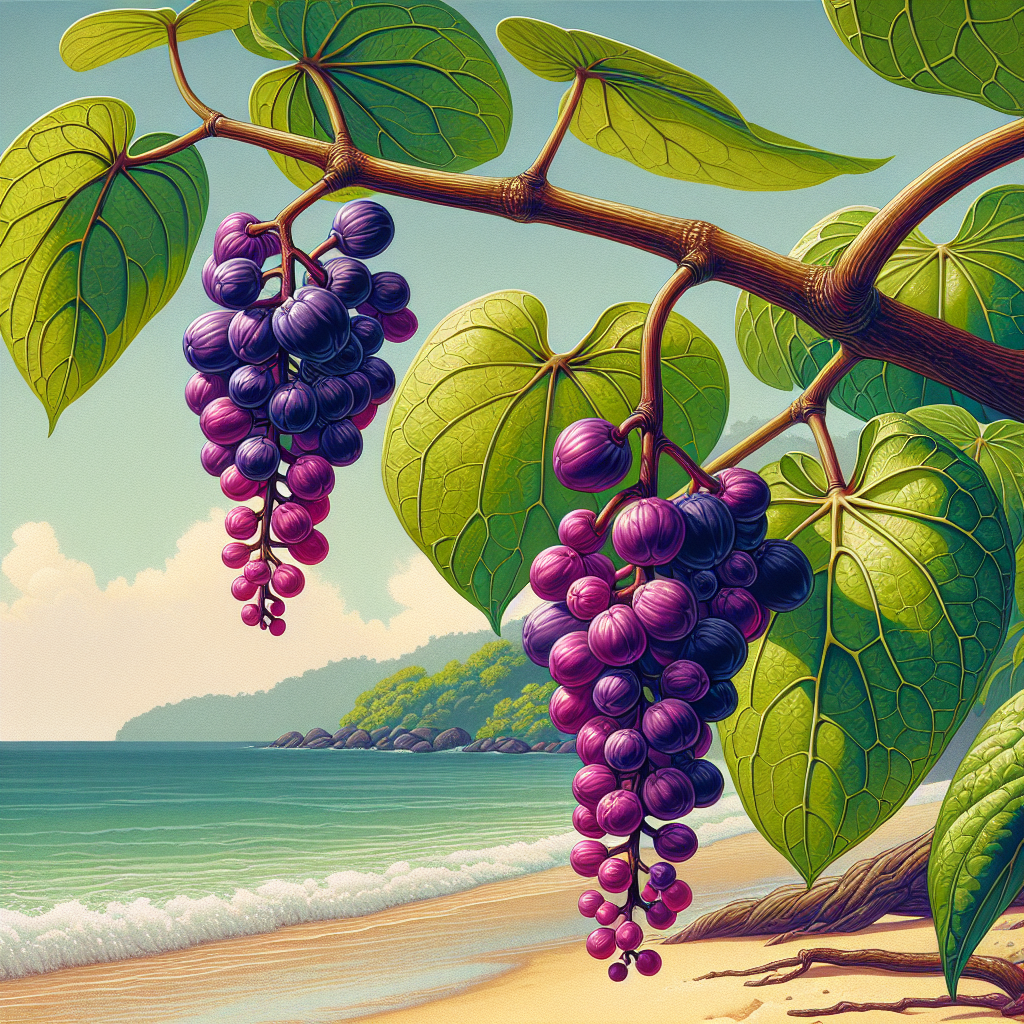
Introduction to Sea Grape (Coccoloba uvifera)
Sea Grape, scientifically known as Coccoloba uvifera, is a tropical powerhouse that embodies coastal resilience. Native to the sandy beaches and dunes of the Caribbean, Central and South America, and parts of Florida and the southeastern U.S., this evergreen shrub or small tree can reach 10-30 feet in height and width. Its thick, glossy, heart-shaped leaves (up to 12 inches across) turn vibrant red in fall, providing year-round aesthetic appeal. The plant's namesake comes from its clusters of grape-like fruits—round, purple berries about 1 inch in diameter—that ripen from summer to fall, offering a tangy, salty-sweet flavor reminiscent of grapes.
Beyond its edible fruits, Sea Grape serves critical ecological roles: stabilizing dunes against erosion, providing habitat for wildlife, and acting as a windbreak in harsh seaside conditions. Fruits are rich in antioxidants, vitamin C, and fiber, used fresh in juices, jams, jellies, wines, and desserts. Leaves yield a black dye for traditional crafts. For small farms, home orchards, or permaculture designs, Sea Grape offers low-maintenance yields in marginal soils where other crops fail. Its salt and wind tolerance make it a cornerstone for sustainable coastal agriculture. Expect first fruits in 3-5 years from seed or 1-2 years from cuttings, with mature plants producing 20-50 pounds annually per tree. This deep-dive guide equips growers with professional strategies for propagation, care, and harvest to maximize productivity.
Botanical Profile of Sea Grape (Coccoloba uvifera)
Coccoloba uvifera belongs to the Polygonaceae family, sharing kinship with buckwheat and rhubarb. It's a dioecious species—separate male and female plants required for fruiting—though hermaphroditic forms exist. The leathery, alternate leaves are rounded to cordate, 4-12 inches wide, with prominent veins and a waxy coating that repels salt spray. New leaves emerge bronze-red, maturing to deep green.
Flowers are small (1/8 inch), greenish-white, borne in 3-6 inch panicles from April to July. Male flowers produce pollen; female flowers develop into fruits if pollinated by wind, insects, or bees. Fruits are drupes: fleshy, purple-black skin encasing a large, hard seed. Each cluster yields 10-50 berries, ripening June-October in waves for extended harvest. Seeds are viable for months if kept moist.
Growth habit is multi-trunked, spreading, with reddish-brown bark. Root systems are shallow but extensive, aiding dune stabilization. Sea Grape is hardy in USDA zones 10b-11, tolerating brief dips to 28°F (-2°C). Lifespan exceeds 50 years, with plants self-pruning lower branches to form a rounded canopy. For companion planting, it pairs well with salt-tolerant species, enhancing biodiversity.
Soil, pH, and Climate Requirements for Sea Grape (Coccoloba uvifera)
Sea Grape excels in the harshest coastal conditions, thriving where other plants perish. Optimal soils are sandy, well-drained, with low fertility—loamy sands or beach dunes ideal. It tolerates poor, nutrient-deficient substrates (pH 6.0-8.5), including alkaline limestone and saline soils up to 10,000 ppm salt. Avoid heavy clays or waterlogged sites to prevent root rot. Amend with 20-30% organic matter (compost, coir) for establishment, but mature plants need none.
Climate demands full sun (6-8+ hours daily) and tropical/subtropical warmth: 70-90°F (21-32°C) daytime, no frost. Humidity above 60% preferred; it endures drought once established but fruits best with consistent moisture. Wind tolerance is exceptional, surviving 100+ mph gales. Inland growers mimic conditions with raised beds and windbreaks. Irrigation: 1 inch/week young plants, reducing to rainfall-dependent after year 2. Mulch with seashells or pine bark to retain moisture and mimic native habitat. In marginal climates, container culture in 20-30 gallon pots allows mobility. Test soil salinity pre-planting; elevate beds 12-18 inches in high-salt zones.
Step-by-Step Planting & Propagation
Propagation Methods
- Seeds: Collect ripe berries, pulp removed via mashing/fermenting. Rinse seeds, sow fresh in 4-inch pots with sandy seed mix. Germinate 70-90% in 2-8 weeks at 80°F, light shade. Transplant at 6-12 inches.
- Cuttings: Semi-hardwood, 6-8 inches, June-August. Dip in rooting hormone (IBA 0.1%), plant in perlite-sand under mist. Roots in 4-8 weeks, 80% success.
- Air Layering: For mature plants; girdle branch, apply hormone, wrap sphagnum. Roots in 6-12 weeks.
Planting Steps
- Site Selection: Full sun, 15-20 ft spacing (drip line clearance). Ensure female:male ratio 5-10:1.
- Timing: Spring post-frost, rainy season start.
- Hole Prep: 2x root ball width/depth, backfill sandy loam.
- Planting: Set at soil line, water deeply. Stake if windy.
- Initial Care: Shade cloth 30% first month, fertilize balanced 10-10-10 at 1 lb/tree.
Yields peak year 5+ with proper sex balance. Read more on effective propagation for tropicals.
Care & Maintenance regimes for Sea Grape (Coccoloba uvifera)
Minimalist care yields robust plants. Water: Deep soak weekly first year (1-2 gallons/tree), then drought-tolerant. Fertilizer: Slow-release 8-3-9 palm formula, March/June, 1-2 lbs/tree. Foliar micronutrients (Fe, Mn, Zn) if chlorosis appears. Pruning: Annual winter shaping—remove deadwood, thin canopy for light/air. Elevate canopy by limbing up suckers. Mulching: 4-inch organic layer, replenish yearly. Weed Control: Manual or mulch; avoid herbicides near roots.
Monitor for nutrient deficiencies: yellow leaves indicate iron. In containers, repot every 3 years. Salt pruning: rinse foliage post-storm. For small farms, interplant legumes for nitrogen. Expect 10-20 ft height in 5 years with basic regimes. Integrate into soil health strategies.
Pests, Diseases & Organic Management
Sea Grape's toughness limits issues, but vigilance pays. Pests: Scale insects cluster on stems—hort oil sprays, ladybugs. Mealybugs on new growth: alcohol swabs, neem. Caterpillars defoliate—Bt kurstaki. Birds love fruits—netting.
Diseases: Anthracnose causes leaf spots—improve air flow, copper fungicide. Phytophthora root rot in wet soils—drainage key, phosphite drenches. Fungal leaf spots: remove debris, potassium bicarbonate.
Organic IPM: Beneficials (predatory mites, parasitic wasps), reflective mulches, companion herbs like thyme. Scout weekly; thresholds low for ornamentals. Learn more in pest management fixes. No major viruses reported.
Harvesting, Curing & Optimal Storage
Harvest ripe berries (deep purple, soft) by hand or clip clusters June-October. Peak flavor post-frost in marginal areas. Yields: 20-100 lbs/tree mature. Fruits detach easily; avoid ground drops to prevent bruising.
Processing: Rinse salt, use fresh (3-5 days fridge). For jams: cook with pectin/sugar (1:1 ratio). Juice: blend strained. Wine: ferment pulp (10% ABV). Dry seeds for propagation.
Storage: Whole clusters 1 week 40°F (4°C), 90% humidity. Frozen pulp 6-12 months. Dried fruits 3 months airtight. Commercial: pasteurize for shelf-life. Minimize handling to preserve antioxidants.
Companion Planting for Sea Grape (Coccoloba uvifera)
Leverage Sea Grape's canopy for understory crops. Benefits: Wind protection, shade moderation, nitrogen via legumes.
Top Companions:
- Guava (Apple Guava): Shared climate, pest diversion.
- Legumes (Pigeon pea): Soil enrichment.
- Herbs (Rosemary, Marigold): Repel insects.
- Groundcovers: Beach sunflower, sea oats for erosion.
Avoid allelopathic neighbors. Design polycultures: Sea Grape core, underplant herbs/veggies. Enhances biodiversity, yields. See fall companion guide.