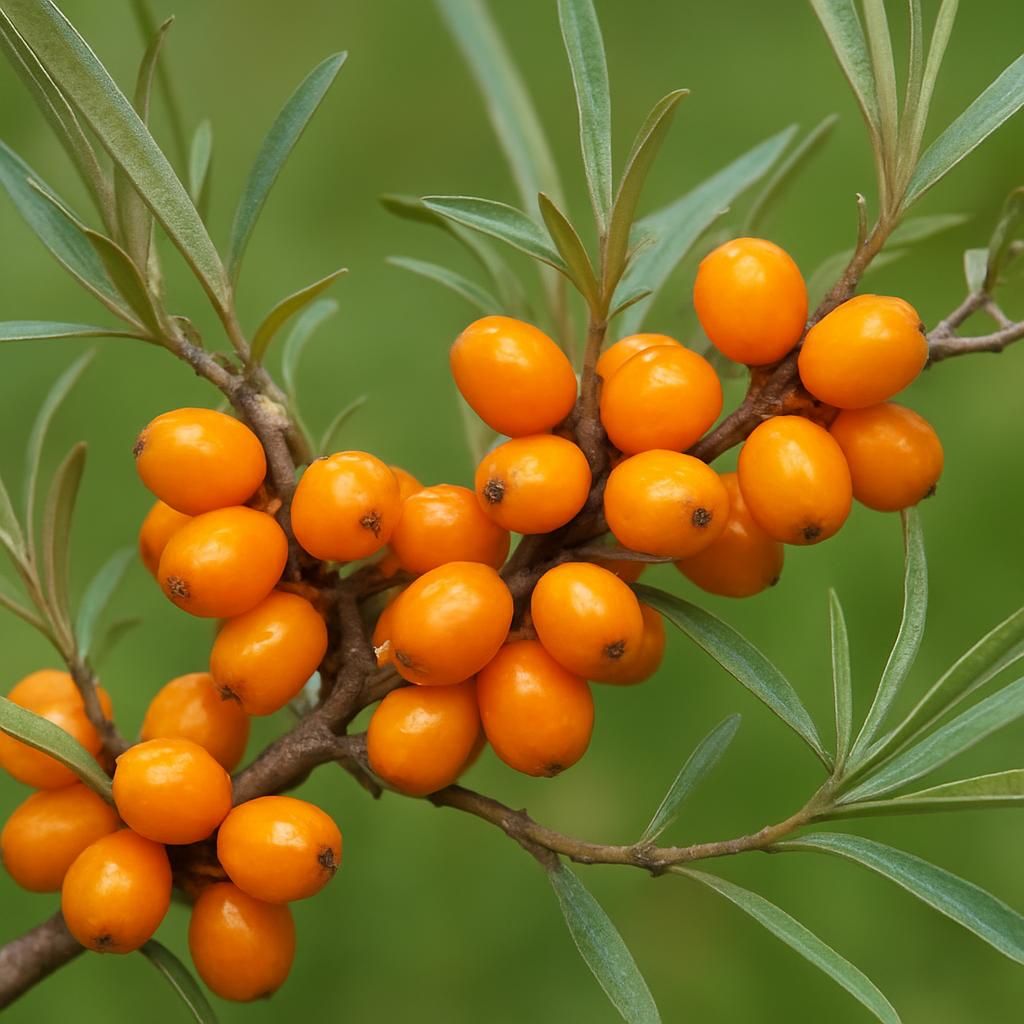
Introduction to Sea Buckthorn
Sea buckthorn (Hippophae rhamnoides) is a multi-stemmed deciduous shrub native to temperate regions of Europe and Asia. Valued for its bright orange berries packed with vitamin C, antioxidants, and essential fatty acids, the plant also improves soil fertility through nitrogen fixation. Its extreme cold hardiness, drought tolerance, and ability to thrive in sandy or saline soils make it an excellent choice for marginal land reclamation and sustainable agroforestry systems.
Commercial interest has grown rapidly due to demand for sea buckthorn oil in nutraceuticals, cosmetics, and functional foods. Both male and female plants are required for fruit production, with female cultivars such as 'Orange Glow' and 'Hergo' commonly paired with pollenizers like 'Pollmix'. With proper management, established plantings can remain productive for 30–40 years.
Botanical Profile of Sea Buckthorn
Sea buckthorn belongs to the Elaeagnaceae family and typically grows 2–6 m tall with a spreading habit. Stems are covered in silvery scales and sharp thorns, while narrow, lanceolate leaves are gray-green above and silvery beneath. The plant is dioecious, producing small, inconspicuous yellowish flowers in spring before leaves fully emerge. Female plants develop clusters of round to oval drupes that ripen from late summer through early autumn.
Roots form extensive symbiotic associations with Frankia bacteria, enabling atmospheric nitrogen fixation. This trait allows sea buckthorn to colonize nutrient-poor sites and improve soil for subsequent crops. The species exhibits high genetic diversity, with numerous subspecies adapted to coastal dunes, riverbanks, and high-altitude plateaus.
Soil, pH, and Climate Requirements for Sea Buckthorn
| Parameter | Ideal Range | Notes |
|---|---|---|
| Soil Type | Sandy loam to loamy sand | Excellent drainage essential; tolerates gravel and saline soils |
| Soil pH | 6.0–8.0 | Prefers slightly alkaline conditions; avoid heavy clays |
| Temperature Range | −40 °C to 35 °C | Extremely cold hardy; requires 800–1200 chilling hours |
| Annual Precipitation | 300–600 mm | Drought tolerant once established; supplemental irrigation improves yields |
| Sunlight | Full sun (≥8 hours) | Partial shade reduces fruit quality and quantity |
| USDA Hardiness Zones | 3–7 | Performs best in cool temperate climates |
Step-by-Step Planting & Propagation
- Site Selection: Choose a south- or west-facing location with full sun and protection from strong winds. Conduct a soil test to confirm pH and drainage.
- Soil Preparation: Incorporate 5–8 cm of well-rotted compost and correct pH if below 6.0 with agricultural lime. Avoid high-nitrogen amendments that suppress nodulation.
- Plant Spacing: Space female plants 2.5–3 m apart in rows 4 m apart. Plant one male for every 6–8 females, positioning males upwind.
- Planting Time: Early spring (before bud break) or autumn (after leaf drop) are optimal. Soak bare-root plants 1–2 hours before planting.
- Planting Depth: Set plants at the same depth as the nursery container; backfill and water thoroughly. Apply 5–7 cm of organic mulch, keeping it 10 cm from the trunk.
- Propagation: Use 15–20 cm hardwood cuttings taken in late winter, treated with 3000 ppm IBA, and rooted in a 1:1 perlite-sand mix under intermittent mist. Seed propagation is possible but results in variable offspring; stratify seeds 90 days at 4 °C.
Care & Maintenance regimes for Sea Buckthorn
| Task | Schedule | Details |
|---|---|---|
| Watering | Year 1: 15–20 L/week per plant | Deep watering every 7–10 days; reduce to 2–3 irrigations per season once established |
| Fertilizer | Early spring & post-harvest | Apply 20–30 g N, 40 g P₂O₅, 60 g K₂O per mature plant; prefer organic sources such as composted manure |
| Pruning | Late winter (dormant) | Remove dead, damaged, and crossing branches; thin 20–25 % of oldest wood every 3–4 years to maintain productivity |
| Mulching | Spring & autumn renewal | Maintain 5–8 cm layer of wood chips or straw to suppress weeds and conserve moisture |
| Weed Control | Monthly during growing season | Hand weeding or shallow cultivation within 1 m of trunk; avoid herbicide drift |
Pests, Diseases & Organic Management
Sea buckthorn is relatively pest-resistant but can suffer from aphids, spider mites, and leaf-feeding caterpillars. Regular monitoring and strong plant health reduce outbreaks. Organic controls include insecticidal soaps, neem oil, and releases of predatory mites. Fungal issues such as Verticillium wilt and root rots are rare in well-drained soils. Maintain good airflow through proper spacing and annual pruning. Avoid overhead irrigation to minimize foliar disease pressure.
Harvesting, Curing & Optimal Storage
Berries ripen from late August to early October depending on cultivar and climate. Hand harvesting is labor-intensive; many commercial operations use trunk shakers or mechanical harvesters designed for currants. Collect fruit when fully colored but still firm. Immediately cool berries to 0–2 °C to slow respiration. For fresh market, store at 95 % RH for up to 7 days. For processing, freeze at −18 °C within 4 hours of harvest. Dried berries retain quality for 12 months when packaged in oxygen-barrier bags with desiccants.
Companion Planting for Sea Buckthorn
Sea buckthorn pairs well with nitrogen-demanding crops such as Corn and Wheat in agroforestry systems. Understory plantings of Clover or Hairy vetch further enhance soil nitrogen while suppressing weeds. Aromatic herbs like Thyme and Rosemary deter aphids. Avoid planting near shallow-rooted vegetables that compete for moisture. In windbreaks, interplant with Apple or Pear trees to create multi-layered productive systems.
For additional guidance on soil health strategies that benefit sea buckthorn plantings, see The Hidden Power of Mulching: 8 Organic Strategies to Transform Small Farm Soil.