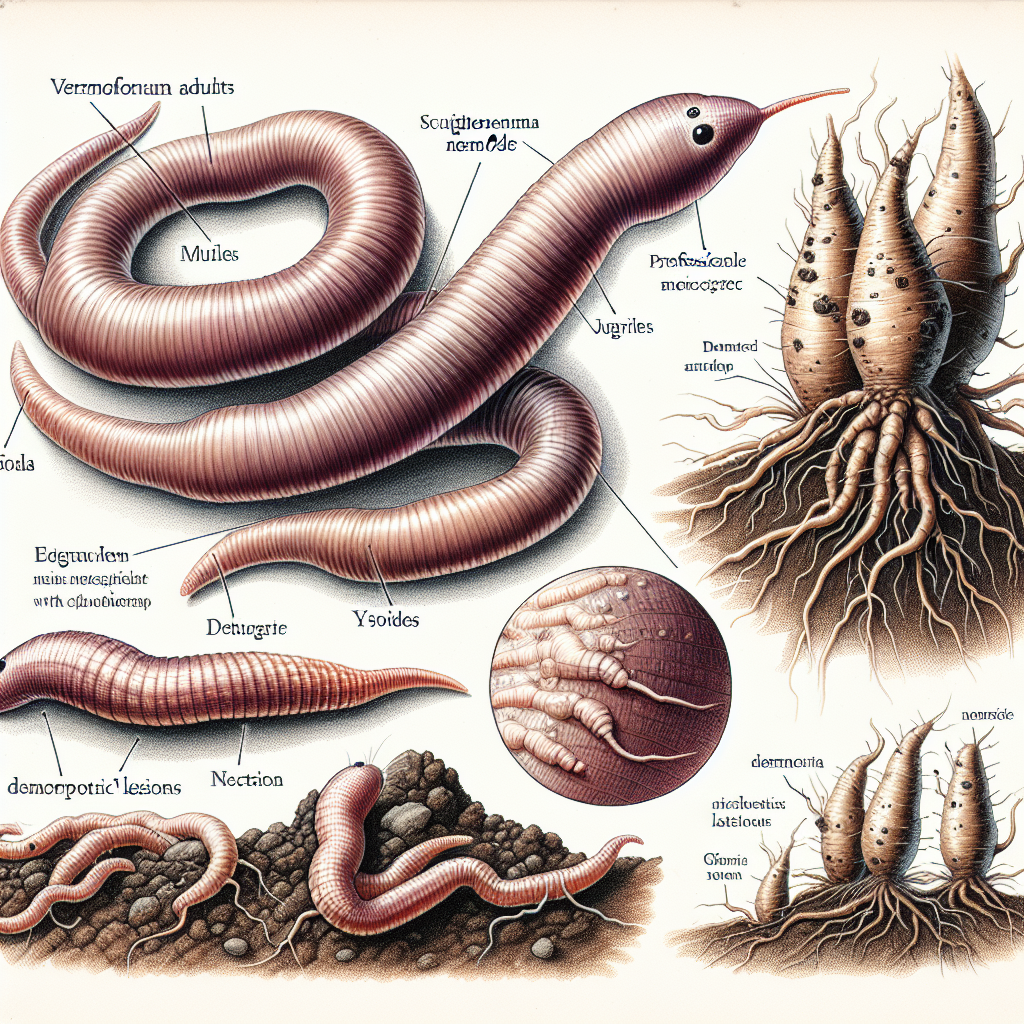
Introduction to Scutellonema bradys
Scutellonema bradys, commonly referred to as the sting nematode or yam nematode, is a destructive plant-parasitic nematode belonging to the family Tylenchidae. This microscopic roundworm (typically 0.8-1.2 mm in length) targets the underground parts of tropical root and tuber crops, particularly yams (Dioscorea spp.) and sweet potato. First identified in West Africa in the early 20th century, it has since spread to major yam-producing regions including the Caribbean, South America, Asia, and parts of the southern United States.
Unlike migratory endoparasitic nematodes that move freely within roots, Scutellonema bradys is primarily an ectoparasite, feeding externally on root hairs, epidermis, and cortex tissues. Its feeding punctures roots, leading to cell necrosis, reduced nutrient uptake, and secondary infections by bacteria and fungi. Infestations can reduce yields by 30-70%, with severe cases causing complete crop failure. In subsistence farming systems reliant on yams, this pest exacerbates food insecurity and economic losses, costing millions annually in lost production.
Understanding Scutellonema bradys is crucial for tropical agriculture, where soil temperatures above 25°C (77°F) favor its proliferation. Farmers often confuse its damage with drought stress, nutrient deficiencies, or root-knot nematodes, delaying intervention. Early diagnostics and proactive management are key to mitigating its impact. For more on integrated pest strategies, check this Spring Pest Patrol blog.
Identifying Symptoms & Damage
Scutellonema bradys damage manifests subtly above ground but is devastating below. Key symptoms include stunted plant growth, yellowing of lower leaves (chlorosis), and premature senescence, mimicking water stress. Affected plants produce fewer, smaller tubers with rough, cracked skins and internal necrosis known as 'top rot'—a dry, corky decay starting from the tuber crown.
Root systems show characteristic short, stubby laterals with dark lesions and galls-like swellings. Unlike root-knot nematodes, no true galls form; instead, expect profuse fibrous root proliferation and cortical cracking. Severely infested roots appear blackened and brittle, prone to root rots. Tuber inspection reveals shallow cavities, reddish-brown discoloration, and weight loss up to 50%.
Diagnosis requires soil/root sampling: extract nematodes using centrifugal flotation or Baermann funnel methods. Populations exceeding 500 nematodes per 100 cm³ soil indicate damaging levels. Symptoms worsen in sandy soils with low organic matter. Differentiate from lesion nematodes by Scutellonema's stylet (knobbed, 20-25 µm) and six lateral lines under microscopy. Field scouting in rainy seasons reveals weed hosts like Cyperus spp. harboring the pest.
Economic thresholds vary: in yams, >1,000 nematodes/plant signals action. Yield losses correlate with population density—low levels (<500) cause 10-20% reductions, escalating exponentially. Early detection via symptom mapping and lab confirmation prevents spread.
Lifecycle and Progression of Scutellonema bradys
Scutellonema bradys completes its lifecycle in 20-30 days under optimal conditions (27-32°C, moist soil). Vermiform juveniles and adults (both sexes similar) penetrate root epidermis with spear-like stylets, feeding on cellular contents. Females swell into saccate forms, laying 50-100 eggs externally. Eggs hatch in 4-7 days, releasing J1-J4 juveniles that molt into adults.
As an ectoparasite, it rarely enters vascular tissues, remaining soil-borne. Populations peak during wet seasons, with dormant stages surviving dry periods up to 2 years in tubers/soil. Reproduction is parthenogenetic, favoring rapid buildup. One generation per month yields thousands per plant annually.
Progression: Initial feeding (2-4 weeks) causes minor lesions; chronic infestation (2-3 months) leads to root decay and top rot. Tuber invasion occurs via wounds during harvest/storage, with nematodes surviving 6-12 months in planted sets. Understanding this cycle informs timed interventions, like fallowing during peak reproduction.
Environmental Triggers & Risk Factors
Warm, humid tropics (25-35°C, >60% soil moisture) trigger Scutellonema bradys outbreaks. Sandy, acidic soils (pH 4.5-6.0) with low organic matter (<2%) enhance mobility and survival. Monocropping yams/sweet potatoes for >2 years builds populations >10-fold.
Risk factors include infested planting material (seed yams retain 20-50% nematodes), poor rotation, and flooding promoting dispersal. Drought stress exacerbates damage by weakening roots. Weeds (e.g., guinea grass) and alternate hosts like cassava serve reservoirs. High nitrogen favors nematode reproduction; phosphorus deficiencies worsen susceptibility.
Climate change intensifies risks via prolonged wet seasons. Soil solarization fails in humid areas; assess via pre-plant nematode assays.
Organic Control & Treatment Plans
Organic management integrates cultural, biological, and physical tactics. No certified nematicides exist for organics; focus on suppression.
Cultural Controls: Rotate with non-hosts like cowpeas or marigolds (Tagetes spp.) for 2-3 years, reducing populations 70-90%. Hot-water treat seed tubers (48°C/30 min) kills 95% nematodes. Crop residues bury via deep plowing.
Biological Controls: Apply Paecilomyces lilacinus or Purpureocillium oxalisporum (10^9 CFU/g) at planting; suppresses 50-60%. Neem cake (1-2 t/ha) and chicken manure biofumigate via isothiocyanates.
Physical Methods: Soil solarization (6 weeks summer) in dry tropics kills 80%. Flood fallow (15 cm water/4 weeks) drowns nematodes.
Treatment Plan: 1) Sample/confirm infestation. 2) Remove infested plants. 3) Rotate 2 years. 4) Amend soil (10 t/ha compost). 5) Plant resistant varieties (e.g., D. rotundata hybrids). 6) Monitor quarterly. Expect 60-80% reduction first season.
Combine with cover crops like velvetbean for allelopathy.
Preventing Scutellonema bradys in the Future
Prevention hinges on clean starts and vigilant monitoring. Source certified, hot-water-treated seed yams from nematode-free zones. Implement 3-year rotations: yams → cereals (corn) → legumes. Maintain soil organic matter >4% via green manures, suppressing nematodes 40%.
Sanitize tools/equipment; quarantine new fields. Use trap crops like Sudax sorghum. Annual soil tests guide amendments—balance NPK, add lime if pH <5.5. Scout monthly; rogue infested plants. Long-term, breed/plant resistant cultivars like Florido yam. Fallow with Stylosanthes grass mulching.
Integrated strategies yield sustainable control, minimizing reinfestation.
Crops Most Affected by Scutellonema bradys
Primary hosts: Yam species (Dioscorea alata, D. rotundata, D. cayenensis—white, yellow, water yams). Sweet potato (Ipomoea batatas) suffers 20-50% losses. Secondary: cassava, taro, some grasses.
Global hotspots: Nigeria (70% production affected), Ghana, Côte d'Ivoire, Jamaica, Brazil. Economic impact: $100M+ annual losses in Africa alone. Susceptibility high in intensive systems; intercropping mitigates.