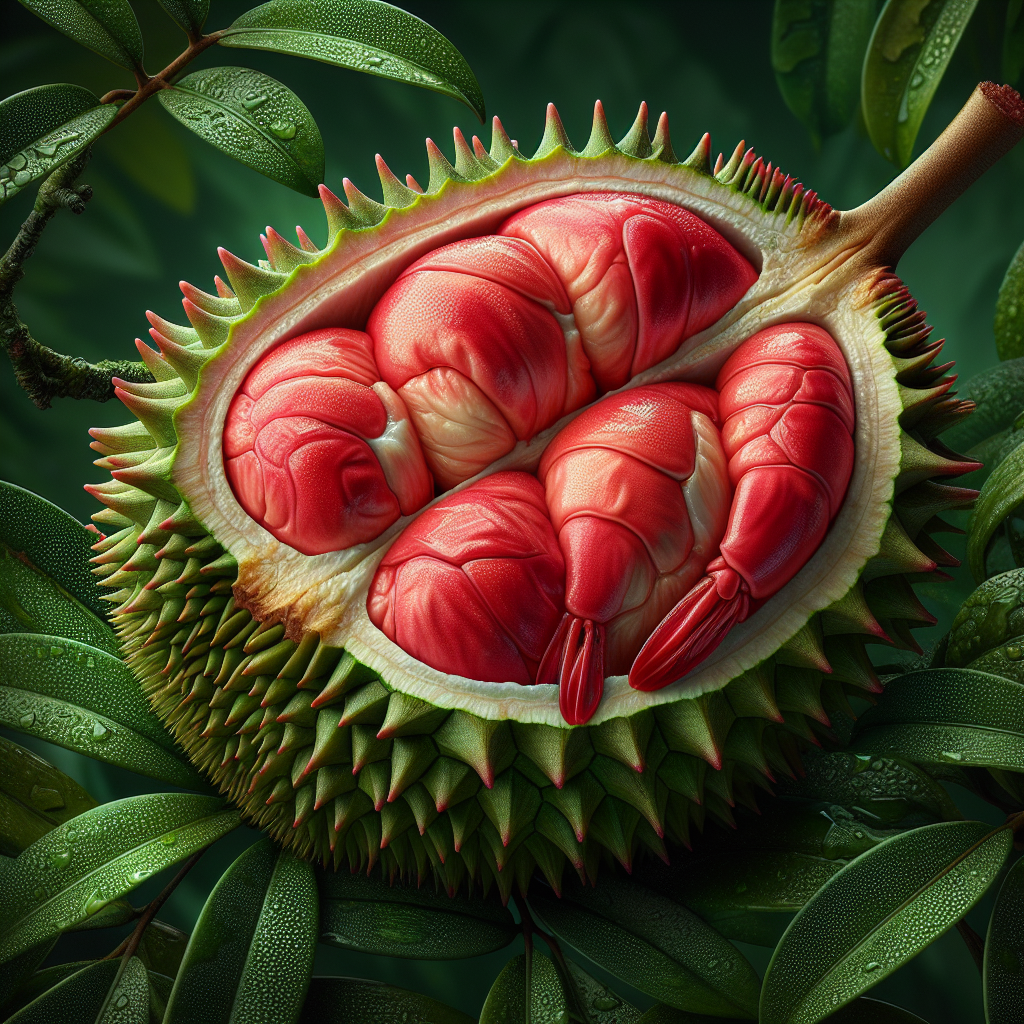
Introduction to Red Prawn Durian
Red Prawn Durian, a standout cultivar of the iconic Durio zibethinus, captivates fruit enthusiasts worldwide with its unique ruby-red arils that resemble succulent prawns—hence its evocative name. Unlike standard durian varieties, Red Prawn offers smaller seeds, thicker flesh, and an intensely sweet flavor profile blending caramel, vanilla, and roasted almond notes, making it one of the most sought-after durians in premium markets. Originating from selective breeding in Malaysia and Thailand, this variety commands prices up to 5-10 times higher than common durians due to its scarcity and superior eating quality.
Growers are drawn to Red Prawn Durian for its commercial potential, with mature trees yielding 50-150 fruits per season under optimal conditions. However, success requires understanding its tropical exigencies: high humidity, rich soils, and vigilant pest control. This deep-dive guide equips professional agriculturists with evidence-based strategies, from site selection to post-harvest handling, ensuring thriving orchards and maximized profitability. For foundational knowledge on durian cultivation, see the comprehensive Durian (crop) entry.
Botanical Profile of Red Prawn Durian
Red Prawn Durian belongs to the Malvaceae family, classified as Durio zibethinus 'Red Prawn', a natural hybrid variant selected for its distinctive pigmentation and flavor. Trees reach 20-40 meters in height at maturity, featuring a straight trunk up to 1 meter in diameter, buttressed roots for stability in deep loams, and a broad canopy spanning 10-15 meters. Leaves are oblong-lanceolate, 10-25 cm long, glossy dark green above and silvery below due to dense stellate hairs.
Flowers emerge in clusters on mature branches, creamy-white with five petals, 3-5 cm across, and a pungent nocturnal fragrance to attract bats and pollinators. Pollination is primarily entomophilous, with peak blooming from March to May in equatorial regions. Fruits develop over 12-16 weeks, oval to heart-shaped, 15-30 cm long, weighing 1.5-4 kg, with thick (1-2 cm) green-brown rind covered in pyramidal spines. The hallmark red arils (85-90% flesh-to-seed ratio) result from high lycopene and carotenoid content, distinguishing it from yellow-fleshed siblings.
Genetically, Red Prawn exhibits hybrid vigor from D. zibethinus crosses, showing resistance to some wilt pathogens. Trees grafted on rootstocks like D. kutejensis enhance vigor and dwarfing for high-density planting (6x6m spacing). Phenologically, it fruits year-round in tropics but peaks June-August, with alternate bearing mitigated by cultural practices.
Soil, pH, and Climate Requirements for Red Prawn Durian
Red Prawn Durian demands deep, well-drained alluvial or volcanic loams with 20-30% clay for moisture retention and aeration. Optimal soil texture is sandy loam to clay loam, with organic matter >3% to support mycorrhizal associations vital for nutrient uptake. Avoid heavy clays prone to waterlogging, which induce Phytophthora palmivora. Test for nematodes pre-planting; solarization or biofumigants are recommended.
pH range is 5.5-6.5, slightly acidic to neutralize aluminum toxicity while retaining phosphorus. Amend with dolomite lime if below 5.0, targeting 6.0 for peak micronutrient availability (Zn, Fe, B). Conduct annual soil tests; maintain CEC >15 meq/100g and base saturation (Ca 60-70%, Mg 10-15%).
Climatically, it requires equatorial tropics: 26-32°C average, no frost, rainfall 2000-3000 mm/year evenly distributed, or irrigation-supplemented dry seasons <3 months. Humidity >75% prevents stomatal closure; wind speeds >15 km/h damage flowers. Elevations <800m ideal; altitudes above increase alternate bearing. For heatwave mitigation strategies, refer to Why Summer Heatwaves Are Silently Killing Small Farm Yields - And 7 Organic Strategies to Fight Back. Mulch with 10-15 cm organic matter to buffer temperatures.
Step-by-Step Planting & Propagation
Propagation favors grafting over seed for uniformity, using chip-budding or cleft-grafting on 1-2 year rootstocks. Select scions from high-yield mother trees; success rates exceed 85% in humid conditions. Seeds germinate in 10-20 days at 30°C in shaded beds, but seedlings vary genetically.
- Site Prep: Clear land, plow 60 cm deep, incorporate 20-30 t/ha farmyard manure + 1 t/ha rock phosphate. Raise beds 1m wide if flood-prone.
- Nursery: Sow in polybags (30x40 cm) with 1:1:1 topsoil:sand:FYM. Shade 50%, water daily; transplant at 30-40 cm height.
- Planting: Dig 60x60x60 cm pits, fill with 50 kg FYM + 500g TSP + 200g MOP. Plant at 7x7m (200 trees/ha), stake immediately. Best season: post-monsoon.
- Grafting: At 6-12 months, bud when sap flows; wrap with parafilm. Field-graft at 1.5m height for dwarfing.
- Establishment: Irrigate 50-100 L/tree/week first year; prune basal suckers.
Expect canopy closure by year 5, first fruits year 6-7.
Care & Maintenance regimes for Red Prawn Durian
Fertilize based on leaf analysis: young trees 100g NPK 15-15-15 + 50g urea/tree/year, split 6x. Mature: 2-3 kg N, 1.5 kg P2O5, 2 kg K2O/tree/year via fertigation. Foliar MgSO4 (2%) if deficient. Irrigate 40-60 L/tree/week dry season, mulching conserves 30% water.
Prune annually post-harvest: remove deadwood, watersprouts, maintain 3-4 main scaffolds. Tip-prune to induce flowering. Intercrop legumes years 1-3 for N-fixation. Thin fruits to 30-50/tree for size. Monitor EC <1.5 dS/m to avoid salinity.
Pests, Diseases & Organic Management
Key pests: Fruit borers, Aphids, capsule borers. Use neem oil (3%) sprays, pheromone traps (20/ha), release Trichogramma (5cc/ha/week). Birds and squirrels deterred by netting.
Diseases: Phytophthora rots—use metalaxyl drenches + drainage; anthracnose—copper fungicides. Organic: Trichoderma biofungicides, Bacillus subtilis. For broader strategies, see Why 90% of Small Farms Fail at Pest Management - And 8 Organic Fixes That Actually Work. Scout weekly; IPM thresholds: 5% infested fruits.
Harvesting, Curing & Optimal Storage
Harvest at 120-140 days post-anthesis when spines flatten, rind yellows, and fruit detaches easily (85-90% maturity). Use pole pruners; yield 20-40 t/ha. Cure 2-5 days at 25-28°C, 85% RH to reduce moisture loss.
Store at 13-15°C, 85-90% RH for 4-6 weeks; ethylene absorbers extend shelf-life. Ripen at 25°C; aril firmness 1-2 N for market. Postharvest dips in calcium chloride minimize chilling injury.
Companion Planting for Red Prawn Durian
Pair with Ginger for pest repulsion and soil aeration; Thai Basil deters flies. Nitrogen-fixers like Pigeon pea (interrows) boost fertility. Avoid water-hogging Banana. Marigolds suppress nematodes. See Why Companion Planting Feels Like Guesswork for Small Farms - And How AI Makes It Foolproof for optimization.