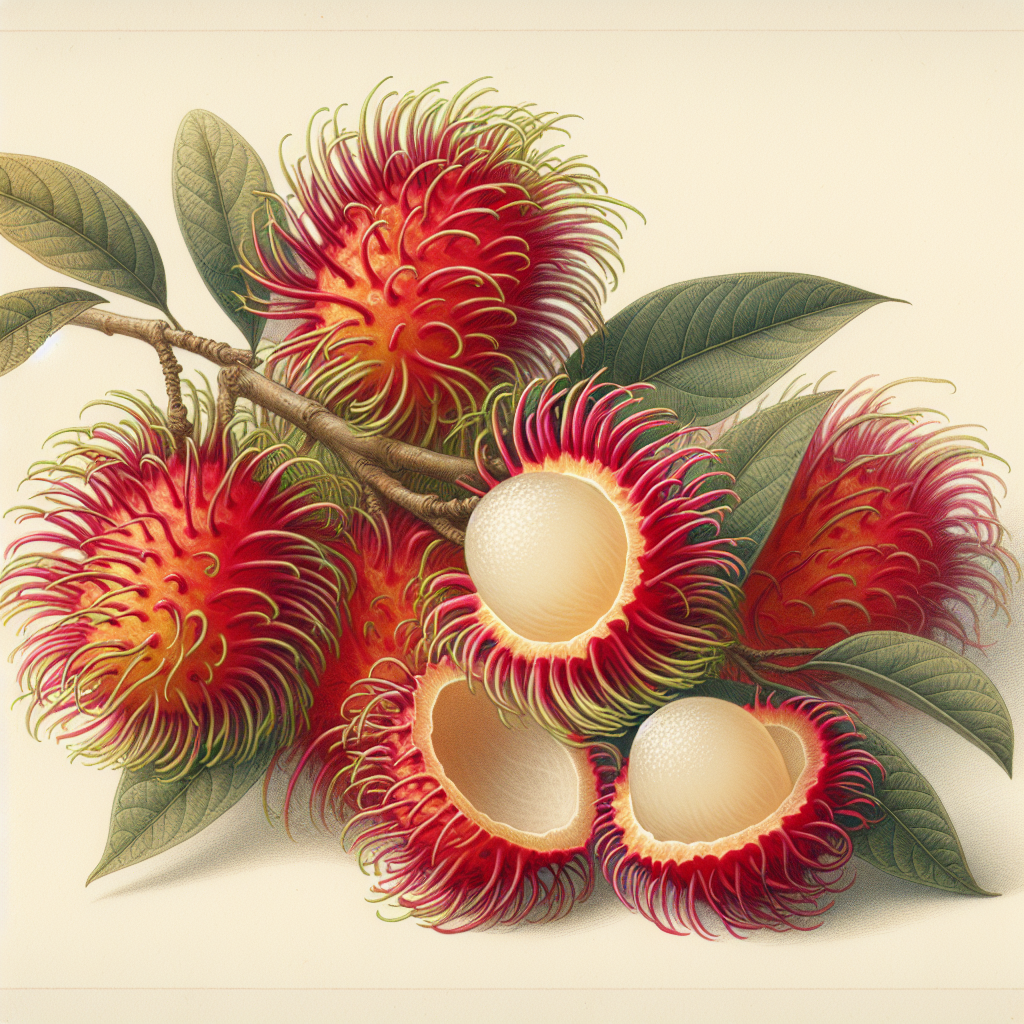
Introduction to Rambutan (Rongrien)
Rambutan Rongrien stands out as one of the most sought-after cultivars of Nephelium lappaceum, originating from Thailand where it has been selectively bred for superior fruit quality. Named after the Rongrien family who pioneered its development, this variety produces large, oval fruits weighing 40-60 grams each, with bright red skin adorned by short, flexible spines that are less aggressive than wild types. The translucent white flesh offers an exceptionally sweet flavor, often exceeding 30° Brix, with low fiber content and a small, shriveled seed that detaches easily—key traits for market appeal.
Thriving in tropical lowlands, Rongrien rambutan trees can reach 15-20 meters if unpruned but are typically managed at 6-8 meters for easier harvesting. Yields peak at 50-80 kg per tree after 5-7 years, with first fruits appearing in 3-4 years from grafting. This guide equips growers with professional strategies for propagation, care, and pest management, drawing from decades of Southeast Asian orchard practices. For similar tropical fruits, explore Durian (crop) cultivation techniques.
Rongrien's adaptability to humid conditions and resistance to some common fruit drop issues make it ideal for small farms and commercial plantations in USDA zones 10b-11. Its thin pericarp reduces post-harvest waste, boosting profitability. Expect 2-3 flushes per season in optimal conditions, with fruits clustering in attractive panicles of 20-50 pieces.
Botanical Profile of Rambutan (Rongrien)
Rambutan Rongrien belongs to the Sapindaceae family, closely related to lychee and longan. It is a dioecious evergreen tree with pinnate leaves 20-40 cm long, composed of 6-10 pairs of lanceolate leaflets that emerge coppery-red before maturing to glossy dark green. New growth is vigorous, with trees capable of 1-2 meters annual extension under ideal nutrition.
Flowers are small, greenish-white, and functionally male, female, or hermaphroditic, borne on axillary panicles up to 30 cm long. Rongrien is prized for its high female flower ratio (up to 70%), reducing the need for pollinators compared to wild types. Fruits develop rapidly post-anthesis, reaching maturity in 100-110 days, with skin turning vivid red and spines softening as sugar accumulates.
Roots form a shallow, wide-spreading system, extending 3-4 times the canopy radius, making soil preparation critical. The cultivar shows moderate vigor, with a spreading canopy that benefits from annual pruning to maintain light penetration and airflow. Genetic stability from clonal propagation ensures uniform performance, distinguishing it from seed-grown variants.
Soil, pH, and Climate Requirements for Rambutan (Rongrien)
Rongrien rambutan demands well-drained, fertile loamy soils rich in organic matter, with sandy loam or clay loam ideal (20-30% clay content). Avoid heavy clays prone to waterlogging, as roots are susceptible to Phytophthora (disease). Optimal pH is 5.0-6.5; test and amend with dolomite lime if below 4.8 to prevent micronutrient lockout.
Climate-wise, it flourishes in 24-32°C averages, with high humidity (70-90%) essential for fruit set. Annual rainfall of 2000-3000 mm is perfect, supplemented by irrigation during dry spells (<100 mm/month). Temperatures below 10°C induce leaf drop and growth cessation; frost is lethal. Elevations up to 600m suit Rongrien, but coastal lowlands yield best. For heat stress mitigation, see Why Summer Heatwaves Are Silently Killing Small Farm Yields - And 7 Organic Strategies to Fight Back.
Soil preparation involves deep tilling (60-80 cm) and incorporation of 20-30 kg/m² compost or green manure like Gliricidia (crop). Mulch with coconut husk or rice straw to retain moisture and suppress weeds. Conduct percolation tests: water should drain at 5-10 cm/hour to avert root issues.
Step-by-Step Planting & Propagation
Propagation of Rongrien is primarily via grafting onto seedling rootstocks for vigor and disease resistance. Select 1-2 year-old N. lappaceum seedlings (20-30 cm tall) as rootstocks.
Budding (Preferred Method): In the rainy season, use shield budding. Slice a bud patch (2x3 cm) from a healthy Rongrien scion, insert into a T-cut on rootstock bark. Wrap with parafilm; 80-90% success in 3-4 weeks.
Cleft or Veneer Grafting: For larger rootstocks, split and wedge scions. Align cambium layers, secure with clips. Success rate 70-85%.
Planting: Space trees 8-10m apart (100-150 trees/ha). Dig 60x60x60 cm pits, fill with topsoil + 10 kg compost + 500g rock phosphate + 200g wood ash. Plant at native soil level, stake firmly. Irrigate immediately.
Air-layering works for quick replacements: girdle 3-4 cm branches, apply rooting hormone (IBA 5000 ppm), wrap with moist sphagnum moss. Roots form in 6-8 weeks. Transplant with soil ball intact. Avoid seed propagation for Rongrien to preserve traits.
Care & Maintenance regimes for Rambutan (Rongrien)
Young trees need fortnightly irrigation (50-100 L/tree) for first 2 years, tapering to weekly in dry seasons. Mature trees require 1000-2000 L/week during fruiting. Drip systems optimize water use.
Fertilization: Annual program—Year 1: 100g NPK 15-15-15/tree, split 4x. Mature: 1-2 kg N, 1 kg P, 1.5 kg K/tree/year + 20 kg compost. Foliar sprays of micronutrients (Zn, B, Mn) post-flush. Soil tests guide adjustments.
Pruning: Annually after harvest, remove deadwood, watersprouts, and inward branches. Train to open center for light (30-50% canopy penetration). Tip prune terminals to encourage branching.
Weed control via mulch and shallow cultivation. Intercrop with legumes like Pigeon pea (crop) years 1-3 for nitrogen fixation.
Pests, Diseases & Organic Management
Common pests include Aphids (pest), mealybugs (pest), and fruit borers. Monitor weekly; blast with water jets or neem oil (2-3 ml/L) weekly. Introduce ladybugs for aphids.
Diseases: Anthracnose (disease) causes leaf spots and fruit rot—ensure airflow, apply copper fungicide (preventive, 7-10 day intervals in wet season). Phytophthora root rot managed by drainage and biofungicides like Trichoderma.
Organic IPM: Yellow sticky traps for flies, pheromone traps for borers. For details, check Why 90% of Small Farms Fail at Pest Management - And 8 Organic Fixes That Actually Work. Remove mummified fruits to break cycles.
Harvesting, Curing & Optimal Storage
Harvest at full red color, 100-110 days post-bloom, when spines flex easily. Clip panicles with 5-10 cm stem using secateurs; yield 20-40 kg/panicle. Avoid rain post-harvest to prevent cracking.
Field cure 3-5 days in shade for color uniformity and sugar rise. Grade by size (>30g premium). Store at 13-15°C, 90-95% RH for 2-3 weeks; ethylene absorbers extend life. Market fresh or process into juice/RTL.
Companion Planting for Rambutan (Rongrien)
Pair with shade-tolerant undercrops like Ginger (crop), turmeric, or pineapple in early years for soil health and income. Nitrogen-fixers such as pigeon pea enhance fertility. Avoid deep-rooted competitors like mango. Repel pests with marigolds and Thai Basil (crop). See Fall Companion Planting Guide: Boost Yields and Soil Health for Small Farms and Gardens for synergies. Legumes suppress weeds, improving microclimate.