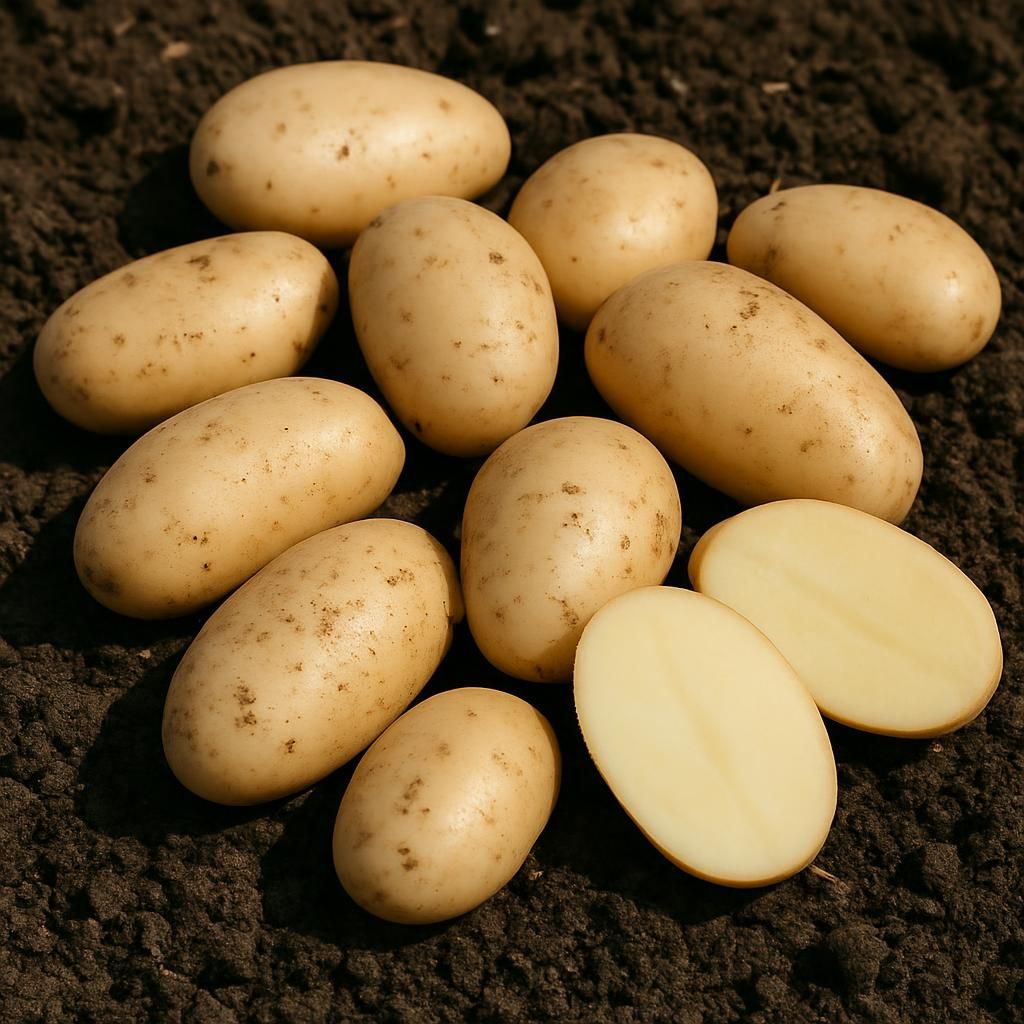
Introduction to Potato (Jersey Royal)
The Jersey Royal potato stands as one of the world's most celebrated early-season varieties, protected by PDO status and prized for its thin, flaky skins and rich, buttery flavor. Originating from the Channel Island of Jersey, this variety has been cultivated since the late 19th century using traditional methods that emphasize seaweed fertilization and hand harvesting. Its distinctive kidney shape and creamy yellow flesh set it apart from mainstream Potato cultivars such as Russet Burbank Potato and Yukon Gold Potato.
Commercial and home growers alike value the Jersey Royal for its rapid maturity (typically 90–110 days) and premium market positioning. The variety thrives in cool, maritime climates with well-drained, fertile soils. Its reputation for superior eating quality has made it a seasonal delicacy in European markets from April through June.
This professional growing guide delivers science-based recommendations for soil management, planting density, irrigation scheduling, and integrated pest management. Whether you operate a small market garden or larger commercial plot, the following sections provide actionable protocols to maximize yield and maintain the authentic flavor profile that defines the Jersey Royal.
Botanical Profile of Potato (Jersey Royal)
Jersey Royal potatoes belong to the nightshade family (Solanaceae) and exhibit the classic Solanum tuberosum morphology: compound leaves, white to pale lavender flowers, and shallow-rooted stolons that terminate in tubers. The variety produces medium-sized, kidney-shaped tubers with smooth, pale-yellow skins and firm, waxy yellow flesh that retains shape when boiled or steamed.
Plants reach 60–80 cm in height with an upright to semi-spreading habit. The foliage is dark green with slightly serrated leaflets. Tuber set typically occurs 40–50 days after emergence, with bulking continuing until haulm senescence. Unlike floury maincrop potatoes, the Jersey Royal maintains low dry-matter content (approximately 18–20 %), resulting in its signature firm texture.
Genetic studies place the variety within the European early-maturing group, showing moderate resistance to common scab but susceptibility to late blight and potato cyst nematodes. Understanding these botanical traits informs every subsequent decision from spacing to harvest timing.
Soil, pH, and Climate Requirements for Potato (Jersey Royal)
Jersey Royals demand well-structured, free-draining soils rich in organic matter. Heavy clays or waterlogged sites promote common scab, black scurf, and tuber rots. The ideal soil is a sandy loam or silt loam with good crumb structure that warms quickly in spring.
| Parameter | Ideal Range | Notes |
|---|---|---|
| Soil Type | Sandy loam to silt loam | Avoid compacted or stony soils |
| Soil pH | 5.5 – 6.2 | Lower pH reduces common scab incidence |
| Organic Matter | 3 – 5 % | Incorporate well-rotted compost or manure |
| Soil Temperature | 7 – 10 °C at 10 cm depth | Plant when soil reaches minimum threshold |
| Air Temperature | 12 – 18 °C daytime average | Cool nights enhance tuber quality |
| Frost Risk | None after emergence | Protect with fleece if late frosts forecast |
| Annual Rainfall | 600 – 900 mm | Supplemental irrigation required in dry spells |
Site selection should prioritize south-facing slopes with good air drainage. Windbreaks reduce wind scorch on foliage while maintaining the cool, humid microclimate essential for tuber bulking.
Step-by-Step Planting & Propagation
- Source certified seed tubers from reputable suppliers to minimize virus and nematode introduction. Select medium-sized seed (35–45 mm) with strong sprouts.
- Chitting: Place seed in single layers in trays at 10–12 °C with indirect light for 4–6 weeks until sprouts reach 2–3 cm.
- Soil preparation: Plough or rotovate to 25–30 cm depth, incorporate seaweed or well-rotted farmyard manure at 20–30 t/ha, then create ridges 75 cm apart.
- Planting window: In Jersey conditions, plant from late January to mid-February under polythene; mainland growers target mid-March to early April once soil temperature stabilizes above 7 °C.
- Planting depth and spacing: Set tubers 10–12 cm deep with 25–30 cm between plants within the row (approximately 40,000–45,000 plants/ha).
- Ridge formation: Immediately after planting, form 15 cm high ridges to protect developing stolons and improve drainage.
- Irrigation: Apply 15–20 mm water immediately after planting if soil is dry to ensure uniform emergence.
Care & Maintenance regimes for Potato (Jersey Royal)
Consistent moisture and balanced nutrition are critical during tuber initiation and bulking. Over-fertilization, particularly with nitrogen, produces excessive foliage at the expense of tuber quality.
| Growth Stage | Water Schedule | Fertilizer Application | Pruning / Haulm Management |
|---|---|---|---|
| Pre-emergence | Maintain soil at field capacity | None | None |
| Emergence to flowering | 20–25 mm/week; avoid water stress | 80 kg N, 120 kg K₂O, 40 kg P₂O₅ per ha at planting | Remove any diseased foliage immediately |
| Flowering to maturity | 25–30 mm/week; reduce 2 weeks pre-harvest | Side-dress 40 kg N at tuber initiation if required | Flail or desiccate haulm 14–21 days before lifting |
| Post-harvest | N/A | Cover crop or green manure | N/A |
Earthing-up should be performed twice: first at 15 cm plant height and again before flowering. Mulching with straw or black polythene conserves moisture and suppresses weeds while maintaining soil temperature.
Pests, Diseases & Organic Management
The Jersey Royal faces pressure from several key pests and diseases. Colorado potato beetle, aphids, and wireworms are the primary insect concerns, while late blight, common scab, and black scurf represent the main disease threats.
Implement a strict rotation of at least four years between potato crops. Use certified seed and rogue out any plants showing virus symptoms. For late blight, apply copper-based fungicides or approved organic alternatives at 7–10 day intervals once conditions favor sporulation. Encourage beneficial insects by planting flowering strips of Thyme and Nasturtium.
Cultural controls include deep ridging to reduce tuber exposure to blight spores and timely irrigation to prevent common scab. Biological options such as Bacillus thuringiensis and entomopathogenic nematodes provide targeted control of caterpillar and wireworm populations without disrupting beneficial fauna.
Harvesting, Curing & Optimal Storage
Harvest begins when tubers reach 25–35 mm diameter and skins are set but not fully mature—typically 90–110 days after planting. Lift carefully with a fork or mechanical harvester to minimize bruising. Remove any damaged or diseased tubers immediately.
Curing is minimal for early-season varieties; store at 8–10 °C and 90–95 % relative humidity for up to four weeks. For longer storage, reduce temperature to 4–5 °C after two weeks. Avoid light exposure to prevent greening and solanine accumulation. Monitor regularly for soft rots and sprouting.
Companion Planting for Potato (Jersey Royal)
Strategic companions improve soil health, deter pests, and optimize space. French marigolds and Nasturtium repel aphids and Colorado potato beetle while attracting beneficial insects. Garlic and Onion planted in alternate rows reduce aphid colonization through volatile compounds.
Leguminous green manures such as clover fix nitrogen and improve soil structure when incorporated before planting. Avoid planting near other solanaceous crops to limit shared disease pressure. Deep-rooted companions like Carrot can be intercropped in wider rows to maximize land use without competition.
Stop Treating Tomato Blight Like a Spray Problem: Here Is What Works Better