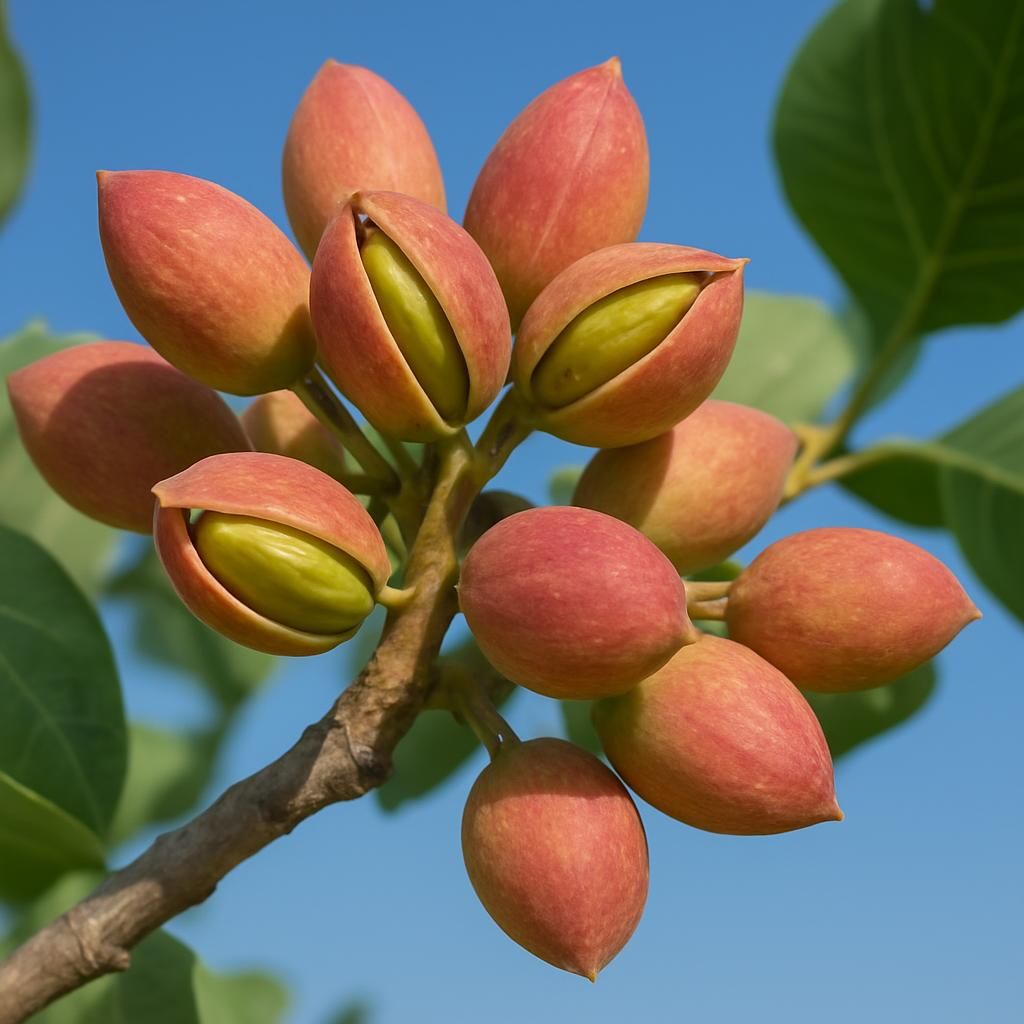
Introduction to Pistachio (Sirora)
Pistachio (Sirora) is a premium early-season cultivar of Pistachio developed for commercial orchards seeking reliable yields in hot, dry regions. Its vigorous growth habit and consistent bearing make it popular among growers transitioning from traditional varieties such as Kerman Pistachio. With proper management, Sirora orchards can deliver high-quality nuts for both domestic markets and export.
Sirora trees exhibit strong drought tolerance once established and respond well to modern irrigation scheduling. The cultivar matures earlier than many standard varieties, allowing harvest before late-season heat stress reduces quality. Its compact canopy and moderate vigor also simplify pruning and pest monitoring in high-density plantings.
This comprehensive guide covers every stage from site selection through post-harvest storage. Emphasis is placed on evidence-based practices that support long-term orchard health and sustainable productivity.
Botanical Profile of Pistachio (Sirora)
Pistacia vera 'Sirora' belongs to the Anacardiaceae family and is a deciduous, dioecious tree. Female trees produce the edible drupes while male trees supply pollen. Sirora is valued for its early flowering and relatively compact stature compared with older cultivars.
Mature trees reach 4–6 meters in height with a spreading canopy. Leaves are pinnately compound with 3–5 leaflets and turn golden in autumn before leaf drop. The fruit is a drupe containing a single seed (nut) enclosed in a hard shell that splits naturally at maturity.
Sirora demonstrates moderate alternate bearing, though proper nutrition and pruning can moderate yield fluctuations. The cultivar shows good tolerance to saline irrigation water, making it suitable for marginal lands where other tree crops struggle.
Soil, pH, and Climate Requirements for Pistachio (Sirora) (MUST INCLUDE A MARKDOWN TABLE OF IDEAL CONDITIONS)
Pistachio (Sirora) performs best on deep, well-drained sandy loam or loam soils with high calcium content. Heavy clay soils restrict root development and increase risk of root diseases. Pre-plant soil testing is essential to correct nutrient imbalances and pH before orchard establishment.
The following table summarizes optimal growing conditions:
| Parameter | Ideal Range | Notes |
|---|---|---|
| Soil Type | Sandy loam to loam | Excellent drainage critical |
| Soil pH | 7.0 – 8.0 | Slightly alkaline preferred |
| Soil Depth | Minimum 1.5 m | Deep roots require unrestricted profile |
| Temperature Range | 15–38 °C daytime | Tolerates short freezes to –10 °C |
| Annual Rainfall | 200–400 mm | Supplemental irrigation required |
| Chill Hours | 600–900 hours below 7 °C | Necessary for uniform flowering |
| Salinity Tolerance | EC < 4 dS/m | Moderate tolerance; monitor irrigation water |
Site selection should favor south-facing slopes with good air drainage to reduce spring frost risk. Windbreaks are recommended in exposed locations to protect young trees from desiccation.
Step-by-Step Planting & Propagation
Propagation of Pistachio (Sirora) is achieved by grafting scions onto seedling rootstocks of Pistacia atlantica or Pistacia integerrima. Seed propagation is used only for rootstock production because seedlings do not come true to type.
- Collect fresh seeds in autumn, stratify at 4 °C for 60–90 days, then sow in well-drained media.
- Grow rootstock seedlings in containers or nursery rows for one to two seasons until stem diameter reaches 10–12 mm.
- Perform whip-and-tongue or cleft grafting in late winter using certified Sirora scion wood.
- Plant grafted trees in late winter or early spring when soil temperatures exceed 10 °C.
- Space trees 5–6 m between rows and 3–4 m within rows for high-density systems.
- Install drip irrigation and mulch immediately after planting to conserve moisture.
Staking young trees for the first two years prevents wind damage and ensures straight trunks. Remove any flowers that appear in the first two seasons to direct energy into vegetative growth.
Care & Maintenance regimes for Pistachio (Sirora) (MUST INCLUDE A MARKDOWN TABLE OF WATER, FERTILIZER, AND PRUNING SCHEDULES)
Successful management of Pistachio (Sirora) requires precise irrigation, balanced nutrition, and annual pruning. Young orchards need more frequent irrigation while mature trees benefit from regulated deficit irrigation to promote nut sizing.
The table below outlines seasonal schedules:
| Season | Water (mm/week) | Fertilizer (kg N/tree/year) | Pruning Focus |
|---|---|---|---|
| Spring | 25–35 | 0.5–0.8 | Remove dead wood; shape scaffold limbs |
| Summer | 35–45 | 0.8–1.0 | Light tipping of vigorous shoots |
| Autumn | 15–25 | 0.3–0.5 | Remove crossing branches |
| Winter | Minimal (dormant) | 0.0 | Structural pruning; renewal cuts |
Fertilizer applications should be split between spring and early summer to match uptake patterns. Leaf tissue analysis every second year guides micronutrient corrections, especially boron and zinc. Mulch application in the tree row suppresses weeds and moderates soil temperature.
Pests, Diseases & Organic Management
Common pests include Navel orangeworm, Spider mites, and Mealybugs. Early monitoring with pheromone traps helps time interventions before populations reach damaging levels.
Major diseases are Verticillium wilt, Phytophthora root rot, and Alternaria late blight. Resistant rootstocks and strict irrigation management are the primary defenses. Organic growers rely on neem oil, kaolin clay, and beneficial insect releases.
Sanitation practices such as removing mummified nuts and fallen leaves reduce overwintering inoculum. Cover crops between tree rows improve biodiversity and support natural enemies of pests.
Harvesting, Curing & Optimal Storage
Sirora nuts reach maturity when hulls split and kernels achieve 40–45 % moisture. Mechanical shaking or hand harvesting occurs from late August through early September depending on climate.
Post-harvest, nuts are hulled within 24 hours, then dried to 5–6 % moisture using forced-air dryers at 32–38 °C. Proper curing prevents mold development and maintains flavor.
Store dried pistachios in sealed containers at 0–4 °C and 65–70 % relative humidity. Under these conditions, nuts retain quality for up to 12 months. Vacuum packaging extends shelf life further for export markets.
Companion Planting for Pistachio (Sirora)
Compatible companions include Clover and Thyme grown in the orchard floor to fix nitrogen and attract pollinators. These low-growing species do not compete with tree roots when mowed regularly.
Avoid planting shallow-rooted vegetables or high-water-demand crops within the drip line. Nasturtium can be used as a trap crop for aphids along orchard borders.
Strategic companion planting enhances biodiversity, improves soil structure, and supports integrated pest management without synthetic inputs.