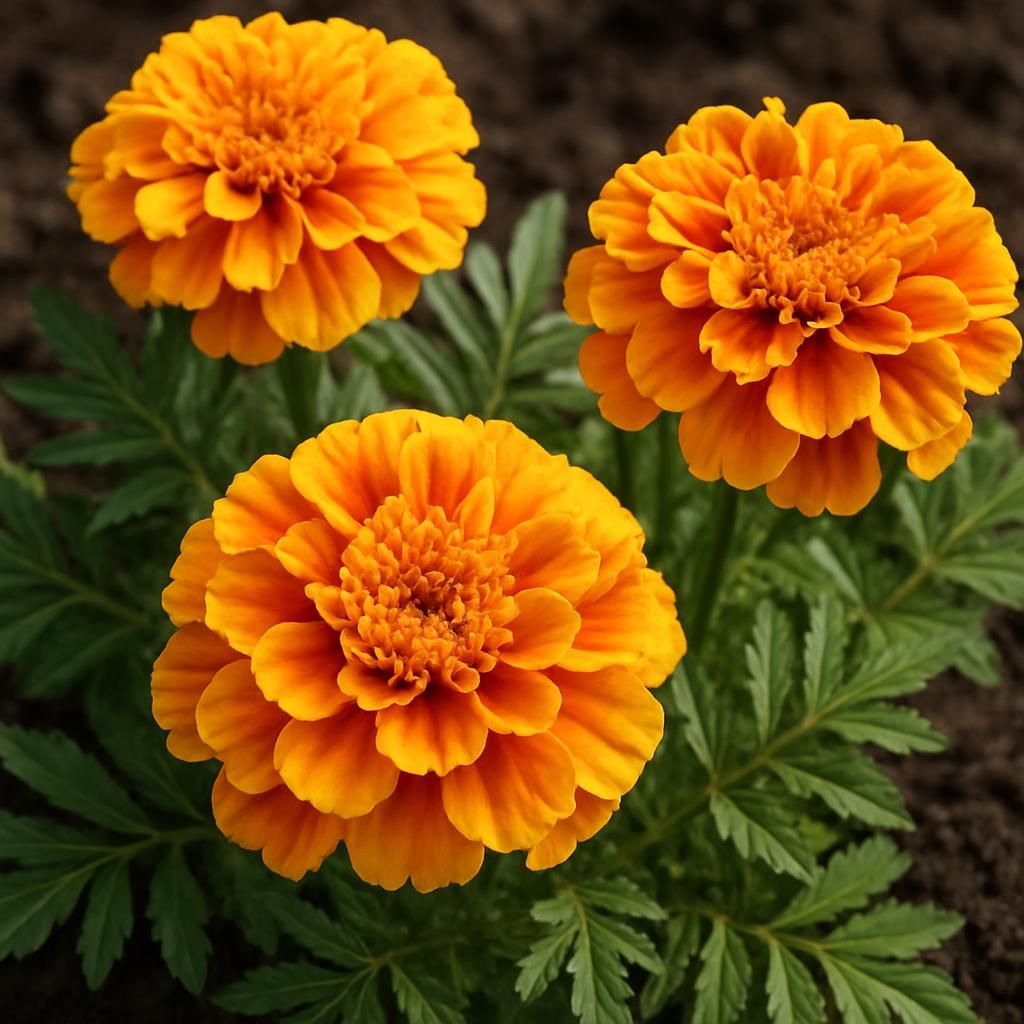
Introduction to Marigold Flower
Marigold (Tagetes spp.) ranks among the most widely cultivated ornamental and companion crops globally due to its rapid growth cycle, vivid coloration, and natural pest-suppression properties. French marigolds (Tagetes patula) and African marigolds (Tagetes erecta) dominate commercial production, while signet marigolds (Tagetes tenuifolia) serve culinary markets. Growers value marigolds for their ability to suppress nematodes and attract beneficial insects when interplanted with vegetables such as Tomato.
Botanical Profile of Marigold Flower
Marigolds belong to the Asteraceae family and feature composite flower heads composed of ray and disc florets. French types reach 15–40 cm with finely divided foliage, while African cultivars exceed 60 cm with larger blooms. All species produce aromatic foliage containing thiophenes and terpenoids that exhibit nematicidal activity. Flowering occurs 45–60 days after sowing under optimal temperatures of 18–30 °C.
Soil, pH, and Climate Requirements for Marigold Flower
Marigolds thrive in well-drained, fertile loams with moderate organic matter. They tolerate a wide pH range but perform best near neutral. The following table summarizes ideal conditions:
| Parameter | Ideal Range | Notes |
|---|---|---|
| Soil Type | Sandy loam to loam | Good drainage prevents root rot |
| pH | 6.0–7.5 | Slight acidity boosts micronutrient uptake |
| Temperature | 18–30 °C day / 10–15 °C night | Frost sensitive below 5 °C |
| Sunlight | Full sun (6–8 h) | Partial shade reduces bloom density |
| Spacing | 20–30 cm between plants | Wider spacing for larger African types |
| Soil EC | < 2.0 dS/m | Sensitive to salinity |
Step-by-Step Planting & Propagation
- Start seeds indoors 4–6 weeks before last frost in cell trays filled with sterile seed-starting mix.
- Sow seeds 3–5 mm deep; maintain 21–24 °C soil temperature for 5–7 day germination.
- Harden off seedlings 7–10 days before transplanting.
- Transplant after soil reaches 15 °C; space 20 cm for French types and 30 cm for African types.
- Direct sow in warm climates after danger of frost, thinning to final spacing when seedlings reach 5 cm.
- Water immediately after transplanting to settle roots.
Care & Maintenance regimes for Marigold Flower
Consistent moisture and moderate fertility sustain continuous blooming. The table below outlines recommended schedules:
| Week | Watering | Fertilizer | Pruning / Pinching |
|---|---|---|---|
| 1–2 (Establishment) | 2–3 cm every 2–3 days | None; starter solution optional | Pinch at 4–6 true leaves |
| 3–6 (Vegetative) | 2.5 cm weekly; mulch to conserve | 5-10-5 at 50 kg/ha | Deadhead spent blooms weekly |
| 7–10 (Flowering) | 2 cm twice weekly | Side-dress 10-10-10 at 30 kg/ha | Remove diseased foliage |
| Post-harvest | Reduce to 1 cm weekly | None | Cut back 10 cm to encourage rebloom |
Pests, Diseases & Organic Management
Common pests include aphids, thrips, and spider mites. Use insecticidal soap or neem oil at 7–10 day intervals. Fungal issues such as powdery mildew and Botrytis arise under high humidity; improve airflow and apply Bacillus subtilis sprays. Crop rotation with Garlic reduces soil-borne pathogen buildup.
Harvesting, Curing & Optimal Storage
Harvest flowers when fully open but before pollen shed for maximum vase life. Cut stems at 30–40 cm in early morning. Bunch in groups of 10–15 and place in 4 °C water for 4–6 hours. Store at 2–5 °C and 85–90 % RH for up to 7 days. Dry flowers at 35 °C for 24 hours for culinary or dye use; store in airtight containers away from light.
Companion Planting for Marigold Flower
Marigolds excel as a trap crop and living mulch. Pair with Tomato to deter root-knot nematodes and whiteflies. Interplant with Cucumber to suppress cucumber beetles. Avoid proximity to Legumes as thiophene residues may inhibit nodulation. Rotate with brassicas to break disease cycles.