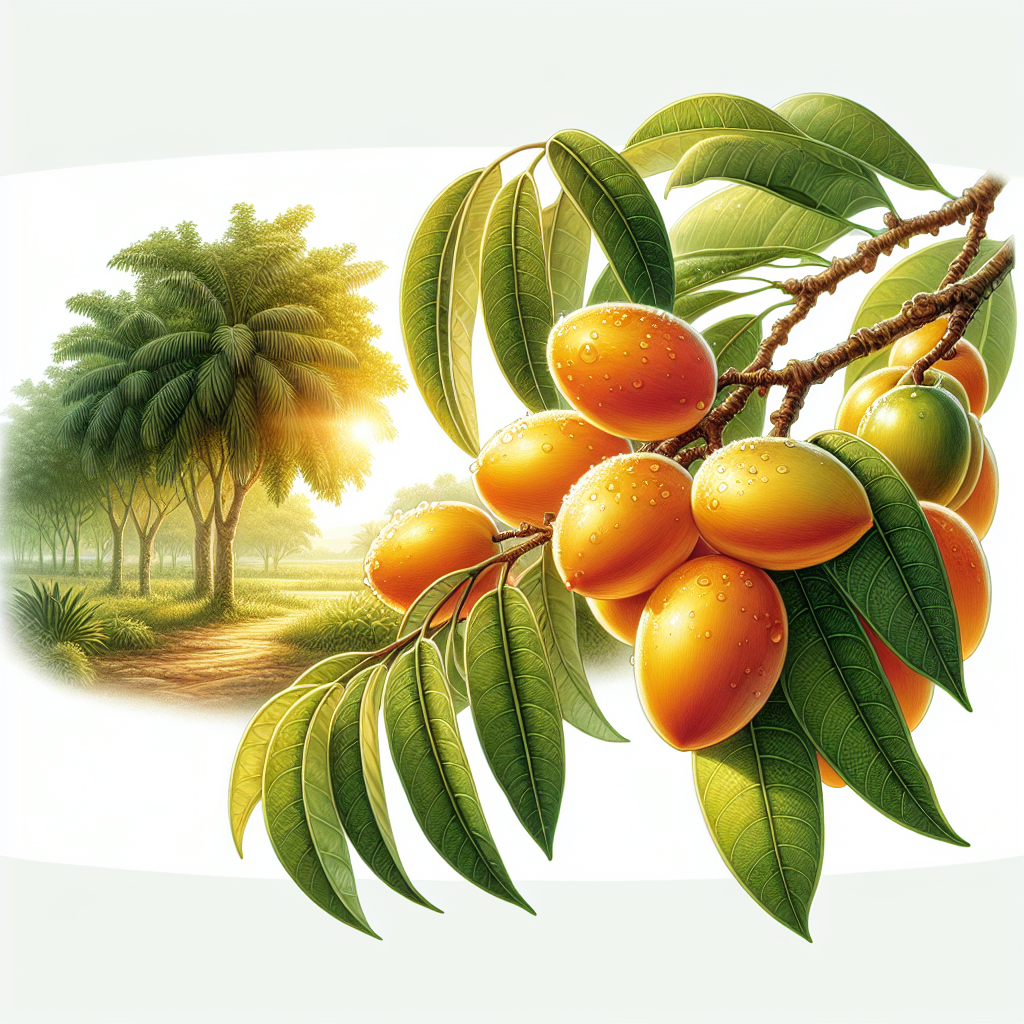
Introduction to Maprang (Mayong Chid)
Maprang (Mayong Chid), scientifically known as Bouea macrophylla, is an underutilized tropical fruit tree from the Anacardiaceae family, closely related to mango. Native to Thailand, Malaysia, Indonesia, and parts of Vietnam, it's celebrated for its small, oval-shaped fruits that ripen to a vibrant yellow-orange hue with a sweet-tart flavor profile blending mango, plum, and citrus notes. The fruits, typically 3-5 cm in diameter, are eaten fresh, juiced, or used in desserts, salads, and preserves, boasting high levels of vitamin C, antioxidants, and fiber.
This tree thrives in humid tropical lowlands, growing 10-20 meters tall with dense, evergreen foliage and attractive reddish new leaves. It's drought-tolerant once established, making it suitable for small farms and home gardens in USDA zones 10-12. Yields begin 3-5 years after planting, with mature trees producing 50-200 kg of fruit annually during the main season (March-May). Beyond its culinary value, Maprang provides shade, windbreaks, and potential agroforestry income. Growers appreciate its low maintenance and resistance to many common tropical pests, though proper site selection is key for optimal production. For more on similar tropical fruits, see our guide on papaya.
Botanical Profile of Maprang (Mayong Chid)
Bouea macrophylla is a medium to large evergreen tree reaching 15-25 meters in height and 20-30 cm trunk diameter in natural settings. Leaves are compound, pinnate, 15-30 cm long with 5-9 pairs of leathery leaflets (8-15 cm), glossy green above and paler beneath. New flushes emerge coppery-red, turning deep green. Flowers are small (3-5 mm), pale yellow, borne in panicles up to 25 cm long from January-February. The fruit is a drupe, 2.5-5 cm long, 2-4 cm wide, with thin, tough skin turning golden-yellow at maturity. Pulp is juicy, aromatic, orange-yellow, surrounding a single hard, flattened seed (2-3 cm). Seeds are recalcitrant, losing viability quickly if dried.
Regional varieties include Thai 'Maprang Ton Hom' (sweet), Malaysian 'Rambai Hutan' (tart), and Indonesian selections. Trees are dioecious or polygamous, requiring pollinators like bees. Phenology: leaf flush post-harvest (June), flowering (dry season), fruit set (March), maturity (2-3 months later). Root system is deep-taprooted with laterals, aiding drought tolerance but sensitive to waterlogging. Wood is hard, reddish-brown, used locally for tool handles. In cultivation, dwarf forms (8-12 m) are selected for orchards. Check our blog on companion planting for integrating Maprang into polycultures.
Soil, pH, and Climate Requirements for Maprang (Mayong Chid)
Maprang demands well-drained, fertile loamy soils rich in organic matter, avoiding heavy clays or sands. Ideal texture: sandy loam to clay loam (20-40% clay). Soil depth minimum 1-1.5 m for root development. Optimal pH 5.5-7.0; tolerates 5.0-8.0 but avoid extremes to prevent nutrient lockup. Conduct soil tests pre-planting, amending with lime for acidity below 5.5 or sulfur for alkalinity above 7.5. Incorporate 10-20 kg compost/m², plus rock phosphate (200 g) and wood ash (500 g) per planting hole.
Climatically, it requires tropical/subtropical conditions: 24-32°C average, minima >10°C, maxima <40°C. Annual rainfall 1200-2500 mm, evenly distributed or with dry flowering period (2-3 months). Humidity 70-90%; frost-intolerant (dies below 0°C). Elevation 0-800 m. Full sun (6-8 hours/day) essential; tolerates partial shade young but reduces yields. Wind protection needed for pollination/fruit set. In marginal areas, use microclimates or rain shelters. Mulch heavily (10 cm organic) to retain moisture, suppress weeds. For heatwave strategies, reference Why Summer Heatwaves Are Silently Killing Small Farm Yields.
Step-by-Step Planting & Propagation
Propagation: Seeds germinate 10-20 days at 25-30°C in moist sand-compost (1:1). Sow fresh seeds 2 cm deep; viability 2-4 weeks. Success 70-90%. Grafting (veneer, cleft) on seedlings 1-2 years old; budding (chip) in rainy season. Rooted cuttings rare due to poor rooting.
Site Prep: Select sunny, sheltered site. Dig holes 60x60x60 cm, 6-8 m apart (5x5 m dense). Fill with topsoil + 20 kg FYM + 500 g lime + 200 g superphosphate.
Planting: Rainy season (May-July). Bare-root or polybag seedlings (50-100 cm, 1-2 years). Plant at soil mark; stake; mulch. Water deeply weekly first year.
Young Care: Prune to single leader; remove basal suckers. Fertilize monthly NPK 15-15-15 (50 g/tree). Irrigate 20-40 L/week dry periods.
Care & Maintenance regimes for Maprang (Mayong Chid)
Irrigation: Deep, infrequent; 40-60 L/tree/week mature dry season. Drip systems ideal (4-6 L/hour). Avoid overhead to prevent fungal issues.
Fertilization: Annual: 1-2 kg N, 1 kg P, 1.5 kg K/tree split 3 applications. Micronutrients: Zn, Mn, B via foliar. Organic: compost 20-50 kg/tree/year.
Pruning: Annual post-harvest: remove dead/crossing branches, open canopy for light/ventilation. Train to 3-4 main scaffolds. Height control <10 m.
Weeding/Mulching: Maintain weed-free basin 2 m radius. Mulch annually pineapple leaves/coconut husk.
Monitoring: Scout monthly growth, pests. Thin fruits if overloaded (>50/tree).
Pests, Diseases & Organic Management
Pests: Fruit flies (fruit flies), seed borers, aphids, mealybugs. Organic: neem oil sprays (2-5 ml/L weekly), yellow sticky traps, bagging fruits. Beneficials: ladybugs, parasitic wasps.
Diseases: Anthracnose (Colletotrichum), powdery mildew, root rot (phytophthora). Cultural: prune ventilation, copper fungicide (Bordeaux mix), avoid wet feet. Biofungicides: Trichoderma.
Integrated Approach: Crop rotation, sanitation, resistant rootstocks. For advanced tactics, see Why 90% of Small Farms Fail at Pest Management. Early detection key; IPM reduces losses 70%.
Harvesting, Curing & Optimal Storage
Harvest when 80% yellow, specific gravity 1.00-1.02 (float test). Twist-pull; yield 50-150 kg/tree. Handle gently; fruits bruise easily.
Curing: Shade-dry 2-3 days 25-30°C to reduce moisture, enhance flavor.
Storage: Fresh: 10-15°C, 85-90% RH, 2-3 weeks. Ripen ethylene bags. Processed: puree freeze (-20°C, 12 months), dried (60°C, 8-12% MC).
Market as premium exotic; postharvest dips (calcium chloride) extend shelf-life.
Companion Planting for Maprang (Mayong Chid)
Maprang pairs well with nitrogen-fixers like pigeon pea, groundcovers (marigold), repellents (thai basil). Avoid water-hungry like banana. Understory: ginger, turmeric suppress weeds, improve soil. Intercrop young orchards legumes. Benefits: pest deterrence, soil fertility, microclimate moderation. Design guilds for biodiversity.