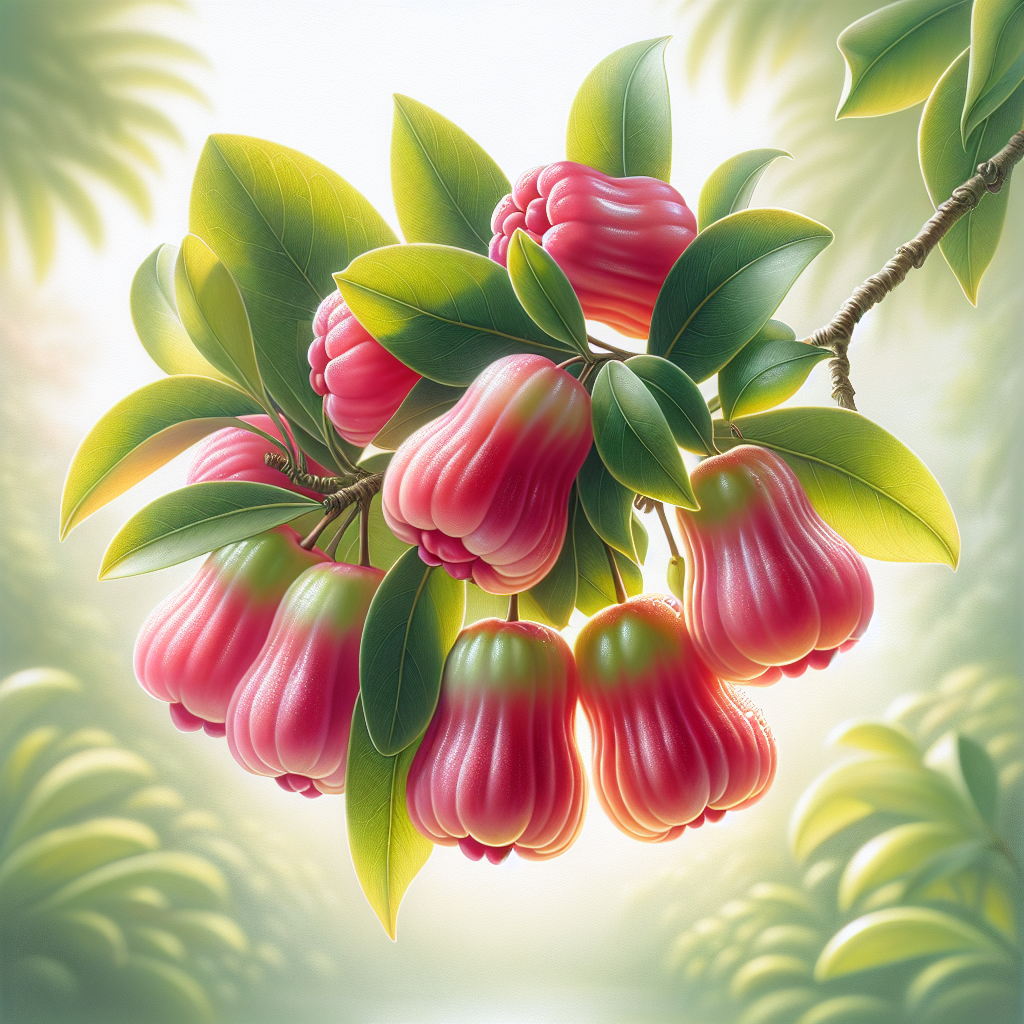
Introduction to Malay Apple (Pink)
The Malay Apple (Pink), scientifically Syzygium malaccense, is a stunning tropical fruit tree celebrated for its showy pink to deep crimson bell-shaped fruits that dangle enticingly from branch tips. Native to Southeast Asia, particularly Malaysia and Indonesia, this evergreen myrtaceous tree has gained popularity worldwide for its ornamental value, refreshing fruit flavor, and relative ease of cultivation in suitable climates. The fruits, ripening in clusters, offer a crisp texture with a mild, sweet apple-like taste blended with rosewater notes, making them perfect for fresh consumption, salads, juices, or desserts.
Growing Malay Apple (Pink) trees can transform a backyard or small farm into a productive tropical oasis. Mature trees reach 10-20 meters in height but can be pruned to 5-8 meters for easier management. They produce fruits year-round in optimal conditions, with peak harvests during the rainy season. This comprehensive guide draws from botanical expertise and agricultural best practices to help you achieve bountiful yields. Whether you're a novice gardener or seasoned farmer, mastering Malay Apple cultivation involves understanding its tropical preferences, precise propagation, vigilant pest management, and timely harvesting. For similar tropical fruits, explore Guava (crop).
Key benefits include high adaptability to humid environments, minimal fertilizer needs once established, and pollinator attraction via fragrant white flowers. However, success hinges on frost-free locations and well-drained soils. Expect first fruits 3-5 years after planting, with yields up to 50-100 kg per mature tree annually. Dive into the sections below for step-by-step mastery.
Botanical Profile of Malay Apple (Pink)
Syzygium malaccense, commonly called Malay Apple (Pink), Malay Rose Apple, or Mountain Apple, belongs to the Myrtaceae family, sharing lineage with guavas and cloves. This evergreen tree features glossy, lanceolate leaves (10-20 cm long) that emit a spicy aroma when crushed. New growth emerges reddish-bronze, maturing to deep green, providing year-round aesthetic appeal.
Flowers are hermaphroditic, 1-2 cm wide, with four petals and numerous stamens, blooming in terminal panicles. Pollination occurs via bees and other insects, though hand-pollination boosts set in low-pollinator areas. Fruits develop 4-8 weeks post-bloom, measuring 3-5 cm long, pear-shaped or bell-like, with thin, waxy pink-to-red skin over white, juicy flesh surrounding a small central seed.
The tree's wood is lightweight and used locally for crafts, while leaves serve in traditional medicine for digestive issues. Varieties include 'Pink' selections with deeper pigmentation and sweeter fruit compared to red or white forms. Root system is shallow and fibrous, prone to waterlogging damage. Growth rate is moderate, 0.5-1 m/year, with a spreading canopy ideal for shade. For related Myrtaceae crops, see Apple Guava (crop).
Nutritionally, fruits provide vitamin C (30-50 mg/100g), antioxidants, and low calories (25-40 kcal/100g), supporting immune health. Trees tolerate light wind but not salt spray, thriving at elevations up to 800m in native ranges.
Soil, pH, and Climate Requirements for Malay Apple (Pink)
Malay Apple (Pink) demands tropical to subtropical conditions: USDA zones 10b-11, with minimum temperatures above 10°C (50°F) and no frost. Optimal temperatures range 24-32°C (75-90°F) daytime, 18-24°C (65-75°F) nights. High humidity (70-90%) is essential; dry spells reduce fruit quality. Annual rainfall of 1500-2500 mm, evenly distributed, suits best—supplement with irrigation in drier areas.
Soils must be fertile, well-drained loams or sandy loams; avoid heavy clays prone to waterlogging, which causes root rot (disease). Incorporate 20-30% organic matter like compost for aeration. pH tolerance: 5.5-7.0, ideally 6.0-6.5. Test soil annually; amend acidic soils with lime, alkaline with sulfur. Mulch with 10-15 cm organic material to retain moisture and suppress weeds.
Full sun (6-8+ hours daily) promotes vigorous growth and fruiting; partial shade (20-30%) acceptable for young trees. Windbreaks protect from strong gusts. In marginal climates, use microclimates or greenhouses. Salt tolerance low; distance 100m+ from coast. For heat management tips, check Why Summer Heatwaves Are Silently Killing Small Farm Yields - And 7 Organic Strategies to Fight Back.
Step-by-Step Planting & Propagation
Propagation
Seeds germinate readily (80-90% rate) but produce variable offspring; use fresh seeds from ripe fruit, cleaned and sown immediately. Sow 1 cm deep in 50:50 sand-compost mix at 25-30°C; sprouts in 10-20 days. Marcotting (air-layering) is preferred for clones: girdle 4-5 cm branch, apply rooting hormone, wrap in moist sphagnum, roots in 6-8 weeks. Grafting (cleft or veneer) onto seedling rootstock ensures dwarfing and true-to-type.
Site Preparation
Select 6x6m spacing for standard trees (4x4m dwarfs). Dig 60x60x60 cm holes, fill with topsoil + 20 kg compost + 500g superphosphate + 200g dolomite. Plant during rainy season onset.
Planting Steps
- Water root ball thoroughly pre-planting.
- Place graft union 10 cm above soil.
- Backfill, firm soil, stake if needed.
- Water deeply (50L/tree), mulch.
- Shade young trees 50% for 3-6 months.
Transplant seedlings at 30-50 cm height. Prune at planting to balance root-shoot ratio.
Care & Maintenance regimes for Malay Apple (Pink)
Water young trees 3-4x/week (20-50L), mature 1-2x/week, more in dry periods—drip irrigation ideal. Fertilize 3-4x/year: NPK 10-10-10 at 200g/tree young, 1-2kg mature, plus micronutrients (Zn, Fe). Foliar spray monthly during growth.
Prune annually post-harvest: remove deadwood, watersprouts, thin canopy for light penetration. Tip prune to encourage bushiness. Thin fruits to 10-15 cm spacing for size.
Weed control via mulch; hand-pull or hoe. Monitor growth; interplant legumes for nitrogen. For soil tips, see Soil Health Mastery: 5 Proven Strategies for Small Farms to Build Fertile Ground Without Breaking the Bank. Expect 2-3m height year 1.
Pests, Diseases & Organic Management
Common pests: Aphids (pest), mealybugs (pest), fruit flies—control with neem oil (2ml/L weekly), ladybugs, yellow sticky traps. Borers: inspect trunks, remove infested wood.
Diseases: Anthracnose (disease) (brown leaf spots)—copper fungicide, prune airflow. Phytophthora root rot (disease)—improve drainage, phosphite drenches. Powdery mildew: sulfur spray.
Organic IPM: companion plants like marigolds, beneficial insects. For strategies, Why 90% of Small Farms Fail at Pest Management - And 8 Organic Fixes That Actually Work. Scout weekly; prune infected parts.
Harvesting, Curing & Optimal Storage
Harvest when fruits fully pink-red, 80-90% color change, firm but yielding to gentle pressure—4-8 weeks post-bloom. Clip clusters with shears; yield 20-50 fruits/tree young, 200+ mature.
No curing needed; cool to 15-20°C post-harvest. Store ripe at 10-13°C, 85-90% RH, 2-3 weeks shelf life. Refrigerate unripe 7-10 days. Market fresh; process into jams if overripe. Handle gently to avoid bruising.
Companion Planting for Malay Apple (Pink)
Pair with nitrogen-fixers like pigeon pea (crop) or gliricidia (crop) for soil enrichment. Repel pests with marigold (crop), thyme (crop), or nasturtium (crop). Underplant with pineapple (crop) or ginger for ground cover. Avoid water-hungry crops. Benefits: pest deterrence, pollination boost, microclimate moderation. For more, Why Companion Planting Feels Like Guesswork for Small Farms - And How AI Makes It Foolproof.