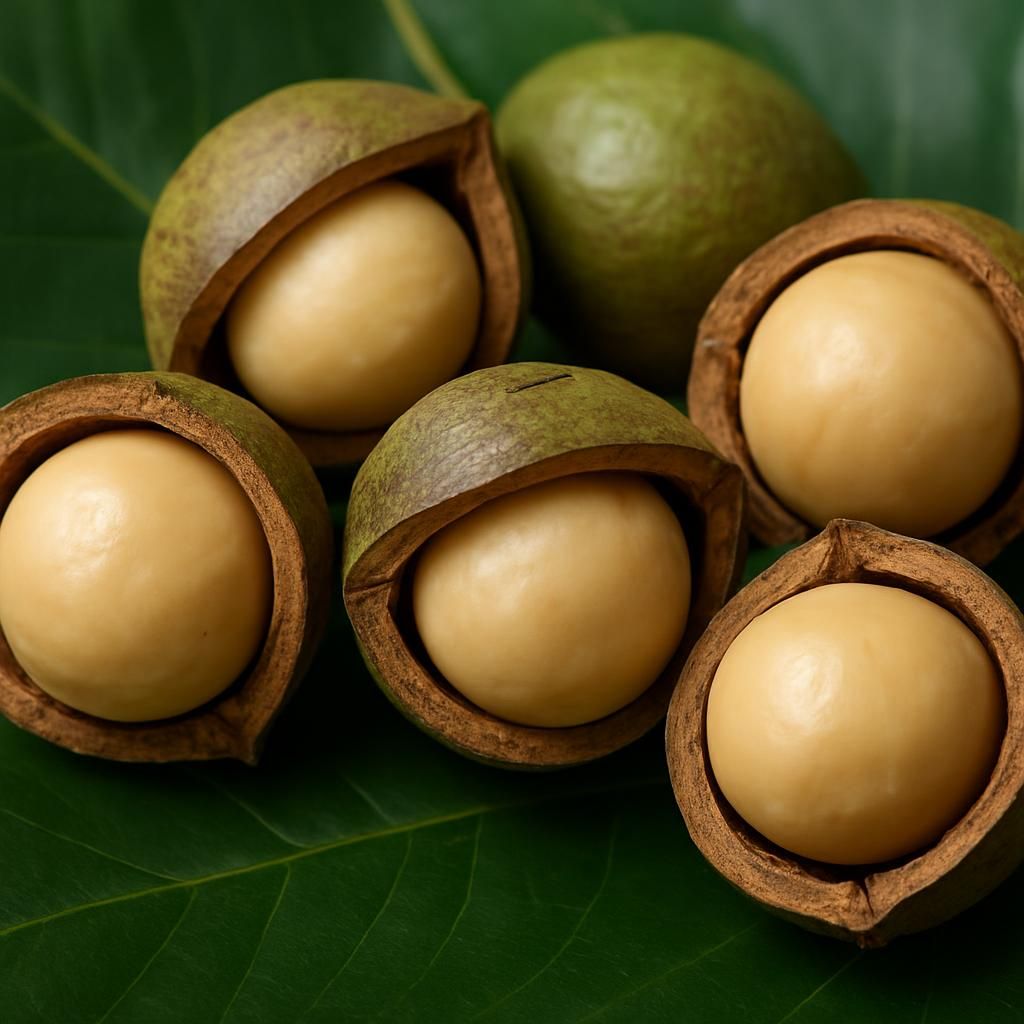
Introduction to Macadamia (Pahala)
Macadamia (Pahala) is a premium hybrid cultivar developed for commercial orchards seeking reliable nut production in subtropical and warm temperate regions. The variety offers excellent kernel recovery and a balanced flavor profile that commands strong prices in both domestic and export markets. As global demand for macadamia continues to rise, Macadamia orchards planted with high-performing selections such as Pahala represent a long-term investment with attractive returns for professional growers.
This comprehensive guide covers every stage of cultivation from site selection through post-harvest handling, with emphasis on evidence-based practices that maximize both yield and kernel quality. Whether establishing a new commercial block or improving an existing planting, the following sections provide the technical detail required for profitable production.
Botanical Profile of Macadamia (Pahala)
Macadamia (Pahala) belongs to the Proteaceae family and exhibits the characteristic evergreen, broadleaf habit of the genus. Trees reach 8–12 meters at maturity with a spreading canopy that requires careful management to maintain light penetration. The glossy, dark-green leaves are typically 10–20 cm long and arranged in whorls of three or four. Flowers are small, creamy-white, and borne on long racemes that appear in late winter to early spring depending on latitude.
The hybrid nature of Pahala combines the thinner shell of Macadamia integrifolia with the greater cold hardiness of Macadamia tetraphylla. Nuts develop inside a hard, woody pericarp that splits at maturity, revealing the characteristic round kernel protected by a thin brown testa. The cultivar typically flowers 4–5 years after planting from grafted stock and reaches commercial production by year 7–8 under optimal management.
Soil, pH, and Climate Requirements for Macadamia (Pahala)
Successful Macadamia (Pahala) production begins with matching the site to the crop’s specific environmental needs. Deep, well-drained soils with good structure are essential because the tree is highly sensitive to waterlogging. The following table summarizes ideal conditions for commercial planting.
| Parameter | Ideal Range | Notes |
|---|---|---|
| Soil Type | Sandy loam to clay loam | Must be free-draining; avoid heavy clays |
| Soil pH | 5.5 – 6.5 | Slightly acidic; correct with lime if <5.0 |
| Organic Matter | 3 – 5 % | Incorporate compost or cover crops |
| Minimum Temperature | −2 °C (28 °F) | Mature trees tolerate light frost |
| Optimal Temperature | 18 – 28 °C (64 – 82 °F) | Growth slows above 32 °C |
| Annual Rainfall | 1000 – 2000 mm | Supplemental irrigation required in dry periods |
| Elevation | 0 – 800 m | Higher elevations may reduce nut set |
Site selection should also consider wind exposure; strong prevailing winds can damage young shoots and reduce pollination efficiency. Windbreaks using fast-growing species such as Gliricidia are recommended in exposed locations.
Step-by-Step Planting & Propagation
Commercial orchards are established using grafted trees rather than seedlings to ensure true-to-type performance and earlier bearing. Grafting is typically performed on seedling rootstocks of Macadamia integrifolia or selected hybrids. The preferred method is whip-and-tongue grafting in late winter when rootstocks are actively growing.
- Select certified disease-free nursery stock with a well-developed root system.
- Prepare planting holes 60 cm wide by 60 cm deep; backfill with topsoil mixed with well-rotted compost.
- Space trees 6–8 m apart in rows 8–10 m apart to allow mechanical access and canopy development.
- Plant at the same depth as the nursery container; water thoroughly after planting.
- Stake young trees and install irrigation emitters immediately.
- Apply a 10 cm layer of organic mulch around each tree, keeping mulch 10 cm from the trunk.
Propagation by seed is possible but results in highly variable offspring and is not recommended for commercial production.
Care & Maintenance regimes for Macadamia (Pahala)
Consistent cultural practices are critical for achieving high kernel recovery and sustained tree health. The following table outlines recommended schedules for water, fertilizer, and pruning.
| Growth Stage | Irrigation Schedule | Fertilizer (NPK) | Pruning Actions |
|---|---|---|---|
| Establishment (Yr 1-2) | 20–30 L/tree/week; keep soil moist | 200 g 10-5-20 every 8 weeks | Formative pruning to establish central leader |
| Vegetative (Yr 3-5) | 40–60 L/tree/week; reduce in cool months | 500 g 15-5-15 split into 3 applications | Remove crossing branches; open canopy |
| Mature Bearing | 80–120 L/tree/week during nut fill | 1.2 kg 12-4-16 + micronutrients annually | Annual canopy thinning after harvest |
| Post-Harvest | Maintain 40 L/week to support recovery | 300 g potassium sulfate | Light structural pruning; remove dead wood |
Monitor leaf nutrient levels annually and adjust programs accordingly. Foliar applications of zinc and boron during flowering improve nut set.
Pests, Diseases & Organic Management
Macadamia (Pahala) is susceptible to several key pests and diseases that can reduce both yield and kernel quality. The most common insect pests include Macadamia nut borer, scale insects, and spider mites. Regular monitoring with pheromone traps and sticky cards allows early detection.
Organic management begins with cultural practices: maintain orchard hygiene by removing fallen nuts and prunings. Introduce beneficial insects such as lacewings and predatory mites. When intervention is required, approved organic options include horticultural oils, neem-based products, and Bacillus thuringiensis formulations.
Major diseases include Phytophthora root rot and anthracnose. Improve drainage and avoid over-irrigation to reduce Phytophthora pressure. Copper-based fungicides applied at flowering and early nut development provide acceptable control under organic standards when used according to label rates.
Harvesting, Curing & Optimal Storage
Macadamia (Pahala) nuts reach physiological maturity when the husk begins to split naturally. Harvest by collecting fallen nuts every 7–10 days to minimize mold and insect damage. Avoid leaving nuts on the ground longer than two weeks.
Post-harvest curing is essential for flavor development and kernel quality. Dry nuts in their husk at 30–35 °C with good airflow until moisture content reaches 10–12 %. Dehusk promptly and continue drying kernels to 1.5 % moisture for long-term storage.
Store cured kernels in airtight containers or vacuum packs at 4–10 °C with relative humidity below 60 %. Properly cured and stored macadamia maintains premium quality for up to 12 months. Regular quality testing for rancidity and moisture is recommended for commercial operations.
Companion Planting for Macadamia (Pahala)
Strategic companion planting enhances biodiversity, improves soil fertility, and provides additional income streams. Leguminous ground covers such as Clover and Pigeon pea fix nitrogen and reduce soil erosion between tree rows. Flowering companions including Marigold and Nasturtium attract pollinators and beneficial insects while repelling certain pests.
Avoid planting shallow-rooted crops that compete directly with macadamia feeder roots. Deep-rooted perennials and carefully managed cover crops offer the best compatibility. In young orchards, inter-row plantings of Banana or Papaya can provide early cash flow before macadamia reaches full production.