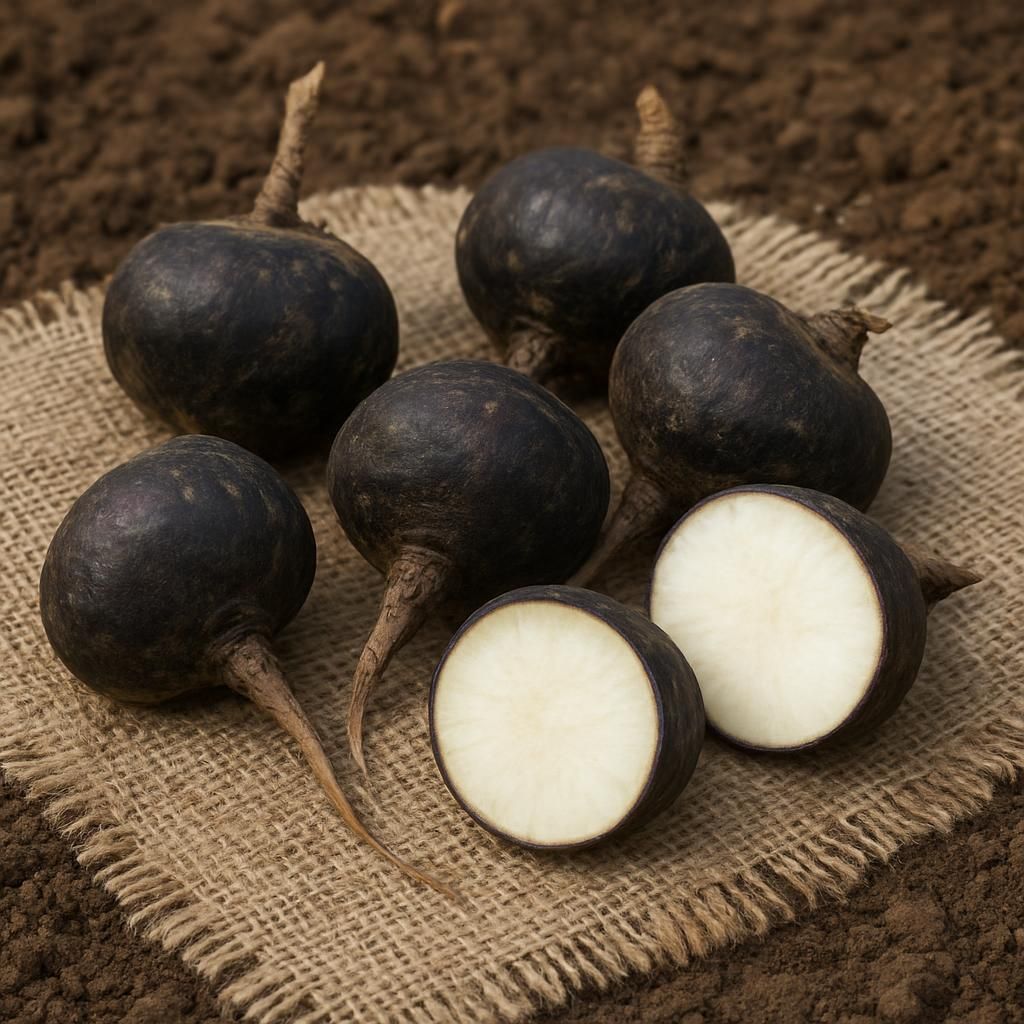
Introduction to Maca (Lepidium meyenii - Black)
Black Maca is a biennial herbaceous plant native to the high plateaus of the Peruvian and Bolivian Andes, where it has been cultivated for over 2,000 years. The black ecotype is distinguished by its dark-purple to nearly black hypocotyl and is favored for its purported adaptogenic properties and higher concentrations of bioactive macamides and macaenes. Commercial production remains concentrated above 3,800 m elevation, but interest in lower-altitude cultivation under controlled conditions continues to grow.
Botanical Profile of Maca (Lepidium meyenii - Black)
Lepidium meyenii belongs to the Brassicaceae family and produces a fleshy, turnip-like storage organ (hypocotyl) that develops underground. The black variety typically reaches 5–8 cm in diameter and develops a crisp, slightly nutty flavor when cooked. Above-ground growth consists of a basal rosette of pinnatifid leaves that rarely exceed 15 cm in length. Flowering occurs in the second year, producing small white to cream-colored racemes that set siliques containing numerous tiny seeds.
Soil, pH, and Climate Requirements for Maca (Lepidium meyenii - Black)
Maca demands cool temperatures, intense solar radiation, and well-drained, nutrient-poor soils typical of puna ecosystems. The following table summarizes ideal agronomic parameters:
| Parameter | Ideal Range | Notes |
|---|---|---|
| Soil Type | Sandy loam to loamy sand | High porosity prevents rot |
| Soil pH | 5.5–6.8 | Slightly acidic to neutral |
| Organic Matter | 1–3 % | Low fertility mimics native conditions |
| Altitude | 3,800–4,500 m | Below 3,200 m requires artificial chilling |
| Temperature (day) | 12–18 °C | Avoid prolonged >22 °C |
| Temperature (night) | 0–6 °C | Frost tolerance down to −5 °C |
| Annual Precipitation | 400–800 mm | Supplemental irrigation if <300 mm |
| Light | Full sun (≥2,000 µmol m⁻² s⁻¹) | UV-B intensity enhances secondary metabolites |
Step-by-Step Planting & Propagation
- Seed Selection & Treatment: Source certified virus-free seed of the black ecotype. Soak seeds for 12 hours in 1 % potassium nitrate to improve germination uniformity.
- Site Preparation: Till soil to 20 cm depth, incorporate 2–3 t ha⁻¹ aged compost, and create raised beds 30 cm high to ensure drainage.
- Sowing Window: Plant at the onset of the rainy season (October–November in the Southern Hemisphere) when soil temperature stabilizes above 8 °C.
- Seeding Rate & Depth: Broadcast or drill 8–10 kg ha⁻¹ at 0.5–1 cm depth; row spacing 30 cm, plant spacing 8–10 cm after thinning.
- Germination & Early Care: Maintain surface moisture for 10–14 days. Thin to final density of 80–100 plants m⁻² once seedlings reach the two-true-leaf stage.
Care & Maintenance regimes for Maca (Lepidium meyenii - Black)
Maca requires minimal intervention once established. The table below outlines seasonal inputs:
| Growth Stage | Irrigation Schedule | Fertilizer (NPK) | Pruning / Other Operations |
|---|---|---|---|
| Establishment (0–45 DAS) | Light overhead irrigation every 3 days | 20-10-10 at 40 kg N ha⁻¹ at 20 DAS | Weed by hand; no pruning |
| Vegetative (45–120 DAS) | 25–30 mm every 10–12 days | None; side-dress 15 kg N ha⁻¹ only if deficiency symptoms appear | Remove flower stalks to maximize root size |
| Pre-Harvest (120–180 DAS) | Reduce to 15 mm every 14 days | None | Hill soil around crowns if exposed |
Pests, Diseases & Organic Management
Black Maca is relatively resistant but can suffer from Aphids, Slugs, and Root-knot nematodes. Damping-off caused by Pythium is the primary seedling disease. Organic controls include:
- Neem oil (0.5 %) foliar sprays every 10 days for aphids.
- Copper hydroxide drenches at 2 g L⁻¹ for Pythium suppression.
- Solarization of beds for 4 weeks prior to planting to reduce nematode populations.
- Beer traps and diatomaceous earth barriers for slugs.
Harvesting, Curing & Optimal Storage
Harvest occurs 180–220 days after sowing when leaves begin to senesce. Lift roots carefully with a digging fork to avoid bruising. Air-dry in shade for 48 hours, then cure at 15–18 °C and 60–65 % RH for 10–14 days. Store cured roots in mesh bags at 4–8 °C with 70 % humidity; viability remains >90 % for 12 months. For fresh market, wash, grade by size, and pack in perforated crates at 0–2 °C.
Companion Planting for Maca (Lepidium meyenii - Black)
Maca benefits from intercropping with nitrogen-fixing Clover and Hairy vetch to improve soil nitrogen without excess fertility. Aromatic companions such as Thyme and Yarrow deter aphids and improve pollinator activity. Avoid planting near Potato or Tomato to reduce shared nematode and fungal pressures. Summer Companion Planting: 10 Organic Pairings to Boost Small Farm Resilience