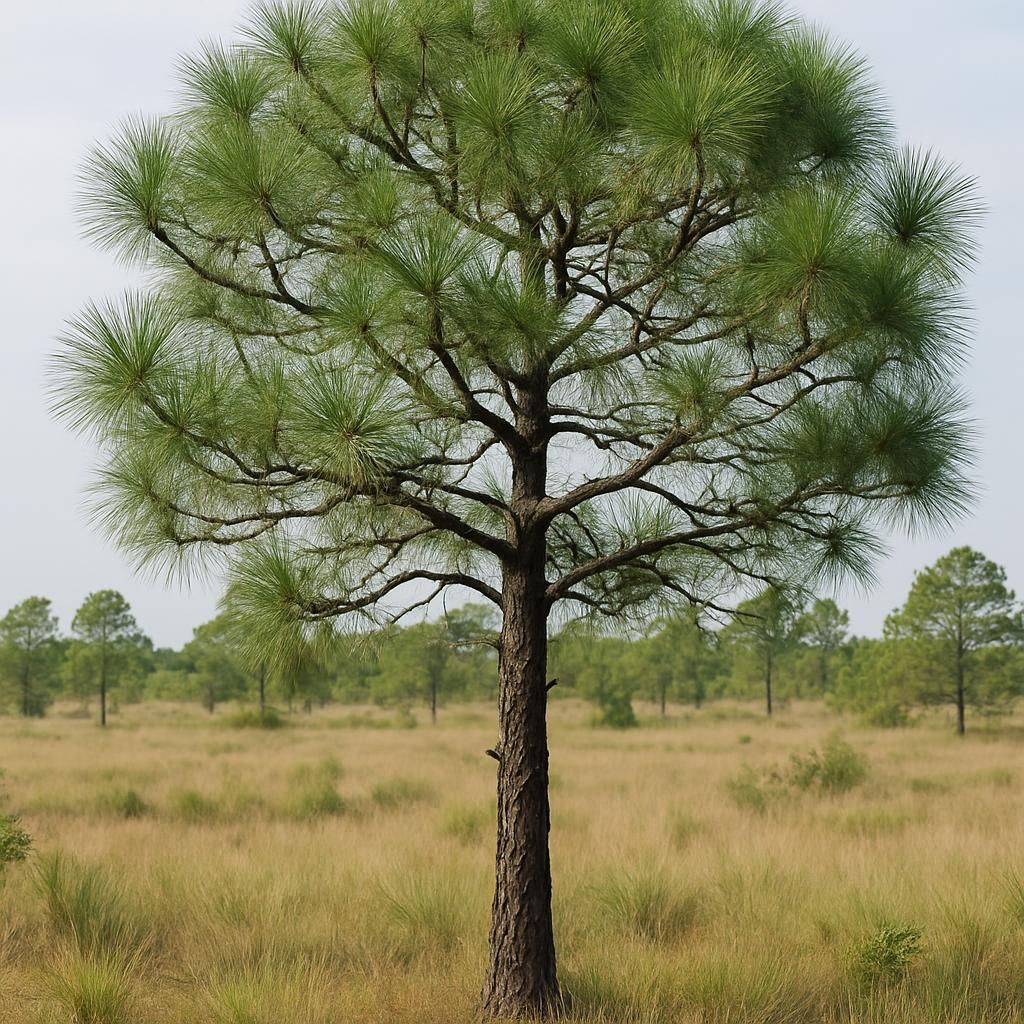
Introduction to longleaf pine
Longleaf pine (Pinus palustris) is a cornerstone species of the southeastern coastal plain, historically dominating millions of acres from Virginia to Texas. Its exceptional longevity—often exceeding 300 years—combined with straight, high-value timber and resin production has made it a priority for both commercial forestry and ecological restoration. The species is uniquely adapted to frequent low-intensity fire, which clears competing vegetation and promotes seedling establishment. Modern growers focus on restoring this iconic pine while producing high-grade lumber, poles, and naval stores.
Botanical Profile of longleaf pine
Longleaf pine belongs to the Pinaceae family and is distinguished by its exceptionally long needles (often 25–45 cm) arranged in fascicles of three. Seedlings undergo a distinctive “grass stage” lasting 3–7 years during which they develop a deep taproot and fire-resistant terminal bud while remaining only 15–30 cm tall. Mature trees reach 30–40 m in height with a straight, clear bole up to 20 m. Cones are large (15–25 cm), and seeds are heavy with a prominent wing. The species exhibits strong apical dominance and forms an open, park-like canopy when managed with prescribed fire.
Soil, pH, and Climate Requirements for longleaf pine (MUST INCLUDE A MARKDOWN TABLE OF IDEAL CONDITIONS)
Longleaf pine thrives on deep, well-drained sandy or loamy soils with low fertility but good aeration. It tolerates periodic drought once established but is sensitive to waterlogging and high water tables. The species prefers a warm, humid subtropical climate with 1,100–1,600 mm annual rainfall and mild winters. Fire frequency of 2–4 years is essential for long-term stand health.
| Parameter | Ideal Range | Notes |
|---|---|---|
| Soil Texture | Sand to sandy loam | Deep, well-drained; avoid heavy clays |
| Soil pH | 4.5 – 6.0 | Strongly to moderately acidic |
| Organic Matter | 1–3 % | Low fertility preferred; excess N harmful |
| Annual Rainfall | 1,100 – 1,600 mm | Evenly distributed; tolerates seasonal drought |
| Mean Annual Temperature | 15 – 22 °C | Frost-free period >200 days |
| Elevation | 0 – 200 m | Coastal plain and lower Piedmont |
| Fire Return Interval | 2 – 4 years | Low-intensity prescribed burns |
Step-by-Step Planting & Propagation
- Site Preparation: Conduct a prescribed burn or mechanical clearing 6–12 months before planting to reduce competition and woody debris.
- Seed Collection: Harvest mature cones in October–November when they turn brown; extract seeds by kiln drying at 40–45 °C.
- Stratification: Cold-stratify seeds at 2–5 °C for 30–60 days to break dormancy.
- Nursery Sowing: Sow stratified seeds in well-drained containers or bare-root beds at 1–2 cm depth in late winter.
- Seedling Care: Maintain 70–80 % shade for the first 4–6 weeks, then harden off. Seedlings reach grass-stage size (15–25 cm) in 12–18 months.
- Field Planting: Plant container or bare-root seedlings on a 2.4 × 2.4 m to 3 × 3 m spacing (1,100–1,700 stems/ha) during December–February when soils are moist.
- Initial Protection: Apply 1 m diameter vegetation control (herbicide or mulch) around each seedling and install tree shelters if deer pressure is high.
Care & Maintenance regimes for longleaf pine (MUST INCLUDE A MARKDOWN TABLE OF WATER, FERTILIZER, AND PRUNING SCHEDULES)
Young plantations require vegetation control and fire management. Once established, stands are maintained with periodic prescribed burns and selective thinning. Fertilization is rarely needed except on severely nutrient-deficient sites.
| Growth Stage | Watering | Fertilizer | Pruning / Thinning Schedule |
|---|---|---|---|
| Year 0–2 (Grass) | Supplemental only in extreme drought | None unless foliar N <1.2 %; 10–15 kg N/ha max | None; protect terminal bud |
| Year 3–7 (Height Growth) | Natural rainfall sufficient | 20–30 kg N/ha at age 4 if height <1 m | Thin to 600–800 stems/ha at age 7–10 |
| Year 8–20 (Pole) | None | None | Prune lower 1/3 of live crown at age 10–12; thin to 300–400 stems/ha |
| Year 20+ (Sawtimber) | None | None | Commercial thinning every 8–12 years; final harvest at 60–80 years |
Pests, Diseases & Organic Management
Longleaf pine is relatively resistant to many forest pests but can be affected by Southern pine beetle, Ips engraver beetles, and Nantucket pine tip moth. Fungal issues include brown spot needle blight and fusiform rust. Organic management emphasizes prescribed fire to reduce fuel loads and improve tree vigor, combined with sanitation thinning of infested trees. Beneficial nematodes and pheromone traps can be deployed against tip moth and bark beetles. Avoid planting on sites with known Phytophthora cinnamomi presence.
Harvesting, Curing & Optimal Storage
Commercial harvest occurs at 35–80 years depending on product goals (poles, sawtimber, or resin). Trees are felled using directional felling to minimize damage to residuals. Logs should be limbed immediately and transported within 2–4 weeks to prevent blue-stain fungi. For resin production, faces are worked for 8–12 years before trees are harvested. Air-dry lumber to 12–15 % moisture content under covered sheds for 60–90 days. Store seeds at 2–5 °C and 6–8 % moisture in sealed containers for up to 5 years.
Companion Planting for longleaf pine
Longleaf pine savannas naturally support a diverse understory of wiregrass, bluestem grasses, and forbs. In managed systems, compatible companions include Clover and Hairy vetch for nitrogen fixation during early establishment, and Thyme or Yarrow to support beneficial insects. Avoid planting aggressive woody competitors such as sweetgum or yaupon holly. Maintain 30–50 % canopy openness to sustain understory biodiversity and wildlife habitat.