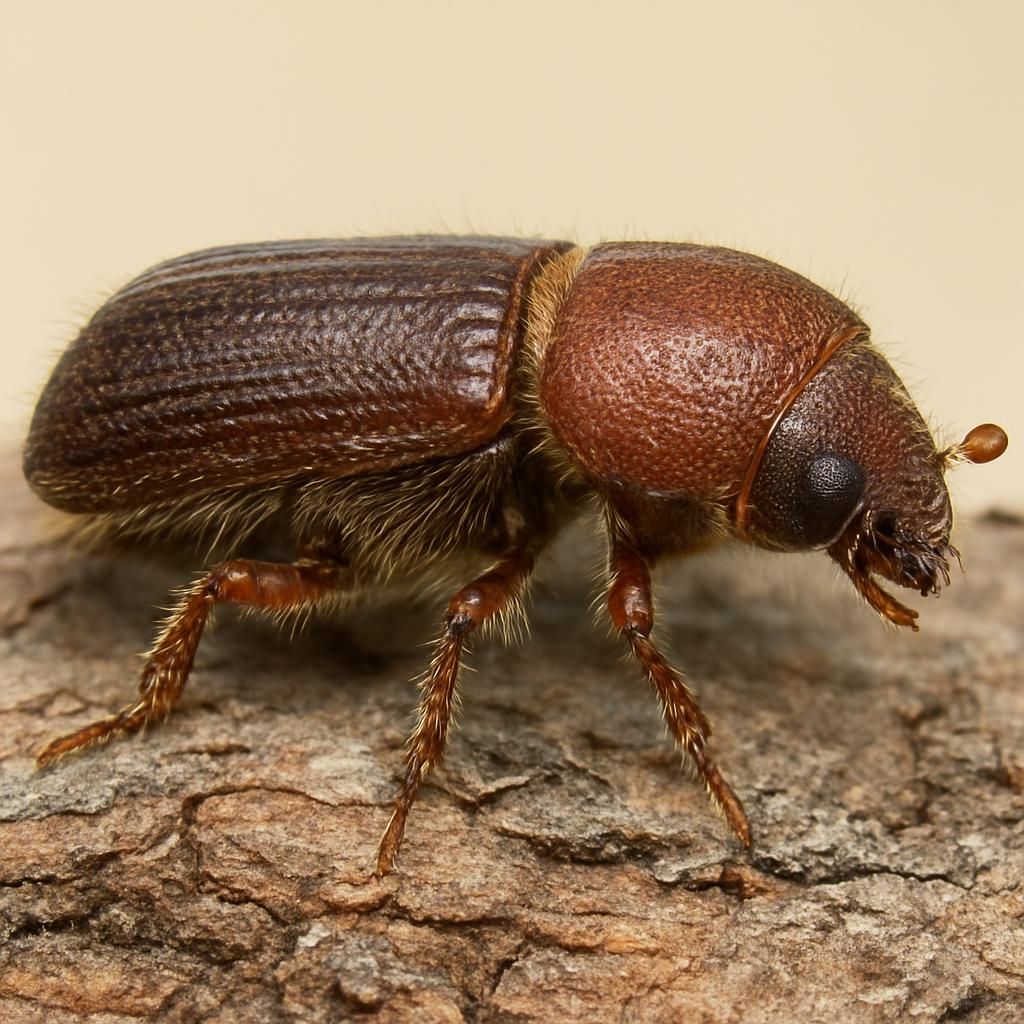
Introduction to Ips engraver beetles
Ips engraver beetles (Ips spp.) are small, cylindrical bark beetles belonging to the family Curculionidae, subfamily Scolytinae. Several species occur across North America and Europe, with the most economically important being Ips pini (pine engraver), Ips grandicollis (eastern fivespined ips), and Ips calligraphus (sixspined ips). These beetles primarily target pine, spruce, fir, and other conifers that are already stressed by drought, lightning, mechanical injury, or recent thinning operations. Unlike some ambrosia beetles, Ips species feed directly on the phloem and cambium layers, creating winding galleries that girdle the tree and interrupt the flow of water and nutrients.
Adult beetles are typically 3–6 mm long, reddish-brown to black, and possess a pronounced rear declivity with spines that distinguish them from other bark beetles. They are strong fliers and can disperse several kilometers in search of suitable hosts. Because they often colonize slash, wind-thrown, or recently dead material before moving to standing trees, Ips engraver beetles frequently cause secondary mortality in forest stands already weakened by environmental stress.
Identifying Symptoms & Damage
The first visible sign of an Ips attack is usually fading foliage that progresses from green to yellow-green and finally to reddish-brown within weeks. Pitch tubes—small masses of resin mixed with boring dust—may appear at entry holes on the trunk, although these are often smaller and less conspicuous than those produced by southern pine beetle. Under the bark, adult beetles and larvae create distinctive, radiating galleries that resemble an engraving pattern, hence the common name. These galleries are free of frass once abandoned and are usually accompanied by blue-stain fungi that further block vascular tissue.
Sawdust-like frass accumulates in bark crevices and at the base of infested trees. Woodpecker activity and flaking bark are secondary indicators as birds search for larvae. In advanced infestations, entire branches or the upper crown may die first, creating a “top-down” mortality pattern typical of Ips species. Early detection is critical because once beetles have established brood galleries, tree mortality is almost certain.
Lifecycle and Progression of Ips engraver beetles
Ips engraver beetles complete multiple generations per year depending on climate and elevation. In the southern United States, three to six generations are possible, while northern populations may produce only one or two. The lifecycle begins when adults emerge from overwintering sites in the bark or duff and fly to new hosts. Females select suitable material, bore through the bark, and construct a nuptial chamber where they mate with one or more males.
| Lifecycle Stage | Description | Duration | Key Conditions |
|---|---|---|---|
| Adult emergence & dispersal | Overwintered adults fly to stressed trees or fresh slash | 1–3 days flight | Temperatures >15 °C, low wind |
| Gallery construction & mating | Females create egg galleries; males join and remove frass | 3–10 days | Phloem moisture 40–60 % |
| Egg laying | Females deposit eggs in niches along gallery walls | 5–14 days | Optimal 20–30 °C |
| Larval feeding | Larvae mine perpendicular to egg gallery, feeding on phloem | 2–4 weeks | High phloem nutrition |
| Pupation | Larvae form pupal cells in outer bark or sapwood | 7–14 days | Moderate humidity |
| New adult emergence | Teneral adults feed briefly before dispersal flight | 1–2 weeks | Requires accumulated degree days |
Environmental Triggers & Risk Factors
Outbreaks of Ips engraver beetles are strongly linked to host stress. Prolonged drought reduces oleoresin flow, allowing beetles to overcome tree defenses more easily. Thunderstorms and ice storms create abundant breeding material in the form of broken tops and wind-thrown stems. Silvicultural practices such as thinning during beetle flight periods or leaving large quantities of slash on site also elevate risk. Stands with high basal area, poor site quality, or recent defoliation by other insects are particularly susceptible. Temperature and humidity influence flight activity; peak dispersal occurs on warm afternoons when maximum daily temperatures exceed 18 °C.
Organic Control & Treatment Plans
Effective management relies on sanitation, cultural practices, and targeted interventions. Because Ips engraver beetles reproduce rapidly in slash, prompt removal or chipping of infested material is the cornerstone of control. Trap trees treated with approved insecticides or solarized under clear plastic can concentrate and destroy emerging adults. Natural enemies including clerid beetles, parasitic wasps, and woodpeckers provide some biological suppression but rarely prevent outbreaks on their own.
| Treatment Option | Frequency | Application Window | Notes |
|---|---|---|---|
| Sanitation harvest & slash removal | Once per generation | Immediately after detection | Chip or burn material >10 cm diameter |
| Trap trees (insecticide-treated) | 1–2 per 10 ha | Early spring & mid-summer | Use systemic or contact insecticide per label |
| Pheromone-baited funnel traps | Weekly monitoring | Flight periods | Place 10–15 m outside stand edges |
| Solarization of slash piles | Single treatment | Peak summer heat | Cover with 6-mil plastic for 8–10 weeks |
| Promote stand vigor via thinning | Every 5–10 years | Dormant season | Reduce basal area to site-appropriate levels |
| Conservation of natural enemies | Ongoing | Year-round | Avoid broad-spectrum sprays during natural enemy activity |
Preventing Ips engraver beetles in the Future
Long-term prevention centers on maintaining healthy, vigorous stands. Select site-adapted species and provenances, avoid planting on marginal sites, and implement timely thinning to reduce competition. Schedule harvesting operations outside peak beetle flight windows and process or remove slash within two weeks of cutting. Maintain buffer zones of non-host species around high-value stands and monitor for early signs of stress such as crown thinning or needle discoloration. Diversifying age classes and species composition reduces the likelihood of widespread outbreaks.
Crops Most Affected by Ips engraver beetles
While primarily a forest pest, Ips engraver beetles can impact commercial Pine plantations, Christmas tree farms, and occasionally ornamental conifers in landscapes. Species such as loblolly, slash, shortleaf, and Virginia pine are highly preferred hosts. In mixed stands, Spruce and true firs may also be attacked when populations are high. Damage to fruit or vegetable crops is negligible, but loss of windbreaks or shelterbelts can indirectly affect Apple, Peach, and Grapes plantings by altering microclimate and increasing wind damage.
For more detailed species-level identification and regional management recommendations, consult the Wikipedia page on Ips (beetle).
Learn practical strategies for maintaining stand resilience after weather events in The Truth About Weather Patterns and Small Farm Resilience.