Introduction to fusiform rust
Fusiform rust, caused by the fungus Cronartium quercuum f. sp. fusiforme, is one of the most economically significant diseases of pine species in the southeastern United States. It primarily infects loblolly pine (Pinus taeda) and slash pine (Pinus elliottii), though longleaf and shortleaf pines can also be affected. The disease produces characteristic spindle-shaped galls that disrupt vascular tissue, leading to reduced growth rates, stem breakage, and mortality in young plantations. Because the pathogen requires both pine and oak hosts to complete its lifecycle, management strategies must address both the primary conifer hosts and alternate oak reservoirs. The economic impact is substantial, with annual losses in the timber industry estimated in the hundreds of millions of dollars.
Identifying Symptoms & Damage
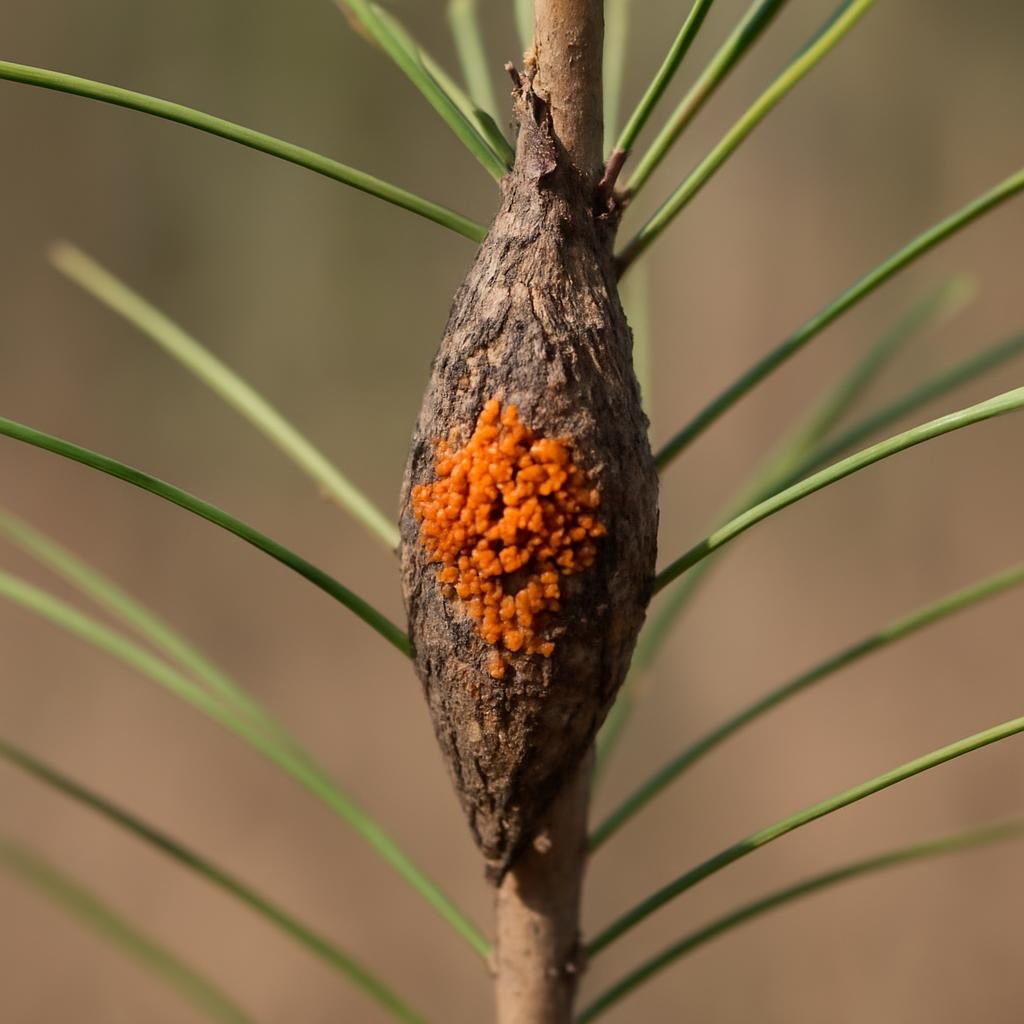
The most diagnostic symptom of fusiform rust is the formation of elongated, spindle-shaped galls on stems and branches of infected pines. These galls typically appear within the first five years of tree growth and can range from a few centimeters to over a meter in length. During spring, bright orange aecia rupture through the bark of active galls, releasing masses of powdery spores. In advanced infections, galls may girdle the stem, causing top dieback or complete tree mortality. On the oak alternate host, symptoms are less conspicuous and consist of small, orange uredinia and telia on the undersides of leaves. Damage assessment should include counting galled trees per acre, measuring gall size, and evaluating the proportion of trees showing stem breakage or reduced height growth.
Lifecycle and Progression of fusiform rust (MUST INCLUDE A MARKDOWN TABLE OF LIFECYCLE STAGES)
The lifecycle of fusiform rust is heteroecious, requiring both pine and oak hosts. Spores produced on pines infect oak foliage in spring, while spores produced on oaks reinfect pines the following year. Understanding each stage is critical for timing cultural and chemical interventions.
| Stage | Host | Timing | Description |
|---|---|---|---|
| Aeciospore production | Pine | March–May | Bright orange aecia form on galls; wind-dispersed spores infect oak leaves |
| Uredinial stage | Oak | April–June | Small orange pustules on leaf undersides produce urediniospores for secondary spread |
| Telial stage | Oak | June–August | Brown telia develop; produce basidiospores that infect pine needles and succulent shoots |
| Basidiospore infection | Pine | April–June | Basidiospores germinate on pine needles and young stems, initiating new galls |
| Gall development | Pine | Year-round | Galls enlarge over multiple seasons; new aecia form each spring on active galls |
Environmental Triggers & Risk Factors
Fusiform rust epidemics are strongly influenced by weather patterns and stand conditions. High humidity and temperatures between 15–25 °C during the spring basidiospore release period favor infection. Stands located within 400 meters of oak-dominated hardwood edges experience elevated disease pressure because of increased inoculum. Young plantations (ages 1–8 years) are most susceptible, particularly when trees have been planted at high densities that promote succulent growth. Soil fertility, especially nitrogen availability, can increase host susceptibility by promoting rapid shoot elongation. Climate change projections suggest that warmer, wetter springs in the Southeast may expand the geographic range and severity of outbreaks.
Organic Control & Treatment Plans (MUST INCLUDE A MARKDOWN TABLE OF TREATMENT OPTIONS AND FREQUENCIES)
Organic management of fusiform rust focuses on cultural practices and biological agents because synthetic fungicides are rarely economical in forestry. Pruning galled branches before aecial rupture, removing nearby oak reservoirs, and planting resistant pine genotypes are the primary strategies. Biological control agents such as Trichoderma spp. applied to pruning wounds may reduce secondary infections. No curative organic sprays exist for established galls; therefore, prevention through resistant stock and sanitation remains the cornerstone of management.
| Treatment Option | Application Method | Frequency | Notes |
|---|---|---|---|
| Resistant pine seedlings | Planting | At establishment | Use families rated <10% infection in regional trials |
| Pruning galled branches | Hand or pole saw | Annually in winter | Remove galls before March to prevent aeciospore release |
| Oak reservoir reduction | Selective removal | Every 3–5 years | Maintain 400 m buffer from pine plantations |
| Trichoderma wound treatment | Brush or spray | Immediately after pruning | Apply to fresh wounds to suppress secondary fungi |
| Mulch and weed control | Ground cover | Seasonally | Reduce competition and maintain tree vigor |
Preventing fusiform rust in the Future
Long-term prevention requires an integrated approach combining genetics, silviculture, and landscape planning. Forest managers should select planting stock from breeding programs that have demonstrated stable resistance across multiple environments. Site preparation that minimizes oak stump sprouts and maintains adequate spacing reduces both inoculum and host susceptibility. Monitoring programs using aerial surveys and ground scouting allow early detection of new infection centers. Diversifying species composition by interplanting longleaf pine or other less-susceptible conifers can lower overall stand risk. Finally, maintaining records of infection rates by family and site helps refine future planting decisions.
Crops Most Affected by fusiform rust
While fusiform rust is primarily a disease of southern yellow pines, related rust fungi affect other conifers and hardwoods. Loblolly pine and slash pine are the most severely impacted commercial species. Longleaf pine shows moderate susceptibility, whereas shortleaf pine and Virginia pine are less commonly infected. Among hardwoods, various oak species serve as essential alternate hosts but rarely suffer economic damage. No vegetable, fruit, or grain crops are known to be affected by this specific rust pathogen.