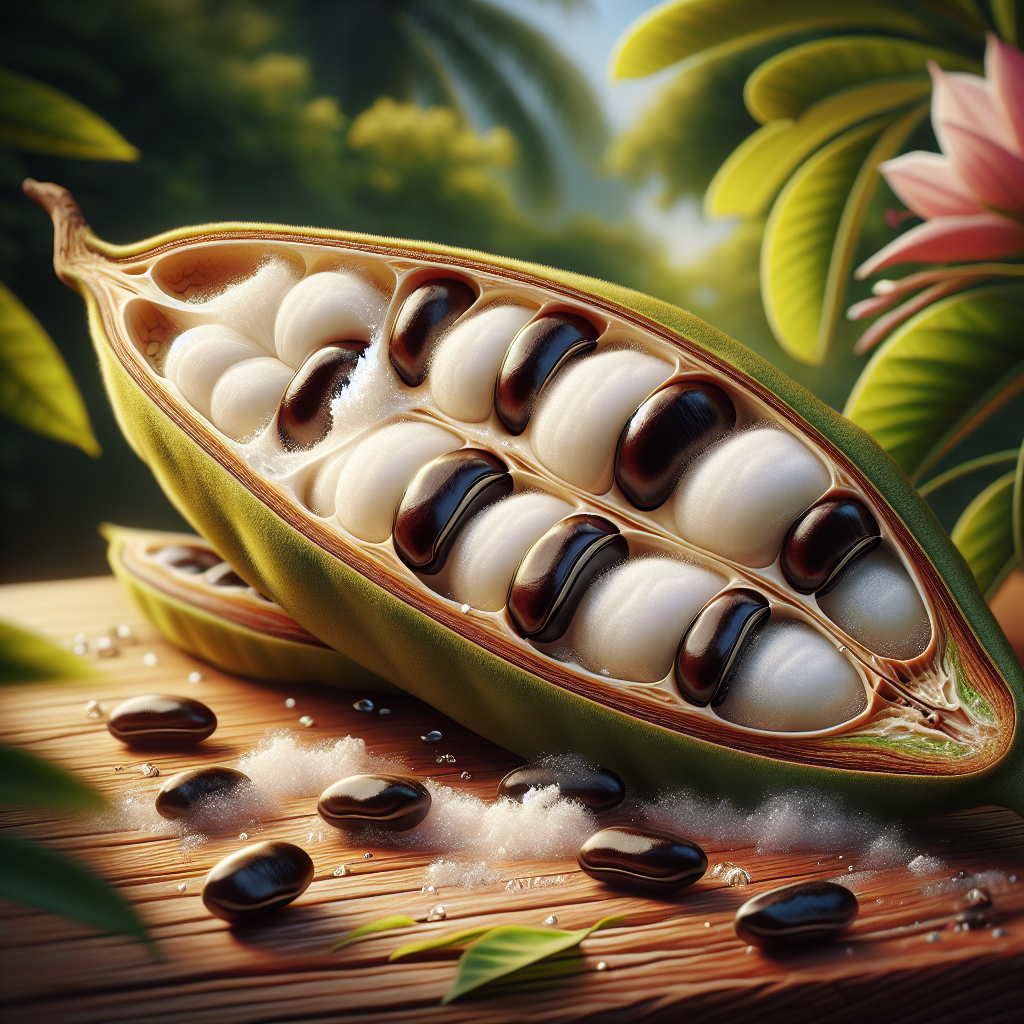
Introduction to Ice Cream Bean (Inga feuilleei)
Ice Cream Bean, scientifically known as Inga feuilleei, is a tropical legume tree renowned for its large, curved pods filled with sweet, fluffy white pulp that earned it its whimsical name. Native to the lowland rainforests of Central and South America, from Mexico to northern Argentina, this tree has been cultivated for centuries by indigenous peoples for food, medicine, and soil improvement. The pods, ripening to 2-4 feet long, contain seeds encased in a creamy aril that tastes remarkably like vanilla ice cream—sweet, juicy, and mildly acidic with a custardy texture.
In modern agroforestry, Ice Cream Bean stands out as a multipurpose crop. It fixes atmospheric nitrogen through symbiotic bacteria in its roots, enhancing soil fertility for intercropped plants like coffee, cacao, or banana. Trees can reach 50-60 feet tall but are often pruned to 20-30 feet for manageability and harvest access. Yields peak at 100-200 pods per mature tree annually, providing a low-maintenance source of fresh produce, livestock fodder, and even timber. For small farms, check out this Fall Companion Planting Guide: Boost Yields and Soil Health for Small Farms and Gardens for integrating it into diverse systems.
Beyond pods, the tree's bipinnate leaves and pinkish flowers attract pollinators, supporting biodiversity. It's drought-tolerant once established but excels in humid conditions, making it ideal for permaculture, reforestation, and backyard orchards in USDA zones 10-12 or equivalent tropical climates. Challenges include pod pests and overwatering, but with proper care, it delivers year-round harvests after 3-5 years.
Botanical Profile of Ice Cream Bean (Inga feuilleei)
Inga feuilleei belongs to the Fabaceae family (legumes), subfamily Mimosoideae, genus Inga with over 300 species. It's a fast-growing, evergreen tree reaching 15-20 meters (50-65 feet) in height with a straight trunk up to 50 cm diameter and a broad, umbrella-shaped canopy spanning 10-15 meters. Bark is smooth, grayish-brown, often used in traditional dyes.
Leaves are alternate, bipinnate to tripinnate, 15-30 cm long with 4-6 pairs of leaflets each 3-8 cm, glossy green above, paler below. New growth flushes reddish. Flowers emerge in dense, bottlebrush-like spikes, 3-5 cm long, creamy-white to pinkish, fragrant, blooming year-round in tropics but peaking in dry seasons. Pollinated by bees and bats, they give way to straight or curved pods 20-100 cm long, 2-5 cm wide, green turning brown-black at maturity.
Pods contain 10-40 flat, lens-shaped seeds (1-3 cm) embedded in sweet, white, cottony aril comprising 70-80% of pulp weight. Seeds are edible when young but harden later, used for necklaces or propagation. Roots form nitrogen-fixing nodules, with deep taproots accessing groundwater. Phenology: vegetative growth rapid (1-2 m/year), first pods at 2-3 years from seed, full production by 5-7 years. Wood is lightweight, used for furniture and fuel.
Soil, pH, and Climate Requirements for Ice Cream Bean (Inga feuilleei)
Ice Cream Bean thrives in fertile, well-drained loamy soils rich in organic matter, tolerating clays and sands but avoiding heavy waterlogging. Optimal pH is 5.5-7.0, slightly acidic to neutral; it adapts to 4.5-8.0 but growth slows outside 6.0-6.5. Incorporate compost or aged manure pre-planting to boost microbial activity and nitrogen fixation.
Climatically, it's a tropical lowland species requiring average temperatures of 22-30°C (72-86°F), with minimums above 10°C (50°F) to avoid chill damage. Annual rainfall of 1200-2500 mm is ideal, evenly distributed; it endures short dry spells up to 4-6 months via deep roots but benefits from mulching. Full sun to light shade suits it—agroforestry under taller canopies like native hardwoods works well. Humidity above 60% prevents leaf scorch; wind protection is key for young trees.
Soil preparation: test for nutrients, amend with lime if pH <5.5, ensure drainage via raised beds or mounds in high-rain areas. Avoid saline soils (>2 dS/m). In suboptimal sites, inoculate seeds/seedlings with Rhizobium bacteria for enhanced N-fixation, yielding 100-200 kg N/ha/year.
Step-by-Step Planting & Propagation
Propagation Methods
- Seeds (Primary Method): Harvest ripe pods, extract seeds, sow fresh (viability drops after 1-2 weeks). Scarify by nicking seed coat or soak in hot water (80°C) 24 hours. Germination 70-90% in 7-14 days.
- Cuttings: Semi-hardwood 20-30 cm, root in mist with IBA hormone, 40-60% success.
- Air-layering/Grafting: For superior varieties, 80% success on established trees.
Planting Steps
- Site Selection: Sunny, sheltered spot with deep soil.
- Seed Starting: Sow 2-3 seeds/pot in 1:1:1 sand-compost-perlite, 1 cm deep, 25-30°C. Thin to strongest seedling at 10 cm.
- Transplanting: At 30-50 cm (3-6 months), space 6-10 m apart (100-300 trees/ha). Dig 50x50x50 cm holes, mix soil with 5-10 kg compost + 100g rock phosphate.
- Planting: Place root ball level, water deeply, mulch 10 cm thick with leaves/wood chips.
- Inoculation: Dust roots with commercial Rhizobium/ Mycorrhizae mix.
Initial care: shade cloth 50% for 1-2 months, irrigate weekly until established. Prune lower branches for straight bole.
Care & Maintenance regimes for Ice Cream Bean (Inga feuilleei)
Watering: Deeply but infrequently post-establishment; 20-40 L/tree/week in dry periods. Mulch conserves moisture. Fertilization: Minimal—N-fixer needs P/K. Apply 100-200g NPK 10-30-10/tree/year 1-3, then organic only. Pruning: Annual formative prune to 3-4 m trunk, remove deadwood. Coppice for fodder. Weeding: Mulch suppresses; hand-pull competitors. Irrigation Systems: Drip for orchards, ensuring no trunk wetting.
Monitor growth: 1-2 m/year height. Thin canopy for light penetration. In agroforestry, pair with shade-tolerant crops. For heat stress, see Why Summer Heatwaves Are Silently Killing Small Farm Yields - And 7 Organic Strategies to Fight Back—Ice Cream Bean mulch excels here.
Pests, Diseases & Organic Management
Pests:
- Aphids: Neem oil sprays, ladybugs.
- Mealybugs: Alcohol dips, predatory beetles.
- Pod borers (larvae tunnel pods): Bt kurstaki, sanitation.
- Leafhoppers: Reflective mulches, insecticidal soap.
- Fruit flies: Bait traps with protein hydrolysate.
Diseases:
- Root rot (Phytophthora): Improve drainage, fungichromin.
- Powdery mildew: Sulfur sprays, airflow.
- Anthracnose: Copper fungicide, prune infected parts.
- Bacterial leaf spot: Remove debris, avoid overhead water.
Organic IPM: Scout weekly, use traps, encourage birds. Companion with marigold for nematodes. Read Why 90% of Small Farms Fail at Pest Management - And 8 Organic Fixes That Actually Work for protocols.
Harvesting, Curing & Optimal Storage
Harvest when pods turn dark brown, rattle (seeds mature), 6-8 months post-bloom. Twist or cut with pruners; yield 20-50 kg/tree mature. Avoid ground drops to prevent rot.
Processing: Split pods lengthwise, scoop aril (discard tough seeds or boil young). Fresh pulp eaten raw; refrigerate 3-5 days. Juice, smoothies, desserts. Dry pulp for powder (dehydrate 50°C, grind).
Storage: Pods 1-2 weeks cool (10-15°C), high humidity. Pulp freezes 6-12 months. Seeds viable 1 month dry, 80% at 4°C.
Market fresh or processed; high demand in ethnic markets.
Companion Planting for Ice Cream Bean (Inga feuilleei)
Leverage nitrogen fixation: underplant coffee, cacao, banana, cassava. Shade reduces understory stress. Avoid grasses competing roots.
Benefits: Pods feed poultry, leaves mulch. With gliricidia for biomass. See Why Companion Planting Feels Like Guesswork for Small Farms - And How AI Makes It Foolproof.