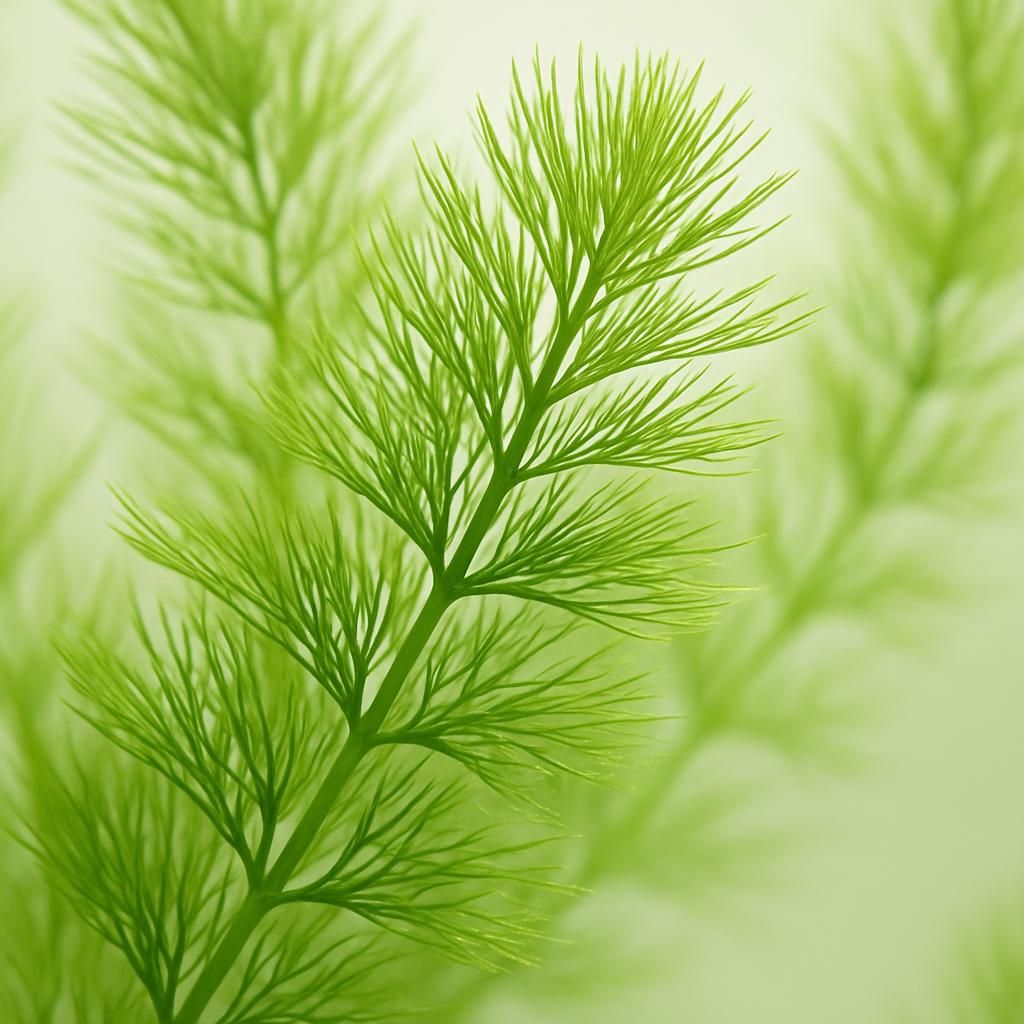
Introduction to Hornwort
Hornwort (Ceratophyllum demersum) is a cosmopolitan, rootless submerged macrophyte valued for its rapid biomass accumulation and exceptional ability to absorb dissolved nutrients such as nitrogen and phosphorus. In commercial and research settings, it is cultivated in constructed wetlands, raceway systems, and high-density pond culture to improve water quality, provide oxygenation, and serve as a renewable source of green biomass for composting or animal feed. Its whorled, needle-like foliage creates dense underwater canopies that support diverse aquatic communities while suppressing algal blooms through light competition and allelopathy.
Professional growers select Hornwort for its tolerance to a wide range of water chemistries and its capacity for vegetative propagation from simple stem cuttings. Because it lacks true roots, it obtains all nutrients directly from the water column, making it an ideal candidate for integrated multi-trophic aquaculture and phytoremediation systems. This guide delivers agronomic best practices drawn from controlled-environment trials and commercial pond operations.
Botanical Profile of Hornwort
Ceratophyllum demersum belongs to the family Ceratophyllaceae. The plant produces slender, branching stems that can reach 1–3 meters in length under optimal conditions. Leaves occur in whorls of 6–12, each divided into 2–4 linear segments with minute serrations. Small, sessile flowers are produced underwater; pollination occurs via water currents. The species is monoecious and produces achene-like fruits containing a single seed, although vegetative reproduction from stem fragments dominates in cultivation.
Hornwort exhibits apical dominance, with new lateral shoots emerging when the main stem is pruned. Its chloroplasts are adapted to low-light aquatic environments, allowing photosynthesis at depths up to 4 meters. The plant stores starch in specialized parenchyma cells, providing energy reserves during short-term nutrient or light limitation.
Soil, pH, and Climate Requirements for Hornwort
Hornwort does not require traditional soil; instead, it is grown in water columns enriched with dissolved nutrients. Ideal conditions are summarized below.
| Parameter | Ideal Range | Notes |
|---|---|---|
| pH | 6.5–8.0 | Tolerates 5.5–9.0 with reduced growth |
| Temperature | 18–28 °C | Growth slows below 12 °C or above 32 °C |
| Light | 200–600 µmol m⁻² s⁻¹ PAR | Full sun to partial shade in ponds |
| Electrical Conductivity | 200–800 µS cm⁻¹ | Higher salinity reduces biomass yield |
| Dissolved Oxygen | >5 mg L⁻¹ | Aeration recommended in dense cultures |
| Nutrient (N) | 5–20 mg L⁻¹ NO₃-N | Excess promotes algal competition |
| Nutrient (P) | 0.5–3 mg L⁻¹ PO₄-P | Monitor to prevent eutrophication |
Step-by-Step Planting & Propagation
- Source clean, disease-free stock plants from certified nurseries or existing cultures.
- Prepare propagation tanks or pond sections with filtered water at 22 °C and moderate aeration.
- Cut healthy apical stems into 10–15 cm segments, removing any decaying tissue.
- Float cuttings on the surface for 24 hours to allow wound healing and initial root hair formation.
- Submerge cuttings at 30–50 cm depth using weighted lines or floating rafts; maintain 10–15 cm spacing.
- Provide gentle water flow (0.1–0.3 m s⁻¹) to prevent sediment accumulation on foliage.
- Monitor for new lateral shoots within 7–10 days; thin to final density of 20–30 stems m⁻² after 3 weeks.
Care & Maintenance regimes for Hornwort
Consistent water chemistry and biomass control are essential for sustained productivity.
| Task | Frequency | Details |
|---|---|---|
| Water Exchange | 10–20 % weekly | Replace with nutrient-balanced source water to maintain N and P targets |
| Fertilizer | Continuous | Drip or pulse-feed 10-5-15 NPK at 2–5 mg L⁻¹ N; adjust based on uptake |
| Pruning / Harvest | Every 14–21 days | Remove top 30 cm to stimulate branching and maintain light penetration |
| pH Monitoring | Daily | Adjust with agricultural lime or CO₂ injection as needed |
| Temperature Control | Seasonal | Shade cloth or heaters to keep within 18–28 °C range |
Pests, Diseases & Organic Management
Although Hornwort is relatively resistant, several issues can reduce yield. Aphids and snails may colonize dense stands. Spider mites occasionally appear on emergent tips in low-humidity greenhouses. Fungal infections such as Pythium can cause basal decay in stagnant water. Organic management includes introducing predatory fish (Gambusia), manual removal of snails, and maintaining dissolved oxygen above 6 mg L⁻¹ to suppress anaerobic pathogens. Copper-based algaecides are avoided; instead, barley straw extract provides mild allelopathic suppression of competing algae.
Harvesting, Curing & Optimal Storage
Harvest when biomass reaches 1.5–2 kg fresh weight m⁻². Use fine-mesh nets or mechanical harvesters to collect floating mats. Rinse gently with clean water to remove debris and epiphytes. For fresh use in aquaculture feed, store at 4 °C for up to 7 days. For composting or drying, spread in thin layers under shade with forced air at 25 °C until moisture drops below 12 %. Vacuum-seal dried material in UV-opaque bags for 12-month shelf life.
Companion Planting for Hornwort
Hornwort pairs effectively with floating species such as Water Lettuce and Water Hyacinth to create layered canopies that maximize nutrient uptake. In pond systems it is often grown alongside Rice in shallow margins where stems provide structural support and oxygenation for rice roots. In constructed wetlands it complements Cattail and Bulrush to enhance total nitrogen removal efficiency.
Water Lettuce improves surface shading while Hornwort oxygenates deeper zones. Rice benefits from the additional dissolved oxygen and reduced algal competition. These pairings increase overall system resilience and biomass output per unit area.