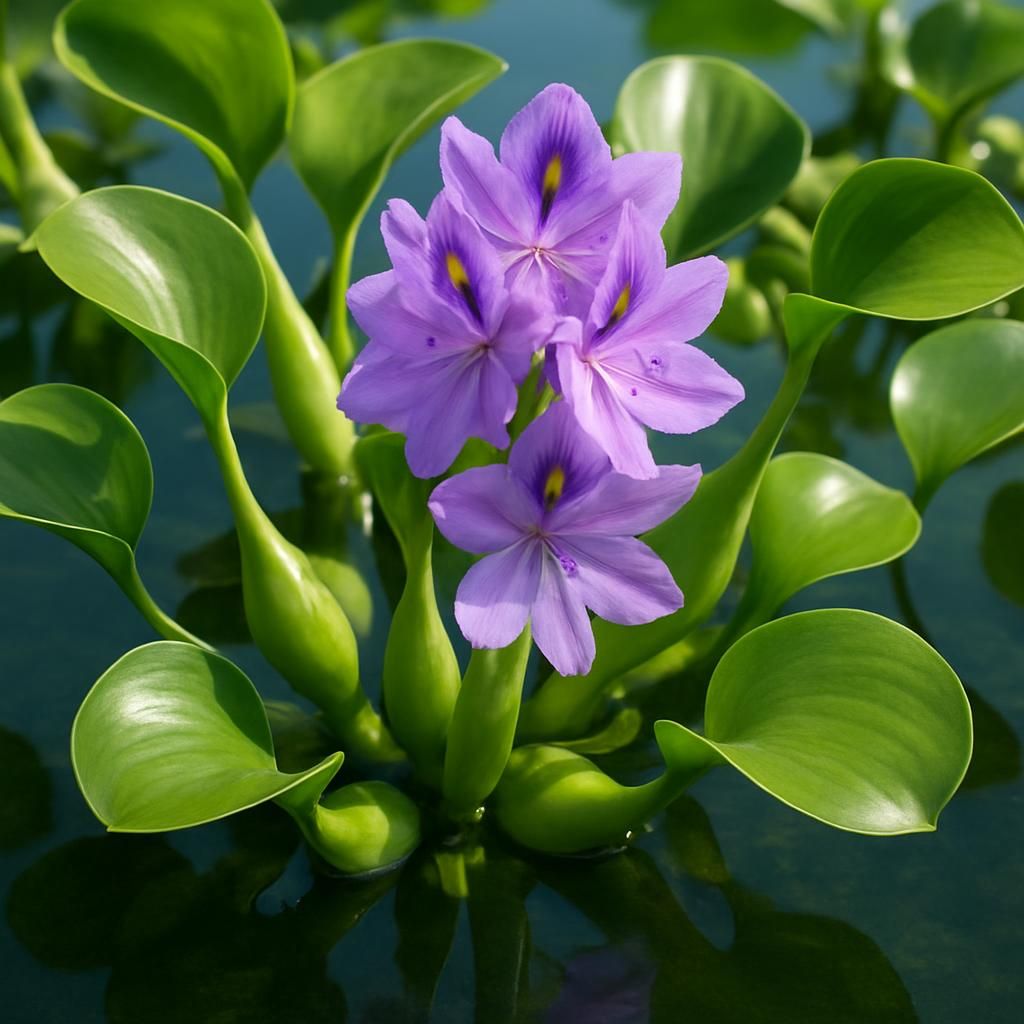
Introduction to Water Hyacinth
Water Hyacinth (Eichhornia crassipes) is a free-floating perennial aquatic plant native to the Amazon basin but now cultivated worldwide in managed ponds, lagoons, and constructed wetlands. Known for its striking lavender flowers and glossy bulbous leaves, it serves multiple agricultural and environmental functions including phytoremediation, livestock fodder, and organic fertilizer production. Professional growers value its rapid growth cycle and ability to absorb excess nutrients from water bodies, making it a cornerstone species in integrated aquatic farming systems.
Botanical Profile of Water Hyacinth
Water Hyacinth belongs to the Pontederiaceae family and exhibits a rosette growth habit with thick, glossy, dark-green leaves supported by inflated petioles that provide buoyancy. The plant produces showy spikes of light-purple flowers with a yellow central spot, typically blooming in warm months. Its extensive fibrous root system hangs beneath the water surface, efficiently extracting nitrogen, phosphorus, and heavy metals. Under optimal conditions, Water Hyacinth can double its biomass in as little as 6–15 days, making it one of the fastest-growing plants on Earth.
Soil, pH, and Climate Requirements for Water Hyacinth
Although Water Hyacinth is a floating plant that does not require traditional soil, it thrives in nutrient-rich, still or slow-moving freshwater bodies. The following table summarizes ideal growing conditions:
| Parameter | Ideal Range | Notes |
|---|---|---|
| Water pH | 6.5 – 7.5 | Slightly neutral conditions optimize uptake |
| Water Temperature | 20 – 32 °C | Growth slows below 15 °C and above 35 °C |
| Nutrient Level | High N & P | Requires consistent fertilization in culture |
| Light | Full sun (6+ hours) | Partial shade reduces flowering |
| Salinity | < 0.5 ppt | Sensitive to brackish conditions |
| Water Depth | 15 – 60 cm | Deeper water supports larger biomass |
Step-by-Step Planting & Propagation
- Select healthy mother plants free of visible pests or disease.
- Divide mature plants by separating daughter rosettes with intact roots.
- Place divisions on the water surface at a density of 5–10 plants per square meter initially.
- Maintain stable water levels and introduce a balanced liquid fertilizer (NPK 10-10-10) at 50 ppm nitrogen.
- Monitor daily for the first week to ensure plants remain upright and roots develop new laterals.
Care & Maintenance regimes for Water Hyacinth
Consistent nutrient management and periodic biomass removal are essential to prevent overcrowding. The table below outlines recommended schedules:
| Task | Frequency | Details |
|---|---|---|
| Water Top-up | Weekly | Replace 10–15 % volume with fresh water |
| Fertilizer | Every 14 days | Apply 20 ppm N liquid fertilizer |
| Pruning | Every 21–28 days | Remove 30 % biomass to maintain open water |
| pH Monitoring | Twice weekly | Adjust with agricultural lime if below 6.0 |
Pests, Diseases & Organic Management
Common issues include Aphids, Spider mites, and fungal leaf spots. Implement integrated pest management by introducing beneficial insects such as lady beetles and maintaining proper plant spacing to improve air circulation. Neem oil sprays at 0.5 % concentration provide effective organic control without harming aquatic life when applied in the evening.
Harvesting, Curing & Optimal Storage
Harvest mature plants by skimming with fine-mesh nets when biomass reaches 80–100 kg per square meter. Rinse thoroughly to remove debris, then sun-dry on raised racks for 48–72 hours until moisture content drops below 15 %. Store dried material in breathable sacks in a cool, shaded area for up to six months. Fresh biomass can be composted immediately or processed into silage for livestock feed.
Companion Planting for Water Hyacinth
Pair Water Hyacinth with Rice in integrated rice-fish-duck systems to enhance nutrient cycling and suppress algal blooms. It also complements Taro and Watermelon when grown in adjacent shallow ponds, providing shade and reducing evaporation while the latter crops benefit from improved water quality.