Introduction to Laurel wilt
Laurel wilt disease represents one of the most devastating threats to laurel family trees in North America, emerging as a deadly fungal infection vectored by an invasive insect. First identified in 2002 in Georgia, USA, after the accidental introduction of the redbay ambrosia beetle from Asia, it has since spread across the southeastern United States, killing millions of native trees like redbay (Persea borbonia) and swampbay (Persea palustrina). The fungus Raffaelea lauricola clogs the water-conducting xylem vessels, leading to rapid tree decline and death within weeks to months.
This disease not only disrupts forest ecosystems—where laurels serve as keystone species for wildlife like the Palamedes swallowtail butterfly—but also poses risks to ornamental plantings and avocado production. Avocado trees (Hass Avocado (crop)), a commercial crop in the same family, are highly susceptible, prompting quarantine measures in Florida. Understanding laurel wilt is essential for growers, landscapers, and forest managers to protect vulnerable species. This guide provides comprehensive diagnostics, lifecycle insights, organic management strategies, and prevention tactics to combat this aggressive pathogen. With no cure for infected trees, proactive monitoring and vector control are key to safeguarding landscapes.
Identifying Symptoms & Damage
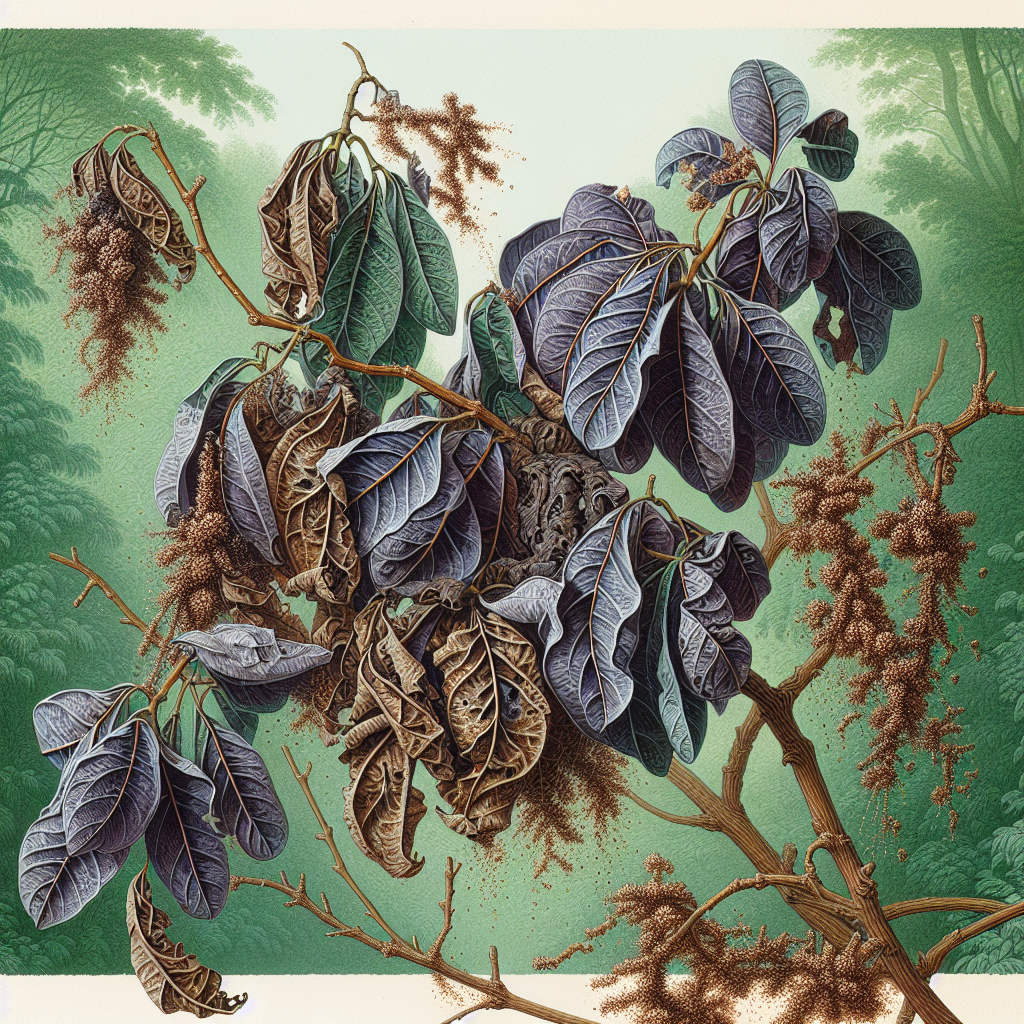
Recognizing laurel wilt early is critical for containment, as symptoms progress rapidly once established. Initial signs appear in the canopy: leaves turn grayish-green to purple, wilting while remaining attached to branches—a hallmark distinction from drought stress where leaves drop prematurely. Affected foliage often clusters at branch tips, giving a 'flag' appearance.
As the disease advances, dark vascular streaking becomes visible under the bark, starting as tan discoloration in the outer sapwood and progressing to black streaks in the xylem. Peel back the bark on wilting branches to reveal this diagnostic feature: a chocolate-brown to black staining in the sapwood, sometimes with a faint fungal odor. Whole branches or the entire tree may die back from the top down.
In cross-section, the wood shows concentric rings of discoloration. Frass (insect waste) packed into beetle galleries at the base or trunk base is another clue. In advanced stages, trees exhibit rapid canopy dieback, with mortality often occurring within 3-6 months. Confirm diagnosis via lab culturing of Raffaelea lauricola or PCR testing, especially to differentiate from similar wilts like Fusarium wilt or Phytophthora. Damage extends beyond aesthetics: dead trees become hazards, and ecosystem loss affects biodiversity, including reduced habitat for butterflies and birds.
Lifecycle and Progression of Laurel wilt
Laurel wilt's lifecycle hinges on the symbiotic relationship between the redbay ambrosia beetle (Xyleborus glabratus) and Raffaelea lauricola fungus. Adult females, the primary dispersers, bore into host trees, excavating galleries packed with frass and fungal spores. The fungus grows from these 'farms,' producing conidia that germinate in xylem vessels, producing mycelia that block water flow.
Beetles carry the fungus in mandibular mycangia (specialized sacs), inoculating trees during attack. Eggs hatch in 4-5 days, larvae feed on fungal-laden frass for 18-30 days, pupate, and emerge as adults. Females disperse to new hosts year-round in warm climates, with peak flight in spring and fall. Multiple generations (3-4 annually) amplify spread.
Progression in trees: Infection starts at attack sites, fungus spreads systemically via xylem within days. Symptoms manifest in 2-8 weeks, full tree death in 1-12 months depending on tree size and health. Susceptibility varies: redbay is most vulnerable, sassafras moderately, avocados highly. The disease overwinters in dead trees, serving as reservoirs for beetles. This cycle enables explosive epidemics, with spread rates up to 100 km/year via natural flight and human-aided movement of firewood.
Environmental Triggers & Risk Factors
Warm, humid subtropical climates favor laurel wilt, with optimal beetle flight at 20-30°C (68-86°F) and high moisture. Infestations thrive in disturbed forests, urban edges, and along waterways where stressed trees predominate. Drought-weakened or flood-damaged laurels are prime targets, as are young saplings and suppressed understory plants.
Human activities accelerate spread: moving infested firewood, logs, or nursery stock over long distances introduces beetles beyond natural dispersal. Ports like Savannah, GA, were entry points. Soil type matters little, but poorly drained sites exacerbate stress, mimicking root rot symptoms. Companion stressors like aphids or drought compound vulnerability.
Risk peaks in spring/fall flights, with males rarely leaving galleries. Native range expansion follows host availability; avocado groves near wild laurels face highest threat. Climate change may extend range northward, potentially impacting ornamental bay trees in landscapes.
Organic Control & Treatment Plans
No fungicide cures laurel wilt; management focuses on vector suppression and sanitation. For small infestations, immediately cut and destroy (chip/burn/solarize) infected trees, removing stumps to <2.5 cm above ground to eliminate breeding sites. Do this during dry periods to minimize spore dispersal.
Organic insecticide sprays target adult beetles: spinosad or pyrethrin-based products applied to trunks 2-3 times during flight peaks (monitor with ethanol-baited traps). Neem oil disrupts beetle feeding. For high-value trees like avocado, trunk-injected potassium phosphite boosts defenses, though not curative.
Biological controls show promise: parasitic wasps (e.g., Tetrastichus spp.) attack beetle larvae; release in trials. Cultural practices: diversify plantings, avoid laurel monocultures, maintain tree vigor via mulching and irrigation. In orchards, girdle and spray lower trunks. Monitor with traps: funnel traps baited with manuka oil lure and capture beetles for detection. Integrated plans combine these for 70-90% reduction in new infections. Consult extension services for site-specific protocols.
Spring Pest Patrol: Organic AI Strategies to Shield Your Crops from Common Invaders
Preventing Laurel wilt in the Future
Prevention is the cornerstone: source plant material from certified disease-free nurseries. Avoid moving firewood from quarantined areas (check APHIS maps); use local sources or heat-treated wood. Install manuka oil traps around high-risk plantings for early detection.
Landscape design: plant resistant species or non-hosts near susceptible trees; avoid stressing plants with proper watering. Scout weekly during flight seasons, focusing on lower trunks. Quarantine new laurels for 1-2 years. Community education curbs spread—partner with neighbors on firewood bans. Long-term: breed resistant laurels; research sterile insect techniques. Vigilance halts epidemics before establishment.
Crops Most Affected by Laurel wilt
Laurel wilt targets Lauraceae family members, decimating natives and crops alike. Redbay (Persea borbonia) suffers 90-100% mortality in epidemics. Swampbay (Persea palustrina) and sassafras (Sassafras albidum) follow, with widespread die-offs impacting ecosystems.
Commercial avocado (Persea americana), especially Hass Avocado and Fuerte Avocado, faces billions in potential losses; Florida quarantines protect groves. Ornamentals like California bay laurel (Umbellularia californica), spicebush (Lindera benzoin), and sweetbay magnolia (Magnolia virginiana) are vulnerable in landscapes. Pondspice (Litsea aestivalis) and silk bay (Persea humilis) are critically threatened endemics. No major field crops beyond avocado, but backyard bay trees and wildlife forage suffer collateral damage.