Introduction to Guggul Resin
Guggul resin, derived from the small deciduous tree Commiphora wightii, is one of the most economically important non-timber forest products of the arid and semi-arid zones of western India and Pakistan. The resin is obtained by tapping the bark and collecting the exudate that hardens into yellowish-brown lumps. Beyond its long-standing role in Ayurvedic pharmacology, guggul is now studied for its antimicrobial, anti-inflammatory, and cholesterol-lowering properties, creating growing commercial demand.
Cultivation of Commiphora wightii offers farmers an opportunity to utilize marginal, drought-prone land that is unsuitable for most conventional crops. The species is exceptionally adapted to rocky, nutrient-poor soils and extreme temperature fluctuations. With proper management, a well-established plantation can yield resin for 25–40 years, providing steady supplemental income while contributing to soil stabilization and biodiversity corridors.
Botanical Profile of Guggul Resin
Commiphora wightii belongs to the Burseraceae family and is characterized by a gnarled trunk, peeling papery bark, and short, sharp spines arranged in pairs. Mature trees rarely exceed 4–6 m in height. The compound leaves are trifoliate with serrated margins and are shed during prolonged dry periods. Small, inconspicuous flowers appear in axillary clusters before the onset of the monsoon, followed by ovoid drupes containing a single seed.
The resin canals are located in the secondary xylem and phloem; tapping wounds stimulate the production of a complex mixture of terpenoids, steroids (notably guggulsterones), and polysaccharides. Resin quality is directly influenced by tree age, tapping frequency, and post-harvest handling.
Soil, pH, and Climate Requirements for Guggul Resin (MUST INCLUDE A MARKDOWN TABLE OF IDEAL CONDITIONS)
Commiphora wightii thrives on shallow, well-drained soils derived from sandstone, limestone, or basalt. It tolerates high salinity and low organic matter but performs best when soil depth is at least 30 cm. The species is strictly xerophytic and requires a pronounced dry season.
| Parameter | Ideal Range | Notes |
|---|---|---|
| Soil Type | Sandy loam to gravelly loam | Avoid heavy clay; ensure rapid drainage |
| Soil pH | 7.0–8.8 | Slightly alkaline preferred |
| Temperature Range | 15–45 °C daytime; 5–15 °C night | Frost below −2 °C can kill young plants |
| Annual Rainfall | 250–600 mm | Supplemental irrigation needed below 250 mm |
| Altitude | 0–1,200 m | Most commercial stands at 200–800 m |
| Relative Humidity | <60 % during active growth | High humidity increases disease risk |
Step-by-Step Planting & Propagation
- Seed Collection & Treatment: Harvest mature drupes in late winter. Remove pulp, soak seeds in 500 ppm GA3 for 24 h, then sow in well-drained nursery beds at 2 cm depth.
- Nursery Phase: Maintain 30–35 °C soil temperature. Germination occurs in 12–18 days. Transplant seedlings at the 4-leaf stage into polybags.
- Vegetative Propagation (Preferred): Take 15–20 cm semi-hardwood cuttings from 3–5-year-old healthy trees in March–April. Dip basal end in 2000 ppm IBA and plant in sand:perlite (1:1). Rooting success exceeds 70 % under intermittent mist.
- Land Preparation: Clear vegetation, contour the land to prevent runoff, and dig pits 60 × 60 × 60 cm at 4 × 4 m spacing.
- Field Planting: Transplant 6–9-month-old plants at the start of monsoon. Apply 5 kg well-rotted FYM per pit mixed with topsoil.
Care & Maintenance regimes for Guggul Resin (MUST INCLUDE A MARKDOWN TABLE OF WATER, FERTILIZER, AND PRUNING SCHEDULES)
Young plants require careful irrigation during the first two summers. Once established, guggul tolerates prolonged drought but benefits from strategic watering to boost resin flow. Fertilization is minimal; excessive nitrogen reduces resin quality.
| Stage | Watering Schedule | Fertilizer (per tree/year) | Pruning Schedule |
|---|---|---|---|
| Year 1–2 | 8–10 L every 10–12 days (dry season) | 2 kg FYM + 50 g NPK 10-26-26 at planting | Formative pruning at 60 cm height |
| Year 3–5 | 15 L every 15–20 days | 5 kg FYM + 100 g NPK split in two doses | Remove dead wood and crossing branches |
| Mature (>5 years) | 20 L at resin tapping initiation only | 8 kg FYM + 150 g rock phosphate every 3 years | Light thinning every 3 years after harvest |
Pests, Diseases & Organic Management
The most common pests include Aphids, Scale insects, and Mealybugs. Occasional outbreaks of Spider mites occur under dusty, dry conditions. Root rot caused by Phytophthora species can develop in poorly drained soils.
Organic control begins with cultural practices: maintain wide spacing for airflow, remove weeds that harbor pests, and apply neem oil (3 mL/L) or horticultural oil at first sign of infestation. For root diseases, improve drainage and drench soil with Trichoderma viride (5 g/L) every six months. Sticky traps and yellow pan traps effectively monitor flying insects.
Harvesting, Curing & Optimal Storage
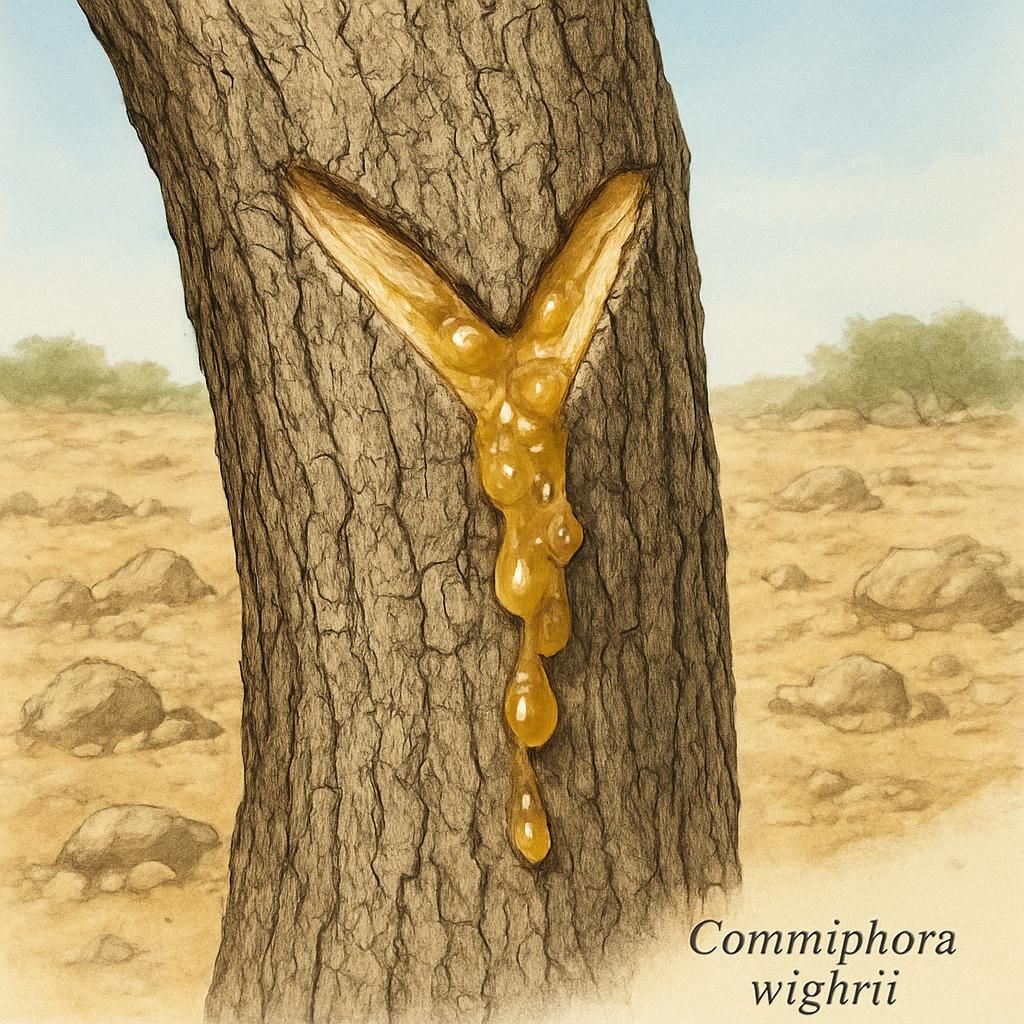
Commercial tapping begins in the fourth or fifth year. Make shallow V-shaped incisions on opposite sides of the trunk during the hottest, driest months (April–June). Collect hardened resin after 15–20 days. Repeat on alternate sides the following year.
Fresh resin is sun-dried on clean mats for 3–5 days until moisture drops below 8 %. Grade according to color and purity, then store in food-grade HDPE drums lined with food-safe plastic at 15–20 °C and <60 % RH. Properly stored resin retains medicinal potency for up to five years.
Companion Planting for Guggul Resin
Guggul performs well with drought-tolerant legumes such as Pigeon pea and Sesame that fix nitrogen and provide light shade during establishment. Aromatic herbs including Thyme and Rosemary deter aphids and improve biodiversity. Avoid planting shallow-rooted vegetables that compete for surface moisture.
For additional guidance on building resilient small-farm systems, see The Hidden Power of Mulching: 8 Organic Strategies to Transform Small Farm Soil.