Introduction to Ginseng (crop)
American ginseng (Panax quinquefolius) is a shade-loving perennial herb native to the deciduous forests of eastern North America. Valued for centuries in traditional medicine, its fleshy roots contain bioactive ginsenosides sought by herbal, pharmaceutical, and export markets. Commercial cultivation now spans both wild-simulated woodland plantings and intensive shaded-field systems, with roots typically reaching marketable size in 4–7 years.
Successful ginseng production demands precise environmental control, long-term soil stewardship, and patience. Growers who master these variables can achieve premium prices for well-formed, disease-free roots. This definitive guide covers every production stage—from site selection to post-harvest curing—using only practical, research-backed recommendations.
Botanical Profile of Ginseng (crop)
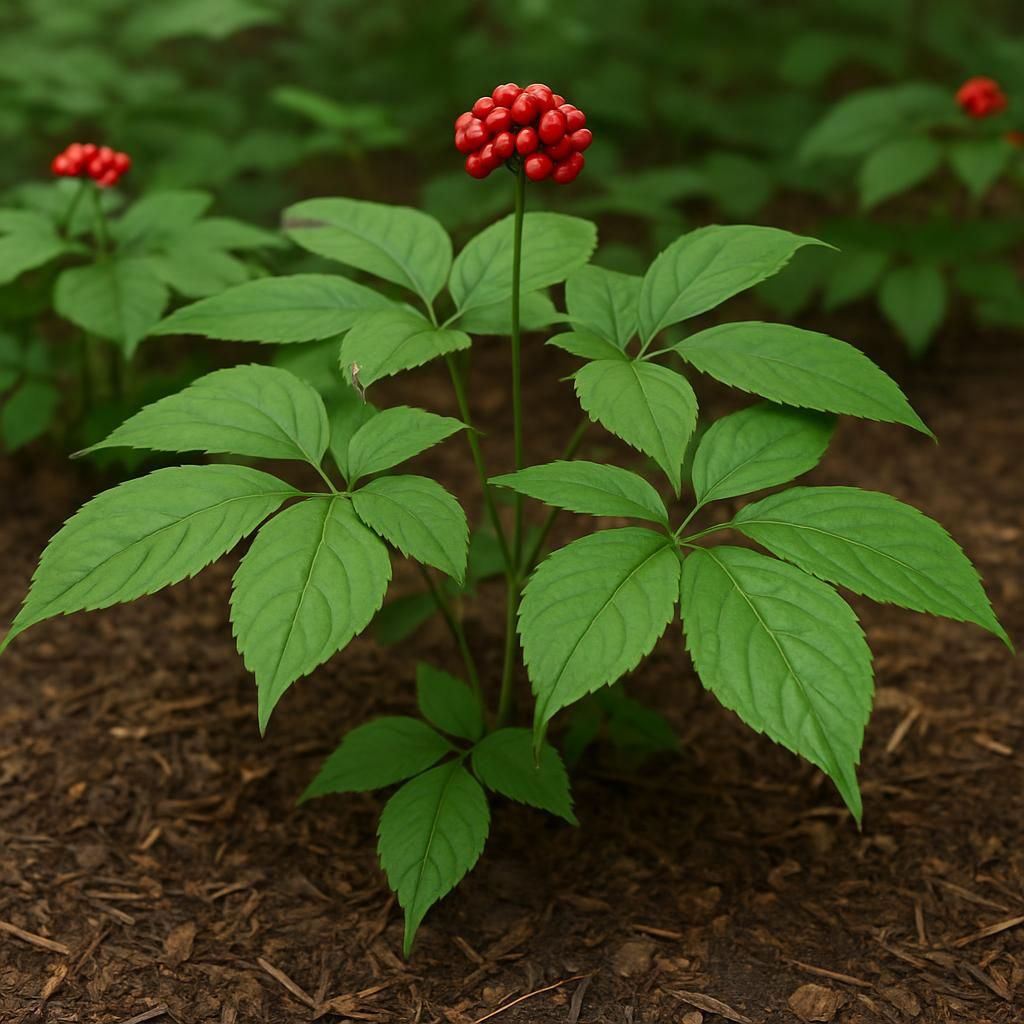
Panax quinquefolius belongs to the Araliaceae family. Mature plants produce a single aerial stem 30–60 cm tall bearing 3–5 palmately compound leaves. Each leaf consists of 3–5 leaflets with serrated margins. In late spring, small greenish-white flowers form an umbel that later develops into bright red berries containing 1–3 seeds. The below-ground portion comprises a fleshy taproot with lateral branches and a distinctive “neck” of annual stem scars used to age plants.
Ginseng is a true perennial that enters winter dormancy as an underground bud. Growth resumes in early spring when soil temperatures reach approximately 10 °C. Seedlings emerge with a single cotyledon and develop one compound leaf in year one, adding leaflets annually until reproductive maturity around year four or five.
Soil, pH, and Climate Requirements for Ginseng (crop)
Ginseng thrives in cool, moist, well-drained woodland soils rich in organic matter. Ideal sites mimic the microclimate of mature hardwood forests with 70–90 % shade.
| Parameter | Ideal Range | Notes |
|---|---|---|
| Soil Type | Loamy sand to silt loam | High humus content; avoid heavy clays |
| Soil pH | 5.5–6.5 | Slightly acidic; test and amend annually |
| Organic Matter | 6–12 % | Incorporate aged leaf mold or compost |
| Drainage | Excellent | Raised beds or slopes prevent waterlogging |
| Temperature Range | 15–24 °C growing season | Requires 120–140 frost-free days |
| Annual Precipitation | 800–1200 mm | Supplemental irrigation in dry spells |
| Shade Requirement | 70–90 % canopy or artificial shade | Critical for leaf health and root quality |
Step-by-Step Planting & Propagation
- Seed Stratification: Fresh berries are collected in autumn, depulped, and stratified in moist sand for 18–22 months at 2–5 °C to break double dormancy.
- Site Preparation: Clear competing vegetation, incorporate 5–8 cm of aged leaf mold, and form raised beds 1.2 m wide.
- Shade Structure: Erect 70–80 % shade cloth on 2 m posts or retain a natural hardwood canopy.
- Sowing: Plant stratified seeds 1–2 cm deep at 10–15 cm spacing in rows 20–25 cm apart during late autumn.
- Mulching: Apply 5–8 cm of shredded hardwood bark or leaves immediately after sowing to moderate temperature and retain moisture.
Transplanting nursery-grown seedlings follows the same spacing and mulch protocol but accelerates time to harvest by one year.
Care & Maintenance regimes for Ginseng (crop)
Consistent moisture, balanced nutrition, and timely sanitation are essential throughout the multi-year crop cycle.
| Task | Schedule | Details |
|---|---|---|
| Watering | 25–40 mm/week during active growth | Drip irrigation preferred; avoid overhead wetting |
| Fertilizer | Early spring (year 2+) | 5-5-5 organic blend at 200 kg/ha; side-dress lightly |
| Pruning/Sanitation | Weekly removal of diseased foliage | Cut at soil line; dispose off-site |
| Mulch Refresh | Annually in late autumn | Maintain 5 cm depth; replace compacted mulch |
| Weed Control | Hand-weed or shallow hoe every 3–4 weeks | Avoid deep cultivation that damages roots |
Pests, Diseases & Organic Management
Major threats include Pythium root rot, Alternaria leaf spot, and Fusarium wilt. Slugs, snails, and rodents also cause significant stand loss.
Organic strategies emphasize prevention: site selection with excellent drainage, strict sanitation, and diverse beneficial soil microbes. Approved products include copper hydroxide for leaf spots, Bacillus subtilis for damping-off, and iron-phosphate baits for mollusks. Regular scouting and immediate removal of infected plants remain the most effective controls.
Harvesting, Curing & Optimal Storage
Harvest occurs after 4–7 years when roots reach 8–12 cm length and 25–40 g fresh weight. Dig carefully with a fork in autumn after foliage senescence. Gently wash soil from roots with low-pressure water, then grade by size and shape.
Curing involves a controlled drying process: maintain 25–30 °C with 40–50 % relative humidity and good airflow for 4–6 weeks until roots snap cleanly. Store cured roots in breathable burlap or paper-lined boxes at 5–10 °C and 60–70 % humidity. Properly cured roots retain market quality for 2–3 years.
Companion Planting for Ginseng (crop)
Ginseng benefits from deep-rooted companions that improve soil structure without competing for light. Goldenseal and wild ginger are traditional woodland partners that share similar shade and moisture needs. Leguminous ground covers such as partridgeberry fix nitrogen while suppressing weeds. Avoid planting near allium species, whose sulfur compounds can inhibit ginseng growth. Diverse plantings also support beneficial insects that reduce pest pressure.
Goldenseal is a particularly compatible understory crop that can be interplanted on the same beds, extending the productive life of woodland sites.