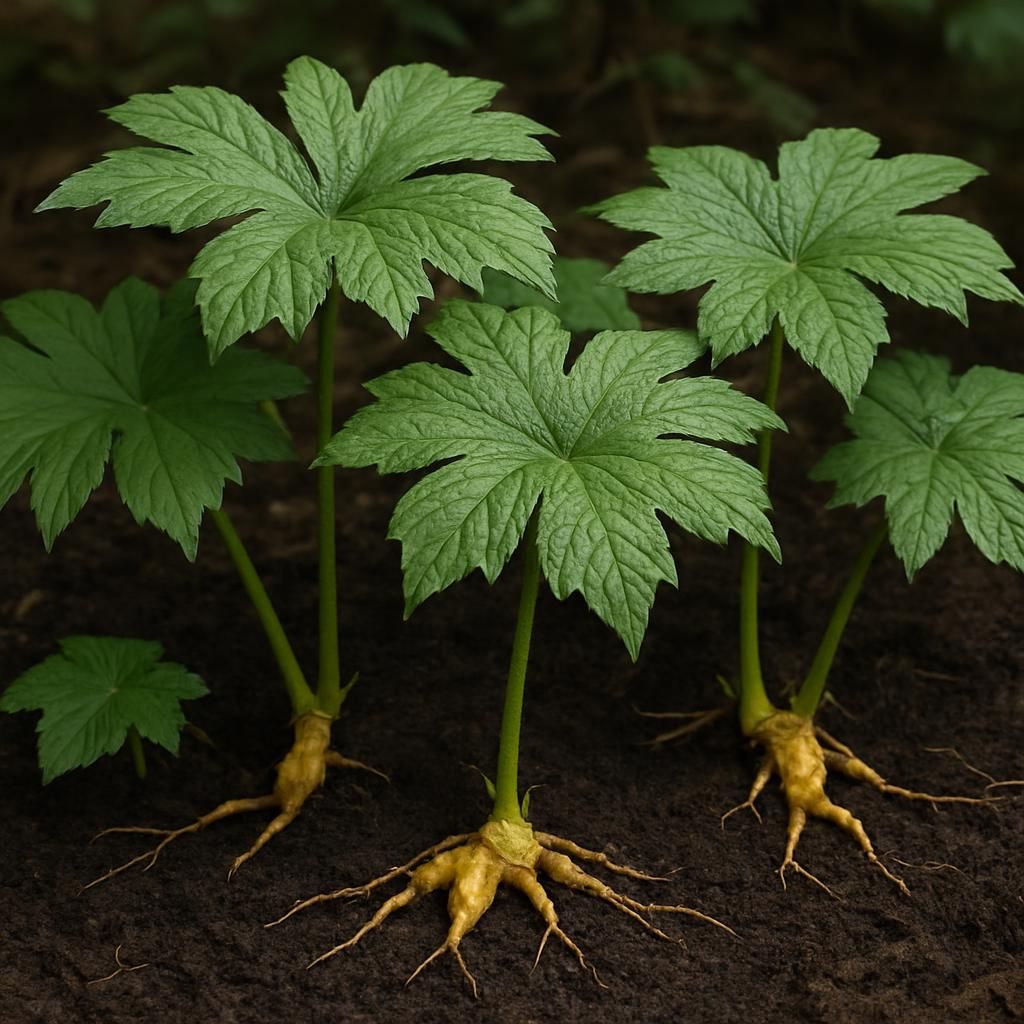
Introduction to Goldenseal
Goldenseal (Hydrastis canadensis) is a native North American woodland herb valued for its bright yellow rhizomes containing the alkaloids berberine, hydrastine, and canadine. Historically used by Indigenous peoples and later adopted into Western herbal medicine, it supports digestive and immune health. Commercial cultivation is challenging due to its slow growth cycle (typically 4–5 years to harvest) and specific habitat needs, but demand for sustainably grown material continues to rise. Forest farming and shaded woodland gardens offer the best opportunities for profitable production while protecting wild populations.
Botanical Profile of Goldenseal
Goldenseal is a low-growing herbaceous perennial in the buttercup family (Ranunculaceae). It emerges in early spring with a single basal leaf that is deeply palmately lobed and wrinkled. A second, smaller leaf appears on flowering stems that reach 20–30 cm in height. The solitary white flower lacks petals and instead features numerous showy stamens surrounding a cluster of pistils. After pollination, the plant produces a raspberry-like red berry containing 10–30 seeds. The plant spreads slowly via a thick, knotty, bright yellow rhizome that sends out fibrous roots. All parts of the plant contain the characteristic yellow alkaloid stain that gives the species its common name.
Soil, pH, and Climate Requirements for Goldenseal
Goldenseal demands rich, well-drained yet consistently moist woodland soil with high organic matter content. It performs best in cool, humid microclimates with dappled shade or 70–80% canopy cover. Avoid compacted or heavy clay soils that retain standing water.
| Parameter | Ideal Range | Notes |
|---|---|---|
| Soil Type | Loamy, high in humus | Incorporate leaf mold or aged compost |
| Soil pH | 5.5 – 6.5 | Slightly acidic woodland conditions |
| Organic Matter | 8–12% | Maintain with annual mulch applications |
| Temperature Range | 15–24 °C daytime / 5–10 °C night | Cool-season woodland perennial |
| Annual Rainfall | 1000–1500 mm, evenly distributed | Supplemental irrigation in dry periods |
| Shade Requirement | 70–80% canopy cover | Avoid full sun which scorches foliage |
| Spacing | 20–30 cm between plants | Rows 60 cm apart in raised beds |
Step-by-Step Planting & Propagation
Goldenseal is most reliably propagated from rhizome divisions or stratified seeds. Begin site preparation one season ahead by clearing competing vegetation and incorporating 5–8 cm of well-aged leaf mold. For rhizome planting, select healthy 5–8 cm sections with at least two buds; plant horizontally 5 cm deep in autumn or early spring. Seed propagation requires cold stratification: mix fresh seeds with moist sand and refrigerate at 4 °C for 90–120 days before sowing in shaded nursery beds. Germination occurs the following spring at low percentages (20–40%), so expect slower establishment. Mulch beds immediately with 5 cm of shredded hardwood or leaf litter to retain moisture and suppress weeds.
Care & Maintenance regimes for Goldenseal
Consistent moisture and organic fertility are critical during the first three years. Hand-weed carefully to avoid damaging shallow roots. Monitor canopy density annually and thin overhanging branches if light levels drop below 70% shade. Fertilization should be conservative—overfeeding encourages lush foliage at the expense of rhizome development.
| Task | Schedule | Details |
|---|---|---|
| Watering | Weekly during active growth | Maintain even soil moisture; 2.5 cm/week |
| Fertilizer | Early spring and mid-summer | Top-dress with 2 cm well-rotted leaf compost |
| Pruning | Late autumn after senescence | Remove dead foliage to reduce disease risk |
| Mulching | Annually in spring and fall | Renew 5 cm hardwood mulch layer |
| Weeding | Monthly during growing season | Hand-pull only; avoid deep cultivation |
Pests, Diseases & Organic Management
Goldenseal is relatively pest-resistant in proper woodland settings, but slugs, snails, and root-knot nematodes can become problematic in overly moist or poorly drained beds. Fungal issues such as Botrytis and leaf spot diseases appear during prolonged wet weather. Implement cultural controls first: improve air circulation, avoid overhead irrigation, and maintain thick mulch layers. Slug traps made from beer or iron-phosphate baits provide effective organic suppression. For nematodes, rotate plantings every 5–7 years and incorporate marigold as a biofumigant cover crop between cycles. Always source disease-free planting stock from reputable nurseries.
Harvesting, Curing & Optimal Storage
Harvest goldenseal when plants reach 4–5 years of age, typically in late summer or early autumn after foliage begins to yellow. Carefully dig rhizomes using a garden fork, shaking off loose soil. Wash gently in cool running water and remove fibrous roots. Cure by spreading rhizomes in a single layer in a shaded, well-ventilated area at 20–25 °C for 7–10 days until the interior is dry and brittle. Store cured material in paper bags or breathable cloth sacks inside a cool (10–15 °C), dark, low-humidity environment. Properly cured and stored rhizomes retain medicinal potency for 2–3 years.
Companion Planting for Goldenseal
Goldenseal thrives alongside other shade-loving woodland species that share similar moisture and soil requirements. Compatible companions include ginseng (not listed but added for context), mayapple, wild ginger, and ferns that provide additional canopy and root competition suppression. Avoid planting near aggressive spreaders such as mint that may outcompete slow-growing goldenseal. Strategic interplanting with black cohosh and bloodroot creates a diverse forest garden that supports beneficial insects and improves overall ecosystem resilience.