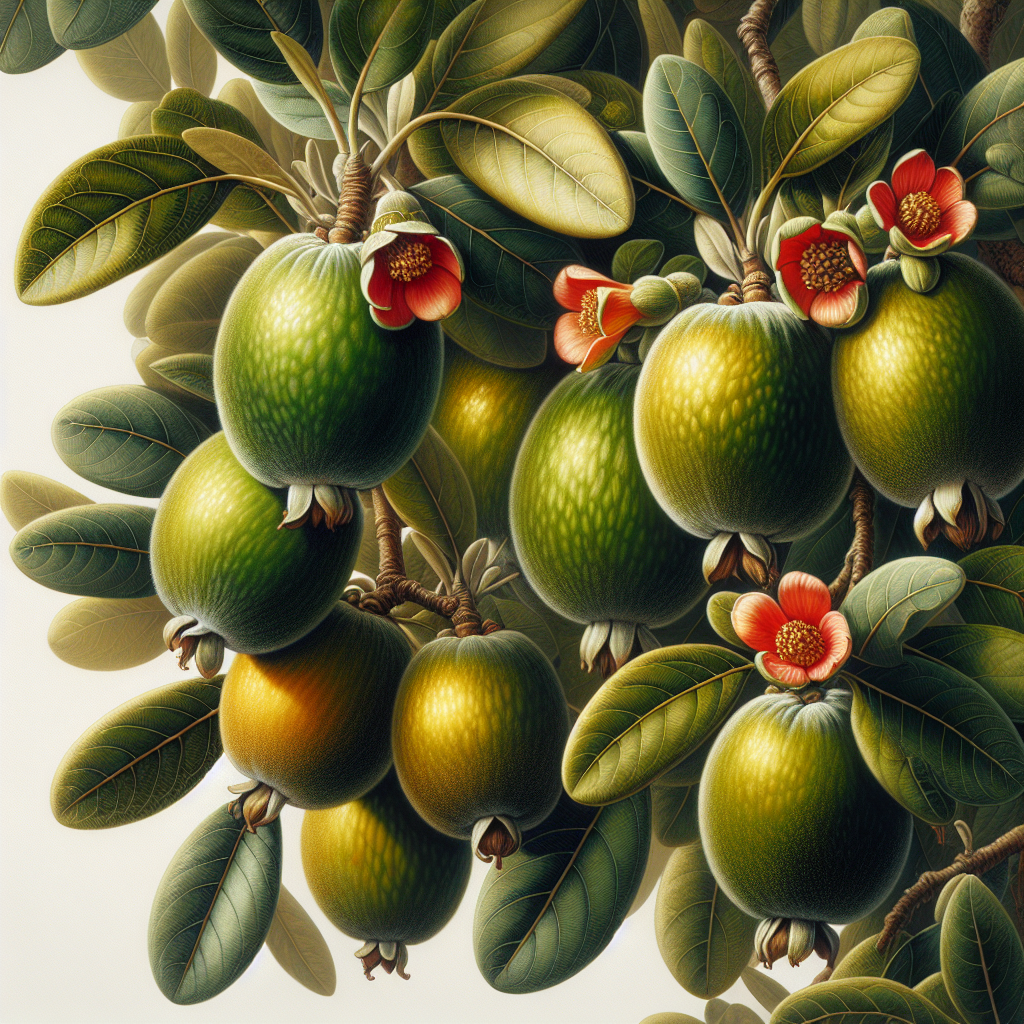
Introduction to Feijoa (Coolidge)
Feijoa 'Coolidge', a standout cultivar of the pineapple guava (Acca sellowiana), has gained popularity among growers for its reliability and productivity. Selected in the 1930s by Oliver Coolidge in California, this variety is prized for its self-fertility, eliminating the need for cross-pollination partners common in other feijoa types. Trees produce an abundance of large, oval fruits—up to 3 inches long—with thick, green skin protecting juicy, sweet-tart flesh that tastes like a blend of pineapple, banana, and guava. Each fruit is packed with vitamin C, fiber, and antioxidants, making it a nutritional powerhouse.
Ideal for home orchards, small farms, and permaculture systems, 'Coolidge' thrives in USDA zones 8-11, tolerating light frosts down to 10°F (-12°C) once established. Mature trees reach 12-15 feet tall, with attractive silver-green foliage and vibrant red edible flowers that add ornamental value. Yields can exceed 50 pounds per tree annually after 3-4 years, with fruits ripening in fall. This guide provides professional-grade advice for maximizing growth, health, and harvest. For more on subtropical fruits, check the Guava (crop) page.
Botanical Profile of Feijoa (Coolidge)
Feijoa sellowiana 'Coolidge' belongs to the Myrtaceae family, native to the highlands of southern Brazil, Paraguay, Uruguay, and northern Argentina. As a selection from the species, 'Coolidge' exhibits compact growth with a bushy habit, dense branching, and evergreen leaves coated in silvery undersides that shimmer in the breeze. The tree's bark is smooth and mottled gray-brown, peeling attractively with age.
Flowers emerge in late spring to early summer, featuring 1-2 inch crimson anthers protruding from white petals—both edible and delicious in salads or desserts. Fruits develop from these blooms, maturing 4-6 months later with a fuzzy green exterior that turns yellowish when ripe. Internally, the pulp surrounds a jelly-like core filled with edible seeds, offering 60-80 calories per 100g, low acidity (pH 3.5-4.0), and Brix levels of 12-15° for superior sweetness.
Root system is fibrous and shallow-spreading, up to twice the canopy width, making mulching essential for moisture retention. 'Coolidge' is parthenocarpic to some degree but excels in self-pollination via its abundant viable pollen, setting fruit without insects in many cases. Compared to standard feijoas, it yields 20-30% more fruit with better size uniformity and storage life. Discover effective pest strategies in Why 90% of Small Farms Fail at Pest Management - And 8 Organic Fixes That Actually Work.
Soil, pH, and Climate Requirements for Feijoa (Coolidge)
'Coolidge' feijoa adapts to a wide range of soils but performs best in well-drained, loamy or sandy loam with 5-15% organic matter. Avoid heavy clays prone to waterlogging, which invite root rot. Optimal pH is 6.0-7.5; test soil and amend with dolomite lime if below 6.0 to prevent micronutrient lockout. Incorporate 2-4 inches of compost or aged manure pre-planting to boost fertility without excess nitrogen, which promotes vegetative overgrowth at fruiting's expense.
Climate-wise, it flourishes in subtropical to mild temperate zones with 200-400 chill hours (below 45°F/7°C). Summer highs of 80-95°F (27-35°C) fuel growth, while winters should stay above 10°F (-12°C). It endures coastal winds, salty air, and drought once rooted, but young plants need frost protection via burlap or microclimates. Annual rainfall of 30-50 inches suits it, supplemented by 1 inch/week in dry spells. In hotter areas, provide afternoon shade to avert sunburn on fruits. Elevations up to 3,000 feet enhance flavor via cooler nights.
Step-by-Step Planting & Propagation
Propagation: 'Coolidge' roots readily from semi-hardwood cuttings taken in late summer. Dip 6-inch cuttings in 3,000 ppm IBA rooting hormone, plant in perlite:vermiculite (1:1), and mist under intermittent fog at 70-80°F (21-27°C). Roots form in 4-8 weeks. Seed propagation works but yields variable offspring; stratify seeds at 40°F (4°C) for 60 days for 70% germination.
Planting: Select 2-3 year grafted trees for quickest bearing. Dig holes 2x root ball width, 12-18 inches deep in full sun (6-8 hours). Space 10-15 feet apart for airflow. Backfill with native soil amended 50/50 compost, adding rock phosphate (3 lbs/cubic yard) for phosphorus. Plant at soil line, water deeply, and mulch 4-6 inches thick with wood chips or straw, keeping it 6 inches from trunk. Stake if windy. For container growing, use 20-25 gallon pots with citrus mix; repot biannually.
Timing: Plant in early spring post-frost or fall in mild climates. Irrigate newly planted trees twice weekly for first year, tapering to deep monthly soaks.
Care & Maintenance regimes for Feijoa (Coolidge)
Watering: Consistent moisture during establishment and fruit swell (March-July); 1-2 inches/week via drip. Mature trees tolerate drought but drop fruits if stressed—check soil 6 inches down; water if dry. Avoid overhead to prevent fungal issues.
Fertilizing: Apply balanced 10-10-10 or citrus formula in March, June, September at 1 lb/tree/year, increasing 0.5 lb annually to maturity. Foliar spray micronutrients (iron, zinc, manganese chelates) if chlorosis appears on young leaves. Organic option: compost tea or fish emulsion monthly in growing season.
Pruning: Annually post-harvest, remove dead/crossing branches, thin canopy for light penetration. Tip-prune to encourage bushiness; maintain open center. Avoid heavy cuts to preserve next year's flower buds on old wood.
Winter Care: Mulch heavily; wrap trunks in colder zones. In pots, move to sheltered spots.
Pests, Diseases & Organic Management
Common pests include aphids, scale insects, and mealybugs, which cluster on new growth. Blast with water jet or apply neem oil (2% solution) weekly. Guava fruit fly attacks ripening fruit—bag or use spinosad bait sprays. Birds love flowers; net trees during bloom.
Diseases: Phytophthora root rot from poor drainage—improve soil and use phosphite drenches. Botrytis causes gray mold on flowers; ensure airflow. Powdery mildew rare but treat with potassium bicarbonate.
Organic IPM: Introduce ladybugs for aphids, plant marigold as trap crop. Monitor weekly; prune infected parts and dispose, not compost.
Harvesting, Curing & Optimal Storage
Harvest when fruits naturally drop or shake free—typically October-November in southern hemisphere, April-May north. Skin yellows slightly, but taste-test for optimal sweetness. Yields peak at 5-7 years. Pick daily to avoid ground rot; handle gently to prevent bruising.
No curing needed; fruits ripen off-tree. Store at 32-41°F (0-5°C), 85-90% humidity for 4-6 weeks. Ripen at room temp; freeze pulp for smoothies or puree (lasts 12 months).
Companion Planting for Feijoa (Coolidge)
Pair with nitrogen-fixers like clover or pigeon pea for soil enrichment. Thyme and yarrow deter pests. Underplant with strawberries or low blueberries for groundcover. Avoid heavy feeders like potato competing for water. Learn more in Why Companion Planting Feels Like Guesswork for Small Farms - And How AI Makes It Foolproof.