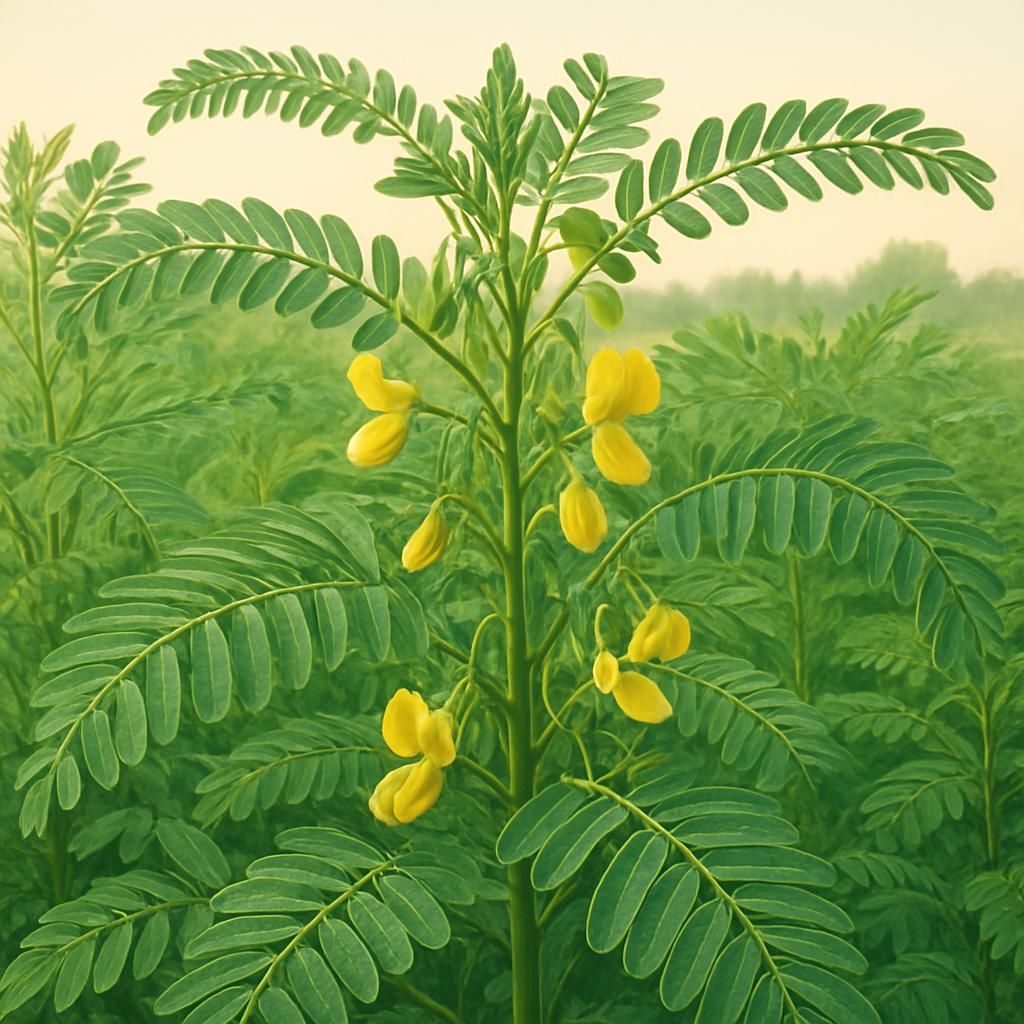
Introduction to Dhaincha
Dhaincha (Sesbania bispinosa) is a versatile, fast-growing leguminous shrub prized by farmers for its ability to rapidly improve soil fertility through biological nitrogen fixation. Native to South and Southeast Asia, it has become an essential component of sustainable cropping systems where it is grown either as a green manure crop or as a dual-purpose plant for fodder and fuelwood. Because it establishes quickly even on marginal lands and tolerates waterlogging and moderate salinity, Dhaincha plays a key role in restoring degraded soils before planting high-value crops such as Rice.
Botanical Profile of Dhaincha
Dhaincha belongs to the Fabaceae family and is characterized by an erect, much-branched habit reaching 1.5–3 m in height. The stems are slender, pithy, and covered with fine hairs when young. Leaves are pinnately compound with 20–40 pairs of linear leaflets. The plant produces attractive yellow flowers with reddish-purple streaks that develop into long, slender pods containing 20–30 small, hard seeds. Its deep taproot system efficiently mines nutrients from lower soil layers while the extensive lateral roots form symbiotic nodules with Rhizobium bacteria.
Soil, pH, and Climate Requirements for Dhaincha
Dhaincha performs best on a wide range of soils, from sandy loams to heavy clays, provided drainage is adequate during the early growth phase. It tolerates pH values between 5.5 and 8.5 and can withstand brief periods of waterlogging, making it suitable for lowland rice rotations.
| Parameter | Ideal Range | Notes |
|---|---|---|
| Soil Type | Sandy loam to clay loam | Avoid waterlogged seedbeds |
| Soil pH | 6.0–8.0 | Tolerates mild acidity and alkalinity |
| Temperature | 20–35 °C | Optimal germination at 25–30 °C |
| Annual Rainfall | 600–1500 mm | Requires 400 mm during first 45 days |
| Altitude | 0–1500 m | Performs well in both plains and hills |
Step-by-Step Planting & Propagation
- Seed Selection & Treatment: Choose certified seed free from bruchid damage. Soak seeds in water for 12–18 hours or scarify lightly with sandpaper to break dormancy.
- Land Preparation: Plough to a fine tilth and incorporate 5–8 t ha⁻¹ well-decomposed farmyard manure. Level the field to ensure uniform moisture.
- Sowing Time: In most tropical regions, sow at the onset of monsoon (June–July) or immediately after rice harvest (October–November).
- Method & Rate: Broadcast 40–50 kg seed ha⁻¹ or drill in rows 30 cm apart at 3–4 cm depth. For green manure, increase rate to 60–70 kg ha⁻¹.
- Inoculation: Mix seed with Rhizobium culture specific to Sesbania at 200 g per 10 kg seed just before sowing.
Care & Maintenance regimes for Dhaincha
Dhaincha requires minimal care once established. The following schedule ensures vigorous biomass production within 45–60 days.
| Growth Stage | Irrigation Schedule | Fertilizer Application | Pruning / Management |
|---|---|---|---|
| Germination (0–15 days) | Light irrigation every 4–5 days | None; rely on seed reserves | None |
| Vegetative (16–45 days) | 1 irrigation at 20–25 days if rainfall <20 mm | 20 kg N ha⁻¹ at 20 days if soils very poor | None |
| Pre-incorporation (46–60 days) | Stop irrigation 7 days before ploughing | None | Cut at 50 % flowering for maximum N-fixation |
Pests, Diseases & Organic Management
Although relatively hardy, Dhaincha can be affected by aphids, Jassids, and pod borers. Root rot caused by Rhizoctonia and collar rot from Sclerotium rolfsii may occur in poorly drained soils. Organic management includes neem-based sprays at 5 ml L⁻¹ for sucking pests, removal of affected plants, and crop rotation with non-hosts such as Sorghum. Seed treatment with Trichoderma viride (5 g kg⁻¹) effectively suppresses soil-borne pathogens.
Harvesting, Curing & Optimal Storage
For green manure, incorporate the crop at 50 % flowering (45–60 days) by ploughing under 10–15 cm deep. When grown for seed, harvest pods when 70–80 % turn brown. Dry pods in shade for 5–7 days, then thresh and winnow. Store clean seed at 8–10 % moisture in airtight containers treated with neem leaves to deter storage pests. Seed viability remains above 80 % for up to two years under cool, dry conditions.
Companion Planting for Dhaincha
Dhaincha is an excellent companion in rice-based systems where it fixes 80–120 kg N ha⁻¹ and improves soil structure for the subsequent rice crop. It pairs well with Maize and Millet in intercropping, providing partial shade and wind protection while enriching the soil. In orchards, Dhaincha rows between young Mango trees suppress weeds and add organic matter. Avoid planting near heavy feeders such as Cabbage without adequate spacing to prevent competition for light during early growth.