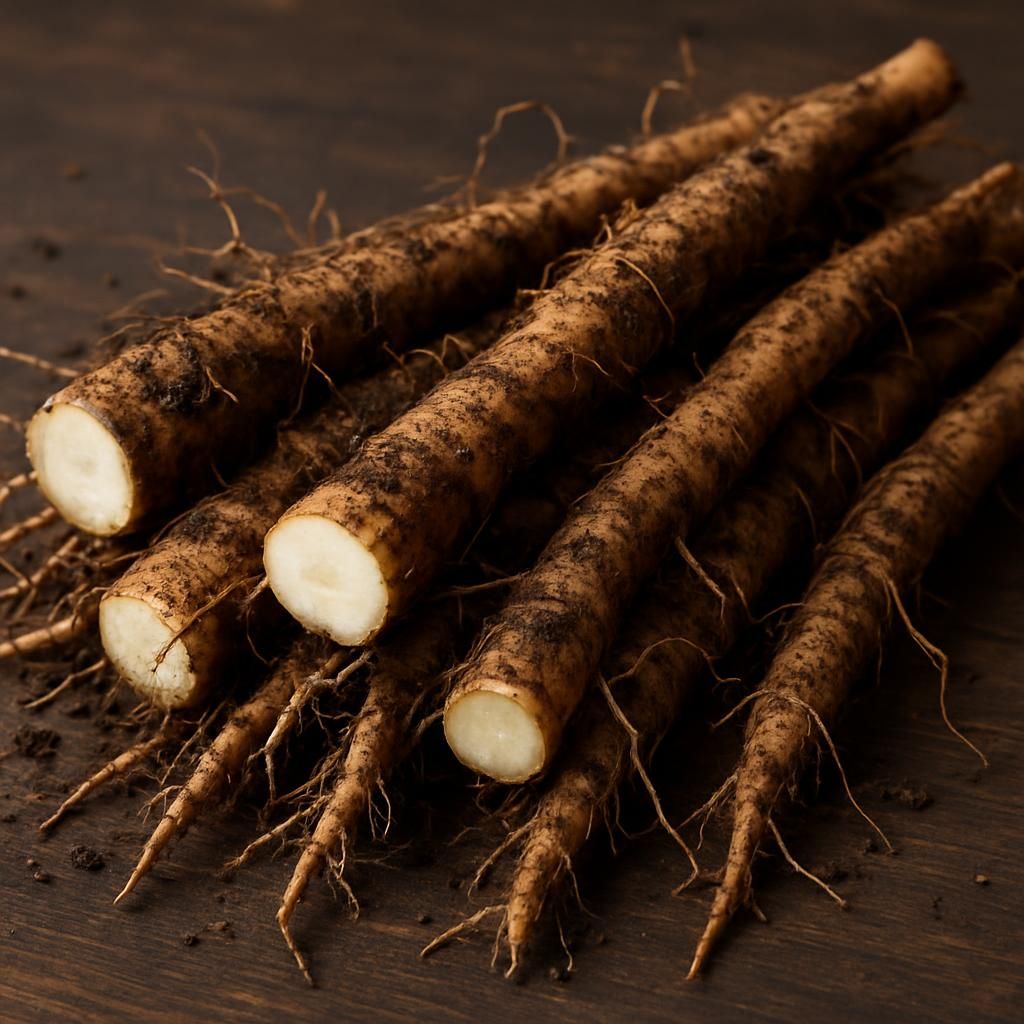
Introduction to Dandelion Root (Taraxacum officinale)
Dandelion root (Taraxacum officinale) is a resilient perennial herb cultivated worldwide for its deep taproot, which is harvested for culinary, medicinal, and beverage uses. Native to temperate Eurasia, it has naturalized across North America and beyond, thriving in gardens, fields, and roadsides. The plant is prized for its high inulin content, bitter compounds, and rich mineral profile, making it popular among herbalists, foragers, and specialty crop growers.
Commercial and home-scale production focuses on selecting vigorous strains with thick, fleshy roots. Dandelion is exceptionally cold-hardy and can be grown as a biennial or short-lived perennial. Its deep root system improves soil structure and brings nutrients to the surface, making it a valuable component of regenerative agriculture systems.
Botanical Profile of Dandelion Root (Taraxacum officinale)
Taraxacum officinale belongs to the Asteraceae family and produces a basal rosette of deeply lobed leaves. In its second year, it sends up a hollow, leafless flowering stalk bearing bright yellow composite flowers that mature into wind-dispersed seed heads. The taproot is the primary harvest target and can reach 30 cm or more in length under optimal conditions.
The species exhibits high genetic variability, with many microspecies and apomictic forms. Roots are typically light tan to brown externally with a white to cream interior. Leaves are rich in vitamins A, C, and K, while the root contains inulin, sesquiterpene lactones, and phenolic acids.
Soil, pH, and Climate Requirements for Dandelion Root (Taraxacum officinale)
Dandelion root performs best in well-drained, loamy soils with moderate fertility. It tolerates a wide pH range but prefers slightly acidic to neutral conditions. The plant is highly adaptable to cool temperate climates and can withstand frost and light snow.
| Parameter | Ideal Range | Notes |
|---|---|---|
| Soil Type | Loamy, well-drained | Avoid heavy clay without amendment |
| Soil pH | 6.0 – 7.5 | Optimal nutrient uptake and root quality |
| Temperature Range | 10–24 °C (growing season) | Roots develop best in cool conditions |
| Annual Rainfall | 500–1000 mm | Supplemental irrigation in dry periods |
| Sunlight | Full sun to partial shade | Full sun maximizes root biomass |
| USDA Hardiness Zones | 3–9 | Extremely cold hardy |
Step-by-Step Planting & Propagation
Dandelion root is primarily grown from seed, though root divisions can be used for clonal propagation. Direct sow in early spring or late summer for fall or overwintered crops. Seeds require light for germination and should be pressed lightly into prepared seedbeds without covering.
- Prepare beds by loosening soil to 30 cm depth and removing stones.
- Sow seeds 1–2 cm apart in rows spaced 30–45 cm apart.
- Thin seedlings to 10–15 cm spacing once true leaves appear.
- For root division, harvest mature roots in fall, cut into 5 cm sections, and replant in spring.
- Maintain even moisture until seedlings are established.
Care & Maintenance regimes for Dandelion Root (Taraxacum officinale)
Dandelion is low-maintenance but benefits from consistent weed control and moderate fertility. Mulching helps retain moisture and suppress weeds. Avoid over-fertilization, which can produce lush foliage at the expense of root development.
| Task | Schedule | Details |
|---|---|---|
| Watering | Weekly during dry spells | 25–40 mm per week; deep, infrequent watering |
| Fertilizer | Early spring & mid-summer | Compost tea or balanced organic fertilizer (NPK 5-5-5) at 1–2 kg per 10 m² |
| Pruning | Remove flower stalks as needed | Prevents seeding and directs energy to roots |
Pests, Diseases & Organic Management
Dandelion root has few serious pests but can be affected by Aphids, Slugs, and occasional fungal leaf spots. Organic management includes encouraging beneficial insects, using floating row covers, and maintaining good airflow. Hand-picking slugs at dusk and applying iron phosphate baits are effective controls.
Crop rotation and removal of senescent foliage help reduce disease pressure. Dandelion is generally resistant to most soil-borne pathogens when grown in well-drained soils.
Harvesting, Curing & Optimal Storage
Roots are typically harvested in the second year during late fall or early spring when inulin content peaks. Dig carefully with a garden fork to avoid breakage. Wash roots thoroughly, trim tops, and dry in a well-ventilated area or dehydrator at 35–40 °C until brittle.
Store dried roots in airtight containers away from light and moisture. Fresh roots can be stored in damp sand at 0–4 °C for several weeks. Properly dried roots retain quality for up to two years.
Companion Planting for Dandelion Root (Taraxacum officinale)
Dandelion pairs well with nitrogen-fixing legumes and aromatic herbs that deter pests. Consider planting alongside Clover, Thyme, or Yarrow to improve biodiversity and soil health. It also benefits from proximity to Lettuce and Spinach, which appreciate the same cool-season conditions.
Avoid planting near shallow-rooted crops that compete for surface moisture. Dandelion’s deep taproot can help break up compacted soil for following crops such as Carrot or Beet.