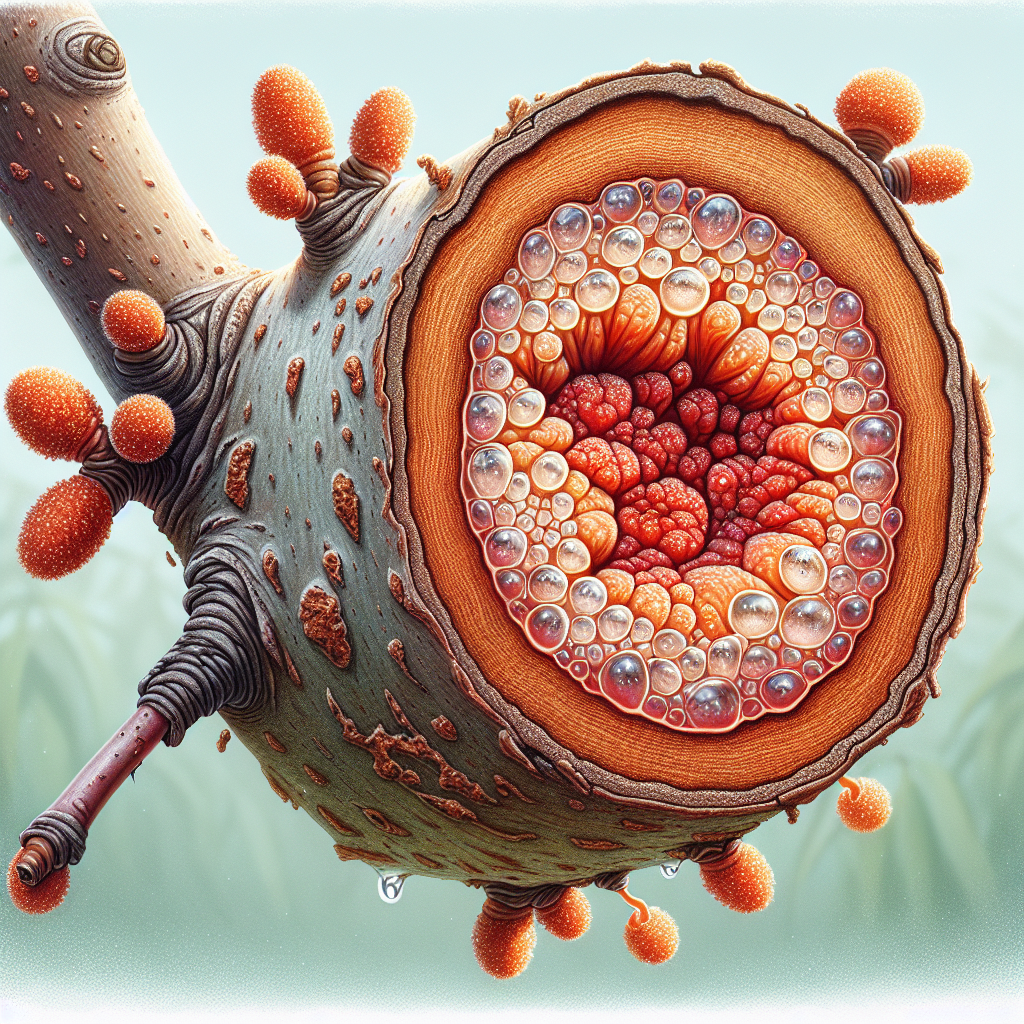
Introduction to Cytospora canker
Cytospora canker represents one of the most prevalent and challenging fungal diseases impacting woody plants, particularly in temperate climates. Caused by various species of the fungus Cytospora (teleomorph: Leucostoma), this pathogen targets a wide range of trees and shrubs, leading to significant economic losses in commercial orchards, nurseries, and urban landscapes. The disease manifests as oval-shaped, sunken lesions on branches and trunks, often accompanied by amber-colored ooze during wet periods, which dries into a distinctive white crust.
First identified in the 19th century, Cytospora canker has become increasingly problematic due to climate variability, intensified orchard management, and urban tree stress. Unlike aggressive pathogens, Cytospora acts as a weak parasite or opportunist, exploiting trees weakened by environmental stresses such as drought, winter injury, mechanical damage, or poor nutrition. In severe outbreaks, entire orchards of stone fruits can suffer 20-50% yield losses, underscoring the need for vigilant monitoring and proactive strategies.
This comprehensive guide provides professional-grade diagnostic criteria, lifecycle insights, organic management protocols, and prevention tactics tailored for growers. By understanding Cytospora canker's biology and triggers, agricultural professionals can implement integrated approaches that minimize spread and protect valuable crops. Early detection remains key, as advanced infections are notoriously difficult to control, often requiring tree removal to prevent further dissemination.
Identifying Symptoms & Damage
Accurate diagnosis of Cytospora canker begins with recognizing its hallmark symptoms, which progress predictably from subtle to severe. Initial signs appear as small, slightly sunken, discolored areas on branches or trunks, typically oval in shape and measuring 2-6 inches long. The bark over these cankers darkens to reddish-brown or purplish hues, peeling away in thin strips to reveal blackened, girdled wood beneath.
A diagnostic hallmark is the presence of exudate: during moist conditions, infected tissues ooze amber gum or liquid, which hardens into a white, crystalline crust upon drying. This 'toothpaste-like' residue contains pycnidia—fungal fruiting bodies—from which orange spore tendrils ('feelers') emerge in high humidity, confirming the pathogen. Branch dieback follows, with leaves wilting suddenly in late summer or fall, often on the lower limbs first.
Advanced damage includes epicormic shoots sprouting below cankers as the tree desperately compensates for lost vascular tissue. Cross-sectioning reveals wedge-shaped necrotic zones in the sapwood. Differentiate from similar diseases like Phytophthora root rot (which affects roots primarily) or bacterial canker (oozing milky sap without crust). Lab confirmation via culturing or PCR is recommended for borderline cases. Yield impacts are profound: in peach orchards, scaffold branches may girdle entirely, reducing fruit production by up to 70% in heavily infected trees.
Lifecycle and Progression of Cytospora canker
Cytospora canker follows a polycyclic lifecycle synchronized with host susceptibility and environmental cues. The fungus overwinters in cankers as stromata-embedded pycnidia within dead bark. In spring, as temperatures rise above 50°F (10°C) and relative humidity exceeds 80%, pycnidia release conidia in pinkish-orange tendrils, splashed by rain or irrigation onto nearby wounds or susceptible tissues.
Primary infection occurs through bark cracks, pruning wounds, or frost cracks, with optimal entry during cool, wet springs (55-70°F). Hyphae colonize the cambium, killing phloem and xylem in a V-shaped pattern. Secondary cycles continue through summer, with new pycnidia forming in expanding cankers. Sporulation peaks in fall, disseminating spores up to 20 feet via rain splash, though wind plays a minor role.
Progression spans 1-3 years per branch: Year 1 sees canker initiation; Year 2 features girdling and dieback; Year 3 results in tree decline if multiple limbs are affected. Under stress, progression accelerates, with cankers expanding 1-2 inches monthly. Learn more about fungal pathogens in our Soil Health Mastery blog post, which discusses building resilience against opportunists like Cytospora.
Environmental Triggers & Risk Factors
Cytospora thrives where host vigor falters, making environmental triggers central to epidemics. Drought stress tops the list: trees with reduced turgor develop microcracks, facilitating entry. Winter injury from rapid freeze-thaw cycles or sunscald creates ideal wounds, especially in young or thin-barked trees.
Poor site selection exacerbates risks—low-lying, poorly drained soils promote root stress, indirectly favoring canker. Overcrowding in orchards reduces air circulation, prolonging leaf wetness and spore germination. Mechanical injuries from mowers, string trimmers, or hail storms serve as infection courts, particularly if not sealed promptly.
Susceptibility varies by cultivar: highly prone varieties include 'Bing' cherry, 'Redhaven' peach, and 'Bartlett' pear. Nutrient imbalances, especially nitrogen excess without balanced potassium, weaken defenses. Climate change intensifies risks, with erratic winters and prolonged droughts reported in 30-50% more orchards per recent extension surveys.
Organic Control & Treatment Plans
No curative fungicides effectively eliminate established Cytospora cankers, shifting focus to sanitation, cultural amendments, and biological boosters. Prune infected branches during dry periods (late summer), cutting 4-6 inches below visible cankers into healthy wood, and disinfect tools with 10% bleach between cuts. Remove prunings immediately and burn or bury away from orchards to halt spore recycling.
Enhance tree vigor with organic mulching (4-6 inches wood chips, kept 6 inches from trunk) to conserve moisture and suppress weeds. Apply compost teas or mycorrhizal inoculants to boost root health, improving drought tolerance. For high-value trees, inject phosphorous acid (organic-approved potassium phosphite) into trunks pre-stress periods to prime defenses—apply at 1-2 quarts/tree diluted.
Biological controls include spraying Bacillus subtilis or Trichoderma spp. on fresh wounds post-pruning. Avoid overhead irrigation; drip systems reduce splash dispersal by 80%. Monitor with sticky traps for early detection. In small farms, integrate these into IPM as detailed in Spring Pest Patrol. Aggressive sanitation can reduce incidence by 60-75% over 3 years.
Preventing Cytospora canker in the Future
Prevention hinges on resilience-building practices from planting onward. Select resistant rootstocks and cultivars: 'Montmorency' tart cherry or 'Lovell' peach rootstock show 40-60% less susceptibility. Plant in well-drained sites with full sun, spacing trees 15-20 feet to ensure airflow.
Maintain vigor through balanced fertility—soil test annually, targeting 100-150 ppm potassium. Irrigate deeply but infrequently during establishment (1-2 inches/week), transitioning to deficit strategies in maturity. Protect trunks with latex paints or wraps against sunscald in young trees.
Prune judiciously in late summer, avoiding spring wounds when spores abound. Scout weekly during wet springs, flagging early cankers. Cover crops like clover suppress weeds without competing. Long-term, rotate scions and remove volunteers. These measures can cut new infections by 85%, per university trials, ensuring sustainable orchards.
Crops Most Affected by Cytospora canker
Cytospora targets over 100 woody species, but stone fruits bear the brunt. Primary hosts include peach (Prunus persica), where it devastates scaffolds; cherry (Prunus avium/spp.), causing 30% annual losses in some regions; plum (Prunus domestica); and apricot (Prunus armeniaca). Pome fruits like apple and pear suffer branch dieback, especially 'Bartlett' pears.
Landscape trees such as maple (Acer spp.), poplar (Populus spp.), and spruce (Picea spp.) are common victims, with cankers girdling ornamentals. In nuts, almond and cottonwood show vulnerability. Tropicals like mango face risks in cooler microclimates. Worldwide, it costs the U.S. fruit industry $10-20 million yearly, emphasizing vigilance across susceptible crops.