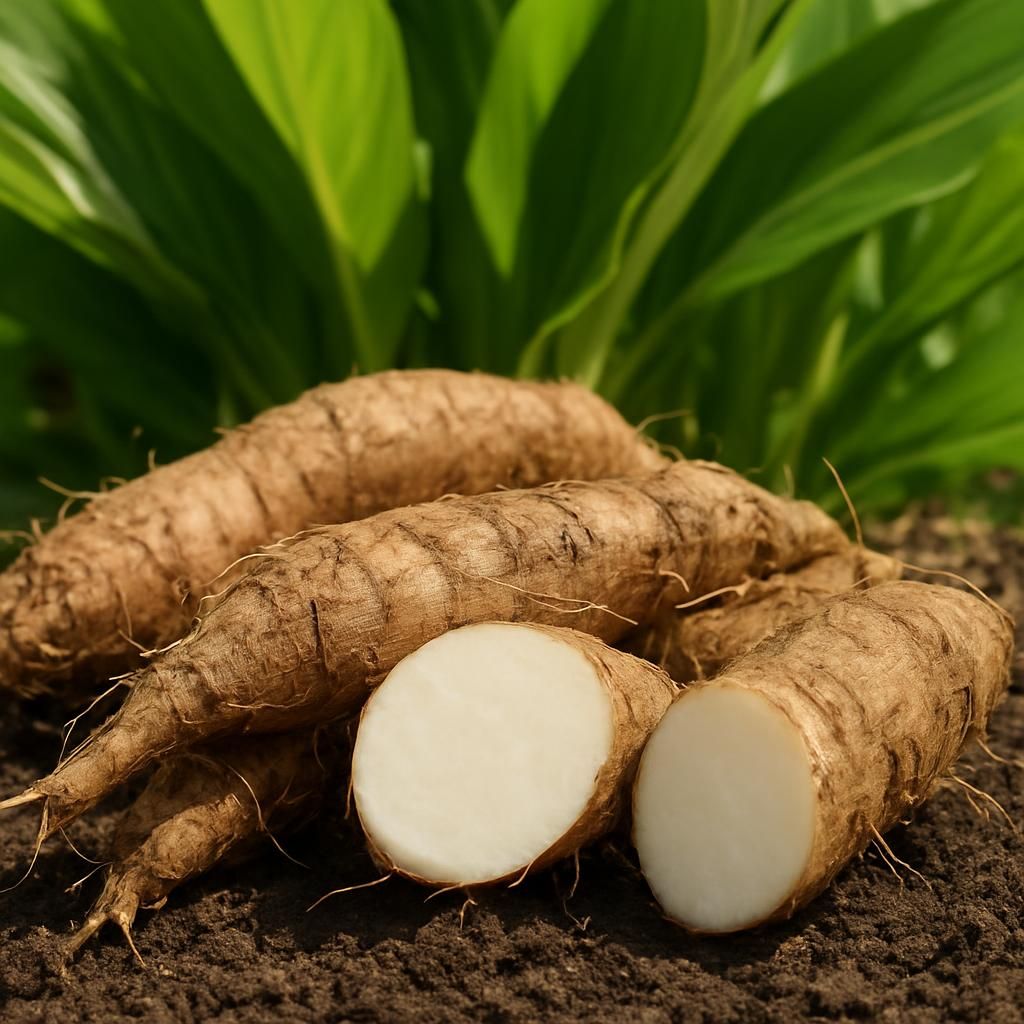
Introduction to Canna (Edulis - Achira)
Canna edulis, widely recognized as Achira, is a perennial herbaceous plant cultivated primarily for its edible rhizomes that contain high levels of easily digestible starch. Native to the Andean region, it has been grown for centuries by indigenous communities in South America and is now spreading to tropical highlands and subtropical lowlands worldwide. The plant produces large, arrow-shaped leaves and striking flowers, making it dual-purpose for both food security and landscape use. Its rhizomes can reach 30–60 cm in length and contain 20–30% starch on a fresh-weight basis, offering a gluten-free alternative to potato and cassava.
Farmers value Achira for its resilience to poor soils, moderate drought tolerance once established, and relatively low pest pressure compared to other root crops. The crop fits well into smallholder systems seeking climate-resilient staples that require limited external inputs. In addition to human consumption, the starch extracted from Achira rhizomes is used in traditional Andean foods, industrial thickeners, and even biodegradable packaging materials.
Botanical Profile of Canna (Edulis - Achira)
Canna indica var. edulis belongs to the Cannaceae family and is characterized by large, alternate leaves with prominent parallel veins and a pseudostem formed by overlapping leaf sheaths. Mature plants reach 1.5–3 m in height with a clumping growth habit. The inflorescence consists of showy red, orange, or yellow flowers that attract pollinators, although seed production is limited and propagation is almost exclusively vegetative via rhizome divisions.
The edible portion consists of thickened, branched rhizomes covered by a thin, fibrous skin that is easily removed after harvest. Internally, the flesh is white to cream-colored with a crisp texture when young and becomes floury when mature. Rhizomes contain approximately 70–75% moisture, 20–25% starch, 1–2% protein, and notable levels of potassium and calcium. Unlike many other root crops, Achira starch granules are exceptionally large (up to 100 µm), giving the cooked product a smooth, glossy texture prized in traditional cuisine.
Soil, pH, and Climate Requirements for Canna (Edulis - Achira)
Achira performs best in deep, well-drained loamy soils but tolerates a wide range of textures including sandy loams and clay loams provided drainage is adequate. The plant prefers slightly acidic to neutral conditions and benefits from moderate organic matter content to support microbial activity around the rhizosphere.
| Parameter | Ideal Range | Notes |
|---|---|---|
| Soil Type | Loam to sandy loam | Avoid waterlogged heavy clays |
| Soil pH | 5.5 – 7.0 | Optimal nutrient uptake occurs near 6.0 |
| Temperature | 18 – 30 °C daytime | Frost sensitive below 5 °C |
| Annual Rainfall | 800 – 2000 mm | Supplemental irrigation in dry periods |
| Altitude | 0 – 2500 m | Performs well in tropical highlands |
| Organic Matter | 2 – 4 % | Improves water retention and fertility |
Step-by-Step Planting & Propagation
Propagation of Achira is achieved exclusively through division of healthy rhizomes. Select disease-free mother plants at the end of the dormant season and cut rhizomes into sections each containing at least one vigorous bud. Allow cut surfaces to suberize for 24–48 hours before planting to reduce rot risk.
Plant rhizome pieces 8–12 cm deep and 40–60 cm apart in rows spaced 80–100 cm. Early planting should coincide with the onset of reliable rains or irrigation availability. In cooler climates, start rhizomes in nursery beds or containers 4–6 weeks before the last frost and transplant after soil temperatures exceed 15 °C. Maintain consistent moisture during the first 30 days to encourage rapid shoot emergence.
Care & Maintenance regimes for Canna (Edulis - Achira)
Achira requires moderate attention during the active growth phase. Mulching with 5–8 cm of organic material conserves soil moisture, suppresses weeds, and moderates soil temperature. Weed control is critical during the first 60 days; thereafter the dense canopy shades out most competitors. Fertilizer applications should be split to match peak demand periods around 30 and 90 days after planting.
| Growth Stage | Water Schedule | Fertilizer Schedule | Pruning/Maintenance |
|---|---|---|---|
| Establishment (0-30 days) | 25–30 mm/week or maintain field capacity | 20 kg N/ha at planting | Remove damaged leaves, no pruning |
| Vegetative (30-90 days) | 20–25 mm/week, reduce if rainfall adequate | 40 kg N + 30 kg K2O/ha split applications | Remove flower stalks to direct energy to rhizomes |
| Tuber Bulking (90-150 days) | 15–20 mm/week, allow slight drying between irrigations | 30 kg N/ha at 90 days | Minimal; cut back senescing foliage at harvest |
Pests, Diseases & Organic Management
Achira is relatively pest-resistant, yet several insects and pathogens can reduce yields if left unchecked. Aphids and Spider mites occasionally colonize leaf undersides during hot, dry spells. Regular scouting and releases of predatory mites or lady beetles provide effective biological control. Slugs may damage young shoots in humid environments; beer traps and copper barriers offer organic solutions.
Fungal issues such as Rhizoctonia crown rot and Pythium root rot occur in poorly drained soils. Improving drainage, avoiding over-irrigation, and incorporating well-composted organic matter reduce incidence. Crop rotation with non-host species such as Corn or Rice further lowers soil-borne pathogen pressure. Viral diseases are rare but can be managed by using certified clean planting material.
Harvesting, Curing & Optimal Storage
Rhizomes reach physiological maturity 150–180 days after planting when foliage begins to yellow and senesce. Harvest by carefully lifting clumps with a fork to avoid bruising. Separate daughter rhizomes from the mother clump and trim excess roots and foliage.
Curing for 3–5 days in a shaded, well-ventilated area at 20–25 °C allows cut surfaces to heal and reduces storage rots. Store cured rhizomes in cool (10–15 °C), dark conditions with 85–90 % relative humidity. Under these conditions, marketable quality is maintained for 4–6 months. For longer storage, slice and dry rhizomes into chips or extract starch for flour production.
Companion Planting for Canna (Edulis - Achira)
Achira integrates well into polyculture systems. Pairing with nitrogen-fixing legumes such as Beans or Peas improves soil fertility while the tall canna canopy provides partial shade for understory crops. Marigold planted along borders repels nematodes and enhances biodiversity. Avoid planting near solanaceous crops that share similar pests. Intercropping with Banana provides mutual wind protection and efficient land use in tropical smallholdings.