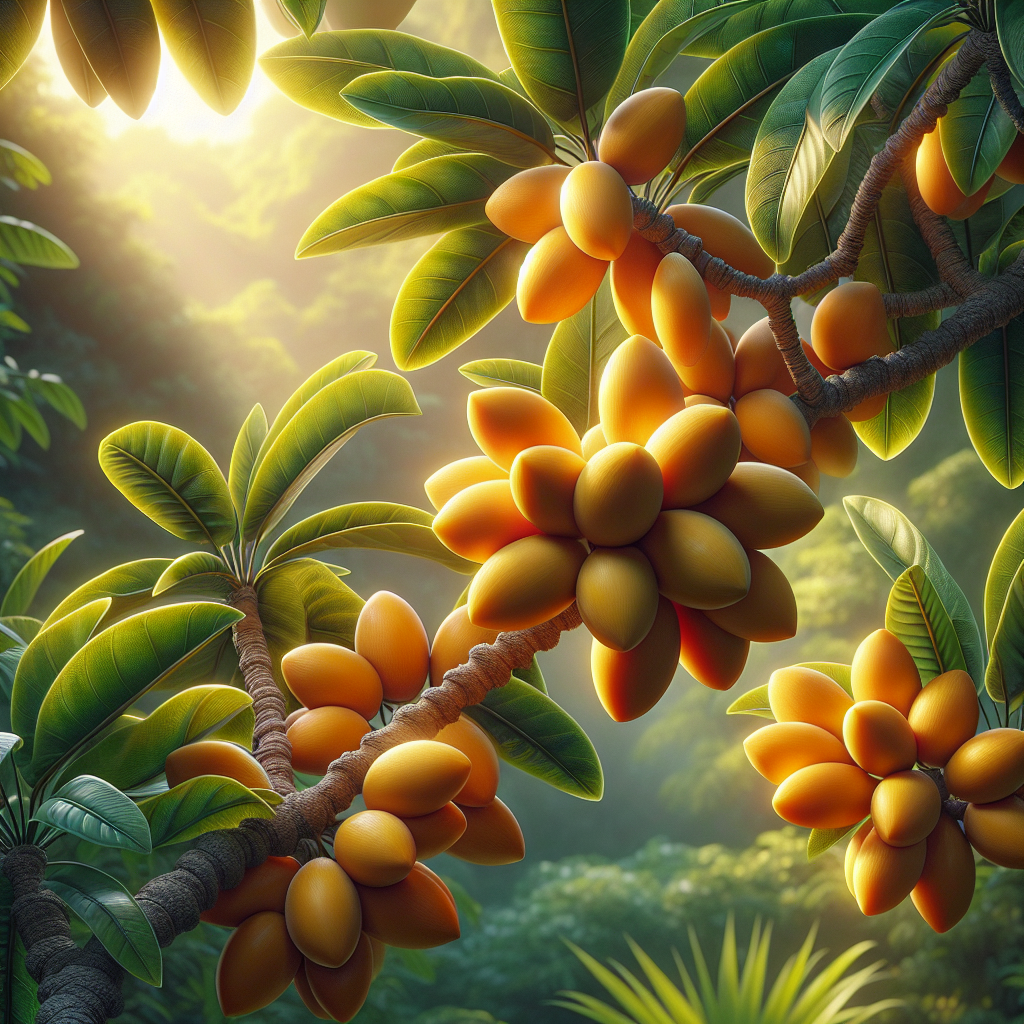
Introduction to Canistel (Bruce)
Canistel (Bruce), scientifically known as Pouteria campechiana, is a fascinating tropical fruit tree often called egg fruit, yellow sapote, or ti-escalote. This evergreen species hails from southern Mexico and Central America, where it has been cultivated for centuries by indigenous communities. The 'Bruce' cultivar is particularly prized for its large, oval fruits that weigh up to 1 pound, featuring a vibrant yellow-orange flesh with a unique, sweet flavor profile blending honey, chestnut, and pumpkin notes. When fully ripe, the flesh achieves a dense, custard-like texture similar to a hard-boiled egg yolk, making it ideal for fresh eating, smoothies, custards, and desserts.
This crop stands out in tropical agriculture for its resilience and productivity. Mature trees can produce 100-300 fruits per season, with yields increasing over time. Nutritionally, canistel is a powerhouse, boasting high levels of beta-carotene (vitamin A precursor), vitamin C, riboflavin, niacin, and minerals like potassium and calcium. It's low in calories yet rich in fiber, supporting digestive health and immune function. For small-scale farmers and home gardeners in USDA zones 10-11 or equivalent tropical regions, Canistel (Bruce) offers a reliable, exotic addition to orchards, with fruits ripening mainly from late summer to fall but capable of year-round production in optimal conditions.
Despite its potential, canistel remains underutilized outside its native range due to limited awareness. However, with rising demand for unique tropical fruits in niche markets, growers are discovering its profitability. Trees are long-lived, often fruiting for 50+ years, and tolerate a range of soils, making it accessible for permaculture systems. This guide provides professional-grade advice to maximize yields, from propagation to harvest. For more on tropical fruit companions, check the Mango (crop) page.
Botanical Profile of Canistel (Bruce)
Canistel (Bruce) belongs to the Sapotaceae family, which includes relatives like mamey sapote and sapodilla. The tree grows to 20-40 feet tall in its natural habitat, though dwarfing rootstocks or pruning can keep it at 15-25 feet for easier management. It features a dense, symmetrical canopy with glossy, elliptical leaves 4-8 inches long, arranged spirally. New growth emerges bronze-red, maturing to deep green, providing year-round shade and ornamental appeal.
Flowers are small (0.5 inches), yellowish-green, and bell-shaped, appearing in clusters along branches. Canistel is dioecious or polygamous, but most cultivars like 'Bruce' are self-fertile, though cross-pollination boosts yields. Fruits develop parthenocarpically in some cases but are larger with pollination. The 'Bruce' variety produces oblong fruits 4-6 inches long, with thick, orange-yellow skin and 1-5 large brown seeds. Ripe flesh is smooth, sweet (Brix 20-25), and egg-like, ripening 8-10 months after flowering.
Growth habits include a deep taproot system for drought tolerance and sensitivity to frost below 28°F (-2°C). Annual growth is moderate, 2-3 feet, accelerating in humid tropics. Phenology aligns with wet seasons: flowering peaks post-dry spell, fruit set during rains. For detailed tropical tree cultivation, see Soil Health Mastery: 5 Proven Strategies for Small Farms to Build Fertile Ground Without Breaking the Bank.
Soil, pH, and Climate Requirements for Canistel (Bruce)
Canistel (Bruce) excels in well-drained, fertile soils but adapts to poor conditions better than many tropicals. Ideal soil is sandy loam or loamy sand with 2-5% organic matter, avoiding heavy clays prone to waterlogging. pH range is broad: 5.5-7.5, with optimal 6.0-7.0. Test soil annually; amend acidic soils with dolomite lime (1-2 lbs per tree) and alkaline with sulfur or peat moss.
Climate demands are tropical/subtropical: average temperatures 70-90°F (21-32°C), no prolonged freezes. It tolerates short droughts but fruits best with 50-80 inches annual rainfall, evenly distributed. Humidity above 60% supports growth; dry winds cause leaf scorch. Full sun (8+ hours) is essential; partial shade reduces yields by 30-50%. Elevation up to 3,000 feet suits it, but coastal areas with salt spray tolerance are ideal.
Mulch heavily (4-6 inches organic material) to retain moisture and suppress weeds. In cooler climates, use frost protection like micro-sprinklers or covers. Windbreaks from Guava (crop) or native hedges prevent damage. Monitor for salinity; EC below 2.0 dS/m prevents stunting.
Step-by-Step Planting & Propagation
Propagation: Fresh seeds germinate in 2-6 weeks at 77-86°F (25-30°C). Clean pulp, plant 1-inch deep in sterile mix. Grafted 'Bruce' scions on seedling rootstock ensure trueness; chip-bud in rainy season. Air-layering works for mature trees: girdle branch, apply rooting hormone, wrap in sphagnum, roots in 8-12 weeks.
Site Prep: Select full-sun site with spacing 20-25 feet apart (15x15 for dwarfs). Dig 2x2x2 ft holes, mix native soil 50/50 with compost. Plant post-rainy season; elevate graft union 6 inches above soil.
Planting Steps: 1. Water seedling/graft overnight. 2. Place in hole, spread roots. 3. Backfill, firm soil, stake if needed. 4. Water deeply (10-20 gallons), mulch 3-4 ft radius. 5. Fertilize lightly post-planting: 1 lb 10-10-10 per tree.
Early Care: Irrigate weekly first year; train to central leader. Expect fruit in 3-5 years from seed, 2-3 from graft.
Care & Maintenance regimes for Canistel (Bruce)
Watering: Deep, infrequent; 1-2 inches/week young trees, mature drought-tolerant. Drip irrigation optimal.
Fertilization: Annual: 1-2 lbs NPK 8-3-9 per tree year 1-3, increase 2 lbs/year to maturity. Micronutrients: iron chelate if chlorotic. Foliar sprays monthly during growth.
Pruning: Annual winter: remove dead/crossing branches, thin canopy for light penetration. Tip prune to encourage bushiness.
Weed Control: Mulch + manual; avoid herbicides near trunk. Intercrop with legumes first years.
Monitor growth; adjust based on vigor. Mature trees need minimal input, yielding consistently.
Pests, Diseases & Organic Management
Common pests: Aphids (pest), Scale insects (pest), fruit flies. Organic fixes: neem oil sprays, beneficial insects like ladybugs. Mealybugs: alcohol dips on branches.
Diseases: Root rot (disease) from Phytophthora in wet soils—improve drainage, use biofungicides. Anthracnose: copper sprays preventively. For advanced strategies, explore Why 90% of Small Farms Fail at Pest Management - And 8 Organic Fixes That Actually Work—wait, no, use the available one.
Cultural IPM: sanitation, resistant rootstocks, monitoring.
Harvesting, Curing & Optimal Storage
Harvest when skin yellows fully, fruits hard—soften at room temp 3-10 days. Twist or clip; yield 50-100 lbs/tree mature. Cure in shade; store ripe at 50°F (10°C), 85-90% RH up to 3 weeks. Process into pulp, freeze for 12+ months.
Companion Planting for Canistel (Bruce)
Pair with nitrogen-fixers like pigeon pea, Pineapple (crop) for groundcover. Avoid water-hogging crops. Benefits from marigolds against nematodes. See Fall Companion Planting Guide: Boost Yields and Soil Health for Small Farms and Gardens for ideas.