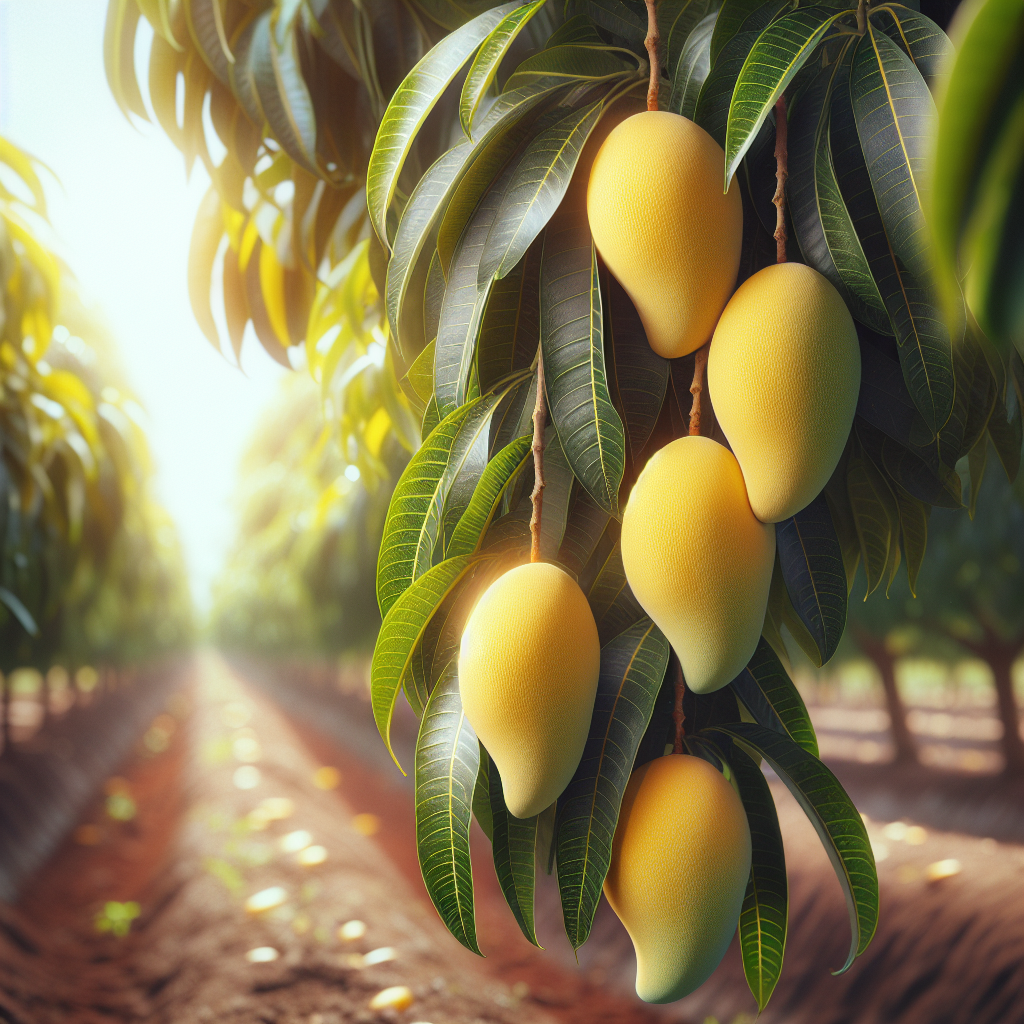
Introduction to Banganapalli Mango
Originating from the Banganapalle region of present-day Andhra Pradesh, this cultivar is one of the most commercially respected Indian mangoes and is widely traded for its attractive appearance, dependable fruit size, and excellent table quality. It is also known in some markets as Benishan or Banganapalle, and it has earned long-standing preference among growers because the fruit is typically large, oblong, smooth-skinned, and visually uniform, making it suitable for both fresh local sale and longer-distance transport.
This is primarily a dessert mango rather than a processing type. The flesh is deep yellow to saffron-yellow, moderately firm when mature-ripe, pleasantly sweet, and notably low in fiber compared with many traditional seedling mangoes. That low-fiber texture is one of the reasons the variety is highly valued by consumers. Compared with some intensely aromatic cultivars, Banganapalli often expresses a cleaner, milder sweetness and elegant aroma, which broadens its market acceptance.
From a grower’s standpoint, the cultivar is best suited to organized orchard systems rather than casual unmanaged planting. Good canopy architecture, regulated irrigation, balanced nutrition, and timely pest management are essential if the goal is export-grade or premium domestic fruit. If you are new to mango culture in general, a broader Mango guide can help frame the species-level basics before you refine practices for this cultivar.
Botanical Profile of Banganapalli Mango
This cultivar belongs to the species Mangifera indica, a long-lived evergreen tree in the family Anacardiaceae. Mature trees can become quite vigorous if left unpruned, often reaching 10-15 meters or more under traditional conditions, though modern commercial orchards usually maintain a much lower canopy, often 4-6 meters, for spray coverage, light penetration, and easier harvesting.
Young flushes commonly emerge reddish to bronze before maturing to glossy green. Leaves are leathery, lanceolate, and arranged alternately. Panicles are terminal, branched inflorescences that can bear hundreds to thousands of small flowers, though only a small fraction set fruit. Mango flowers are functionally mixed: many are male, while fewer are hermaphrodite and capable of setting fruit. Successful fruiting depends heavily on temperature, humidity, carbohydrate status of shoots, and pollinator activity.
Banganapalli fruit is typically elongated-oblique with a smooth peel and relatively thin to medium skin. At physiological maturity, peel color transitions from green to light greenish-yellow, then to rich golden yellow during ripening. The stone is medium-sized relative to fruit size, and the pulp percentage is favorable. The flesh is low in fiber, making it especially desirable for fresh eating. Fruit weight often ranges around 300-500 grams under average orchard conditions, but well-managed trees can produce larger specimens.
Cultivar behavior matters. Banganapalli tends to respond strongly to seasonal shifts and crop load. Heavy flowering followed by poor fruit retention can occur if trees are nutritionally imbalanced or weather fluctuates during bloom. It may also show alternate bearing tendencies under stress, where a heavy crop year is followed by a lighter one. Good pruning, nutrition, and post-harvest care help reduce that cycle.
Soil, pH, and Climate Requirements for Banganapalli Mango
The ideal soil is deep, well-drained, and aerated, with at least 1.5-2 meters of effective rooting depth. Mango roots do not tolerate prolonged water stagnation. Banganapalli is especially vulnerable to decline in poorly drained clay basins where the root zone remains saturated after irrigation or monsoon rain. If water stands in the basin for more than 24-48 hours repeatedly, expect root stress, nutrient imbalance, reduced flowering, and increased disease pressure.
Best soils are sandy loam, loam, red loam, or well-structured alluvial soils with high internal drainage. Heavy black cotton soils can be used only if drainage is excellent and irrigation is conservative. Avoid shallow hardpan soils, saline depressions, or fields with a high water table. Ideally, groundwater should remain below 2 meters during the rainy season.
The preferred soil pH is about 5.5-7.5, though trees can survive somewhat outside that range. For top performance, target 6.0-7.0. Below pH 5.0, aluminum toxicity, weak root activity, and poor calcium-magnesium balance may occur. Above pH 8.0, iron, zinc, and manganese deficiencies become common, often visible as interveinal chlorosis on young leaves. In calcareous soils, repeated foliar micronutrient sprays are often necessary.
Climate is decisive. Banganapalli thrives in tropical to warm subtropical zones with hot summers, mild winters, and a dry spell preceding flowering. Optimal temperatures for vegetative growth are roughly 24-32°C. Flower initiation is favored by relatively cool, dry conditions, often around 15-20°C nights in subtropical regions without frost. Severe heat above 40-42°C during flowering can scorch panicles and reduce fruit set, while high humidity and rain during bloom increase Anthracnose and Powdery mildew risks.
Frost is highly damaging. Young trees may be killed at temperatures near 0°C, and even mature trees can suffer shoot damage. Wind exposure is another hidden constraint. Strong hot winds during fruit development can cause fruit drop, leaf scorch, and skin blemishes. Windbreaks or strategic orchard layout can reduce these losses.
Annual rainfall of 750-2500 mm can be workable if it is seasonally distributed and drainage is secure. What matters most is not just total rainfall, but having a relatively dry flowering and fruit-set window. Continuous rain during bloom is one of the fastest ways to ruin a potential crop.
Step-by-Step Planting & Propagation
Commercial orchards should use grafted plants, not seedlings. Seedling trees are genetically variable, slow to bear, and unreliable in fruit quality. Veneer grafting, epicotyl grafting, or softwood grafting onto vigorous mango rootstocks is standard. Select nursery plants that are 8-12 months old, healthy, pest-free, with a straight graft union and no circling roots.
Before planting, test soil for pH, electrical conductivity, organic carbon, phosphorus, potassium, calcium, magnesium, boron, zinc, and salinity hazards. Deep-rip compacted land if necessary. Establish drainage channels before the first rainy season, not after problems begin.
Planting is usually best done at the onset of monsoon in rainfed areas or post-monsoon to early spring in irrigated systems, provided frost danger is absent. In many Indian conditions, June-August or September-October are common windows depending on rainfall pattern.
Spacing depends on management intensity:
- Traditional orchards: 10 x 10 m or 12 x 12 m
- Moderate-density systems: 8 x 8 m
- High-density systems with regular pruning: 5 x 5 m to 6 x 4 m in suitable intensive setups
For long-term ease, many growers choose 8 x 8 m where vigor is moderate and management is practical. High-density planting can boost early returns but only if pruning discipline is excellent.
Prepare pits around 1 x 1 x 1 m in poor soils, or 60 x 60 x 60 cm in fertile loose soils. Refill with topsoil mixed with 20-30 kg well-decomposed farmyard manure or compost, plus neem cake if available. Avoid placing fresh manure in direct contact with roots. In termite-prone soils, incorporate organic deterrents and maintain field sanitation.
At planting:
- Irrigate the pit lightly the previous day if the soil is dry.
- Remove the nursery bag carefully without breaking the root ball.
- Set the plant so the graft union remains at least 15-20 cm above soil level.
- Backfill gently and firm the soil to remove air pockets.
- Form a shallow basin around the plant.
- Stake if wind is likely.
- Mulch, keeping mulch 10-15 cm away from the trunk.
Immediately after planting, water thoroughly so moisture penetrates the full root ball. For the first 6-8 weeks, keep soil evenly moist but never soggy. A useful field target is moisture near field capacity in the top 20-30 cm, then allowing slight drying before the next irrigation. If soil from the root zone forms a weak ball in the hand but does not ooze or smear, moisture is generally acceptable. If it stays sticky, greasy, and smells sour, overwatering is likely.
Care & Maintenance regimes for Banganapalli Mango
Young trees require structured training. During the first year, remove shoots below the graft union. Encourage 3-4 well-spaced primary scaffold branches beginning 60-100 cm above ground. Avoid narrow crotch angles because they split under crop load. In years 2-3, develop secondary branches evenly around the tree so the canopy becomes open but balanced.
Irrigation must change with age and season. Young trees need frequent light-to-moderate irrigation because their roots occupy a limited soil volume. Mature trees need deeper, less frequent watering. During active vegetative growth and fruit development, irrigate to wet 45-90 cm depth depending on soil texture. Sandy soils may need watering every 4-7 days in hot weather; loams every 7-12 days; heavier soils even less often. Drip irrigation is strongly preferred because it avoids chronic trunk wetness and improves fertilizer efficiency.
A critical nuance for mango is moisture regulation before flowering. In many production zones, slight water stress before floral induction helps suppress excessive vegetative flush and encourages bloom. Once panicles emerge and fruit sets, severe moisture stress must be avoided or fruit drop increases. Overirrigation at this stage can be just as harmful, promoting soft vegetative growth and disease.
Signs of underwatering include dull leaves, downward leaf folding, reduced flush length, and increased fruit shedding during hot windy periods. Signs of overwatering include pale or yellowing leaves, blackened feeder roots, sour-smelling soil, algae on basins, trunk collar stress, and delayed panicle development.
Nutrition should be based on leaf and soil testing, but a general framework helps. Young non-bearing trees benefit from split applications of nitrogen during the warm growing season with moderate phosphorus and potassium. Bearing trees need balanced nutrition with special attention to potassium, calcium, boron, and zinc. Excess nitrogen pushes vegetative growth at the expense of flowering and can worsen pest problems.
Organic matter is highly beneficial. Annual application of compost or well-rotted farmyard manure improves soil structure, microbial activity, and nutrient buffering. Mulching with dry leaves, straw, or shredded prunings helps moderate soil temperature, conserve water, and reduce weed competition. Keep mulch away from direct trunk contact to prevent collar rot.
For micronutrients, foliar sprays of zinc sulfate and boron are commonly useful in deficient orchards, especially before flowering and after fruit set. Calcium sprays may improve skin strength and reduce some physiological issues, though program details should reflect local deficiency status.
Pruning in mango is not about heavy annual cutting like some temperate fruit trees. Instead, use selective canopy management:
- Remove dead, diseased, and crossing branches.
- Open the center enough for light and spray penetration.
- After harvest, lightly head back excessively vigorous shoots if size control is needed.
- In high-density orchards, summer and post-harvest pruning are essential to keep trees within manageable height.
Orchard floor management should reduce competition without leaving soil bare and erosion-prone. Ring weeding around young trees is essential. In mature orchards, living groundcovers or seasonal intercrops can help if they do not compete excessively for water during flowering and fruit fill. For broader fertility planning, see Soil health strategies.
Pests, Diseases & Organic Management
Fruit fly is one of the most serious pests. Female flies puncture fruit to lay eggs, and larvae feed inside the pulp, making fruit unmarketable. Sanitation is the first defense: collect and destroy fallen fruit at least twice weekly during the season. Use methyl eugenol traps where appropriate for monitoring and male annihilation. Bagging high-value fruit can also reduce damage.
Mango hoppers attack panicles and tender shoots, sucking sap and reducing fruit set. Their honeydew also encourages Sooty mold. Organic management includes pruning for airflow, avoiding excessive nitrogen, using yellow sticky monitoring tools, and targeted applications of neem-based formulations during early infestation periods.
Mealybugs can climb trunks and infest shoots, panicles, and fruit. Banding trunks before the crawler stage and destroying weed hosts around the basin can greatly reduce infestation. Beneficial insects often help when broad-spectrum pesticides are avoided.
Stem borer and Bark-eating caterpillar are more serious in neglected orchards. Watch for frass, gum exudation, or boreholes. Remove affected bark carefully and destroy larvae mechanically when infestations are localized.
Anthracnose, caused by Colletotrichum spp., is among the most damaging diseases in humid conditions. It affects panicles, leaves, flowers, and fruit, often remaining latent until ripening. Powdery mildew is especially destructive during cool, dry mornings with humid nights and can wipe out bloom if unmanaged. Sooty mold, Red rust, and Bacterial black spot may also occur depending on region.
Organic disease management relies on prevention:
- Maintain open canopies for rapid drying after dew or rain.
- Avoid overhead irrigation during flowering.
- Remove diseased twigs after harvest.
- Improve potassium and calcium balance for better tissue resilience.
- Use copper- or sulfur-based approved sprays at critical windows where permitted locally.
Timing matters most around panicle emergence, full bloom, pea-sized fruit, and pre-harvest humid spells. Organic systems succeed when they treat disease pressure as a calendar and microclimate issue, not merely a product issue.
Physiological disorders can also reduce quality. Spongy tissue is less associated with this cultivar than some others, but internal breakdown, sunburn, uneven ripening, and sap burn can still occur. Balanced nutrition, proper harvest maturity, and careful handling are the main safeguards.
Harvesting, Curing & Optimal Storage
Harvest maturity should be judged by a combination of shoulder filling, peel color break, days from fruit set, specific gravity, and experience with local season timing. In Banganapalli, fruit should not be harvested too immature merely to extend shelf life. Immature fruit lacks full sugar development and may ripen with flat flavor and shriveled skin.
Typical maturity signs include full cheeks, a slight yellowing near the stalk end or shoulders, and a more developed, less angular fruit profile. The pulp near the stone should have reached physiological maturity. Fruit harvested at this stage will ripen more evenly and express the cultivar’s characteristic sweetness.
Use clippers rather than pulling fruit by hand. Leave a short stalk stub initially to reduce sap flow over the peel. De-sapping is critical because latex burn can scar the skin badly. Place freshly harvested fruit stem-end downward on racks or padded surfaces for 20-30 minutes so sap drains away from the peel. Some packhouses trim the stem after initial draining.
Sorting should remove bruised, insect-damaged, diseased, or malformed fruit. Wash only if the drying process is controlled and sanitation is good. Wet fruit held in warm, poorly ventilated conditions rapidly develops post-harvest disease.
Curing in mango often refers to allowing harvested fruit to stabilize, de-sap, and begin controlled ripening under clean, shaded, ventilated conditions. Ideal pre-ripening holding temperatures are generally around 18-24°C depending on desired marketing window. For normal ripening, 20-24°C is often suitable. Very low temperatures can cause chilling injury, especially below about 10-13°C depending on maturity stage.
For storage, mature-green fruit may hold for 2-3 weeks under carefully managed cool conditions, while ripe fruit has a much shorter market life. Relative humidity around 85-90% helps reduce shrivel, but excessive condensation must be avoided. Good airflow is essential.
Never stack fruit deeply without padding. Compression marks quickly lower market value. Use single or shallow layers in crates with soft liners for premium fruit. If shipping, maintain consistent temperatures; fluctuations accelerate condensation and fungal development.
Companion Planting for Banganapalli Mango
In young orchards, companion planting should support soil health, pollinator activity, and weed suppression without creating severe competition for water or harboring major shared pests. The most useful companions are low-growing or seasonally managed species rather than aggressive perennial competitors.
Clover is valuable as a nitrogen-contributing living cover in suitable climates, especially where irrigation is available and competition is monitored. It can reduce erosion, improve soil structure, and feed beneficial insects when managed by mowing before excessive seed set.
Sunflower can attract pollinators and beneficial insects to the orchard edge, though it should not be packed densely near young trees where it may compete for moisture. Nasturtium works well in smaller mixed orchards as a trap and pollinator-support plant, while Thai Basil can help diversify beneficial insect activity and provide an aromatic understory in intensively managed garden-scale plantings.
In commercial systems, intercrops are best limited to the juvenile years before the canopy closes. Short-duration legumes are often ideal because they improve ground cover and add biomass. Avoid tall, shading, or water-hungry companion species during flowering and fruit fill. Keep at least a weed-free ring around the trunk of young trees, and terminate companion covers if soil moisture becomes limiting.
Good companions are helpers, not permanent competitors. The right system improves infiltration, reduces bare-soil heat, and supports orchard ecology; the wrong one steals moisture from the feeder-root zone just when fruit retention depends on steady plant water status.