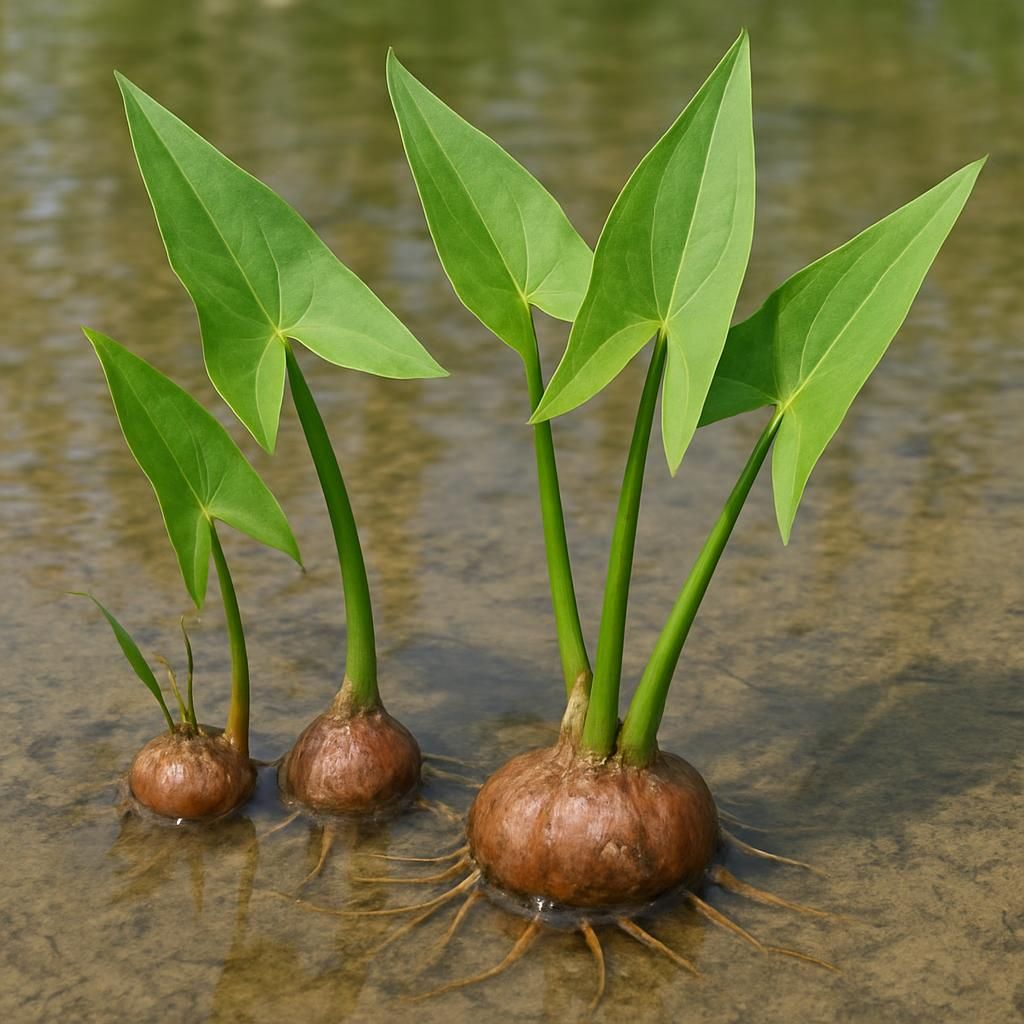
Introduction to Arrowhead
Arrowhead (Sagittaria sagittifolia) is a versatile aquatic vegetable grown primarily for its starchy underground corms. The plant has been cultivated for centuries in East Asia, where the tubers are prized for their mild, slightly sweet flavor and firm texture when cooked. In addition to human consumption, the corms serve as livestock feed and the foliage provides habitat for aquatic wildlife. Because the crop tolerates standing water, it fits perfectly into marginal lands or rice-based rotations.
Modern interest in Arrowhead is rising due to its climate resilience and low fertilizer demand. When grown under controlled flooding, the plant suppresses terrestrial weeds and reduces soil erosion. Commercial growers report yields of 15–25 tonnes per hectare under optimal conditions. The crop cycle is relatively short (5–7 months from planting to harvest), allowing double-cropping in warmer regions.
Botanical Profile of Arrowhead
Arrowhead belongs to the Alismataceae family and is a herbaceous perennial that produces arrow-shaped aerial leaves and submerged linear leaves. The plant spreads via stolons and produces terminal tubers 3–8 cm long. Flowers are white with three petals and appear in whorls on leafless scapes during summer. The species is diploid (2n = 22) and readily hybridizes with related Sagittaria taxa.
The edible portion is the starchy corm, which stores carbohydrates as starch granules up to 25 % fresh weight. Tubers remain dormant during winter and resume growth when soil temperature exceeds 12 °C. The root system is fibrous and shallow, rarely exceeding 30 cm depth, making the crop sensitive to deep tillage after establishment.
Soil, pH, and Climate Requirements for Arrowhead
Arrowhead thrives in heavy clay or silty loam soils that retain water. A minimum soil depth of 25 cm above an impermeable layer is recommended to prevent seepage. The crop performs best under continuous shallow flooding (5–15 cm water depth) during the vegetative stage.
| Parameter | Ideal Range | Notes |
|---|---|---|
| Soil Type | Clay loam to silty clay | High water-holding capacity essential |
| Soil pH | 6.0 – 7.5 | Slightly acidic to neutral; avoid saline soils |
| Temperature (Air) | 18 – 30 °C daytime | Frost sensitive below 5 °C |
| Water Temperature | 15 – 28 °C | Maintain stable flooding for tuberization |
| Growing Season Length | 150 – 210 days | Longer season increases corm size |
| Altitude | 0 – 1 200 m | Lowland tropical to temperate zones |
| Organic Matter | 3 – 6 % | Improves structure and nutrient retention |
Step-by-Step Planting & Propagation
Site Preparation: Level the field to a uniform grade of 0.2 % slope. Install inlet and outlet structures to maintain precise water depth. Incorporate 10–15 t ha⁻¹ well-rotted farmyard manure two weeks before flooding.
Corm Selection: Choose healthy, disease-free corms 4–6 cm in diameter. Pre-sprout corms in moist sand at 20 °C for 10–14 days until shoots reach 5 cm.
Planting Window: In temperate climates plant when soil temperature stabilizes above 15 °C (late April–May). In tropical regions any month with reliable water supply is suitable.
Spacing and Depth: Plant corms 15 cm deep on a 30 cm × 30 cm grid. This density (11 plants m⁻²) balances light interception and tuber size.
Initial Flooding: After planting, maintain 3–5 cm water depth for the first 10 days to encourage rooting, then raise to 8–12 cm.
Care & Maintenance regimes for Arrowhead
Consistent water management is the single most important factor. Maintain 8–12 cm flooding until flowering, then lower to 3–5 cm to promote tuber bulking. Aerate water weekly by draining and refilling to prevent anaerobic conditions.
| Growth Stage | Water Depth | Fertilizer Schedule | Pruning / Thinning |
|---|---|---|---|
| Establishment (0–30 days) | 3–5 cm | 40 kg N, 30 kg P₂O₅, 30 kg K₂O ha⁻¹ at planting | Remove weak shoots at 20 days |
| Vegetative (30–90 days) | 8–12 cm | 30 kg N at 45 days; 20 kg K₂O at 60 days | Thin to 2–3 shoots per plant |
| Flowering (90–120 days) | 5–8 cm | Foliar micronutrients (Fe, Zn, B) if deficient | Deadhead spent flowers |
| Tuber Bulking (120–180 days) | 3–5 cm | No additional N; maintain K levels | Remove senescing leaves to improve light |
Pests, Diseases & Organic Management
Major insect threats include Aphids and Thrips that vector viruses. Root-knot nematodes can reduce tuber quality; rotate with Rice or flooded Taro to break cycles. Fungal issues such as Pythium and Phytophthora are mitigated by maintaining oxygenated water and avoiding over-fertilization.
Organic controls begin with cultural practices: use certified clean seed corms, maintain 10 cm water depth to drown soil pests, and introduce predatory fish (tilapia or carp) at 2 fish m⁻². Neem oil (0.5 % emulsion) applied every 14 days controls aphids and thrips. Copper hydroxide sprays (1 kg ha⁻¹) manage bacterial leaf spots when incidence exceeds 5 %.
Harvesting, Curing & Optimal Storage
Arrowhead reaches harvest maturity when leaves begin to yellow and water temperature drops below 18 °C. Drain fields 7–10 days prior to harvest to firm the soil. Use a modified potato harvester or manual digging forks to lift corms, taking care not to bruise the thin skin.
Post-harvest curing involves washing corms in clean water, air-drying for 24 hours, and storing at 4–7 °C with 85–90 % relative humidity. Under these conditions tubers remain marketable for 4–6 months. Avoid stacking more than 30 cm deep to prevent internal heating and sprouting.
Companion Planting for Arrowhead
Flooded Arrowhead systems pair well with Rice in alternate rows, providing mutual weed suppression and nitrogen scavenging. Water spinach (Ipomoea aquatica) planted along levees utilizes excess nutrients and provides additional income. Avoid planting with deep-rooted terrestrial crops that compete for water. Marigold borders deter nematodes and attract beneficial insects. In temperate climates, interplanting with Lotus extends the productive water surface while Arrowhead occupies the shallow margins.
Stop Treating Tomato Blight Like a Spray Problem: Here Is What Works Better