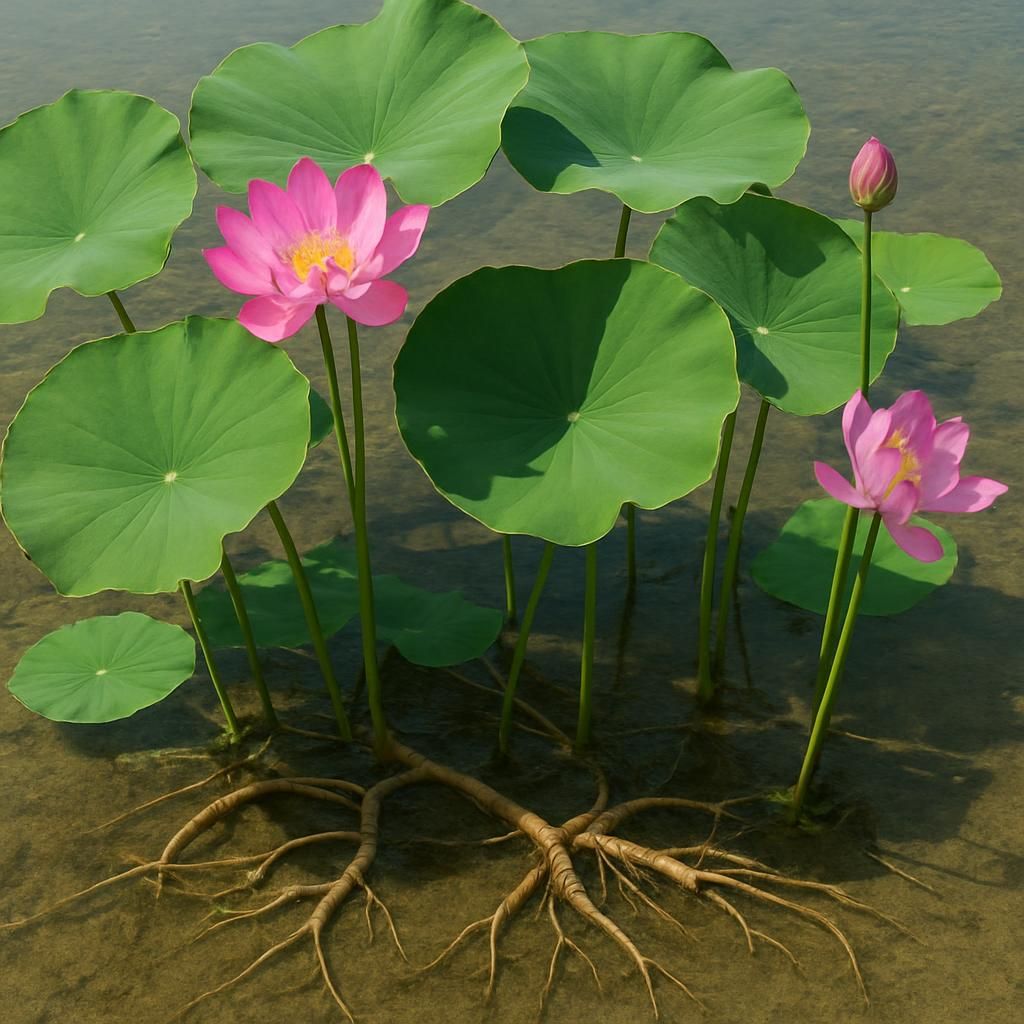
Introduction to lotus
Nelumbo nucifera, commonly known as lotus, is a versatile aquatic perennial valued for its crisp rhizomes, protein-rich seeds, and stunning blooms. Grown commercially in flooded paddies across Asia and increasingly in controlled aquatic systems worldwide, lotus offers high yields when managed with precision irrigation, balanced nutrition, and timely harvesting. This guide delivers professional-grade practices for soil preparation, planting, maintenance, pest control, and post-harvest handling to maximize both rhizome and seed production.
Botanical Profile of lotus
Lotus belongs to the Nelumbonaceae family and features large, circular peltate leaves that emerge above the water surface on long petioles. The plant produces thick, horizontal rhizomes that store starch and serve as the primary propagation material. Flowers are solitary, fragrant, and range from white to deep pink, developing into conical seed pods containing numerous hard-coated seeds. Rhizomes expand laterally through mud while vertical shoots reach the water surface, making lotus uniquely adapted to shallow aquatic environments.
Soil, pH, and Climate Requirements for lotus (MUST INCLUDE A MARKDOWN TABLE OF IDEAL CONDITIONS)
Lotus performs best in heavy clay or silty loam soils that retain water and nutrients. The crop requires warm temperatures, full sun exposure, and consistent shallow flooding. The following table summarizes ideal growing conditions:
| Parameter | Ideal Range | Notes |
|---|---|---|
| Soil Type | Clay or silty loam | High water-holding capacity essential |
| Soil pH | 6.0 – 7.5 | Slightly acidic to neutral preferred |
| Water Depth | 15 – 30 cm (growing season) | Increase to 45 cm during rhizome expansion |
| Water Temperature | 20 – 30 °C | Critical for rhizome and flower initiation |
| Air Temperature | 25 – 35 °C daytime | Frost-free period required |
| Sunlight | Full sun (≥ 8 hours) | Maximizes photosynthesis and flowering |
| Growing Season | 150 – 180 frost-free days | Tropical to warm temperate climates |
Step-by-Step Planting & Propagation
- Select healthy, disease-free rhizome segments containing at least two nodes and terminal buds.
- Prepare flooded beds or containers with 20–30 cm of amended clay soil.
- Plant rhizomes horizontally 10–15 cm deep with buds oriented upward in late spring when water temperature exceeds 20 °C.
- Maintain initial water depth at 5–10 cm until shoots emerge, then gradually raise to 15–30 cm.
- Space plants 60–90 cm apart in rows 1–1.5 m wide to allow leaf canopy development.
- For seed propagation, scarify hard seed coats and sow in shallow trays before transplanting seedlings at the 3–4 leaf stage.
Care & Maintenance regimes for lotus (MUST INCLUDE A MARKDOWN TABLE OF WATER, FERTILIZER, AND PRUNING SCHEDULES)
Consistent water management, targeted fertilization, and selective leaf removal are essential for high-quality rhizomes and abundant flowering. The schedule below outlines standard regimes for commercial production:
| Growth Stage | Water Depth & Management | Fertilizer Application | Pruning / Leaf Management |
|---|---|---|---|
| Establishment (0–4 weeks) | Maintain 5–10 cm; replace weekly | 5 kg NPK 10-10-10 per 100 m² at planting | Remove damaged leaves only |
| Vegetative (4–10 weeks) | Raise to 15–25 cm; monitor clarity | Side-dress 3 kg urea + 2 kg K₂SO₄ at week 6 | Thin overcrowded leaves for airflow |
| Flowering (10–16 weeks) | Stable 20–30 cm; avoid fluctuations | Foliar micronutrient spray (Fe, Zn, Mn) | Deadhead spent flowers to direct energy |
| Rhizome Fill (16–24 weeks) | Maintain 25–45 cm; reduce N | Apply 4 kg potassium sulfate at week 18 | Minimal pruning; focus on disease scouting |
| Pre-Harvest (24+ weeks) | Gradually lower to 10 cm for access | Cease fertilization 4 weeks before harvest | Remove senescing foliage |
Pests, Diseases & Organic Management
Lotus is susceptible to Aphids, Spider mites, and fungal pathogens such as Phytophthora and Pythium. Organic strategies include introducing predatory insects, maintaining optimal water circulation to reduce fungal spores, and applying neem oil or Bacillus thuringiensis sprays at early infestation stages. Regular scouting and removal of infected plant material limit disease spread without synthetic chemicals.
Harvesting, Curing & Optimal Storage
Rhizomes reach maturity 150–180 days after planting when leaves begin to yellow. Harvest by carefully excavating mud beds with forks or mechanical diggers, washing rhizomes thoroughly, and trimming damaged sections. For seed production, collect mature pods when they turn brown. Cure rhizomes at 15–18 °C and 85–90 % relative humidity for 7–10 days to heal wounds, then store at 4–7 °C in perforated crates for up to three months. Seeds store best at 10–12 % moisture in cool, dry conditions.
Companion Planting for lotus
Lotus integrates well with Rice in rotation systems and benefits from nitrogen-fixing aquatic plants such as Azolla (new crop link) to improve water fertility. Avoid planting near heavy feeders that compete for nutrients. Marigold borders deter aphids while Nasturtium provides ground cover in shallow margins. These pairings enhance biodiversity and reduce pest pressure in lotus paddies.