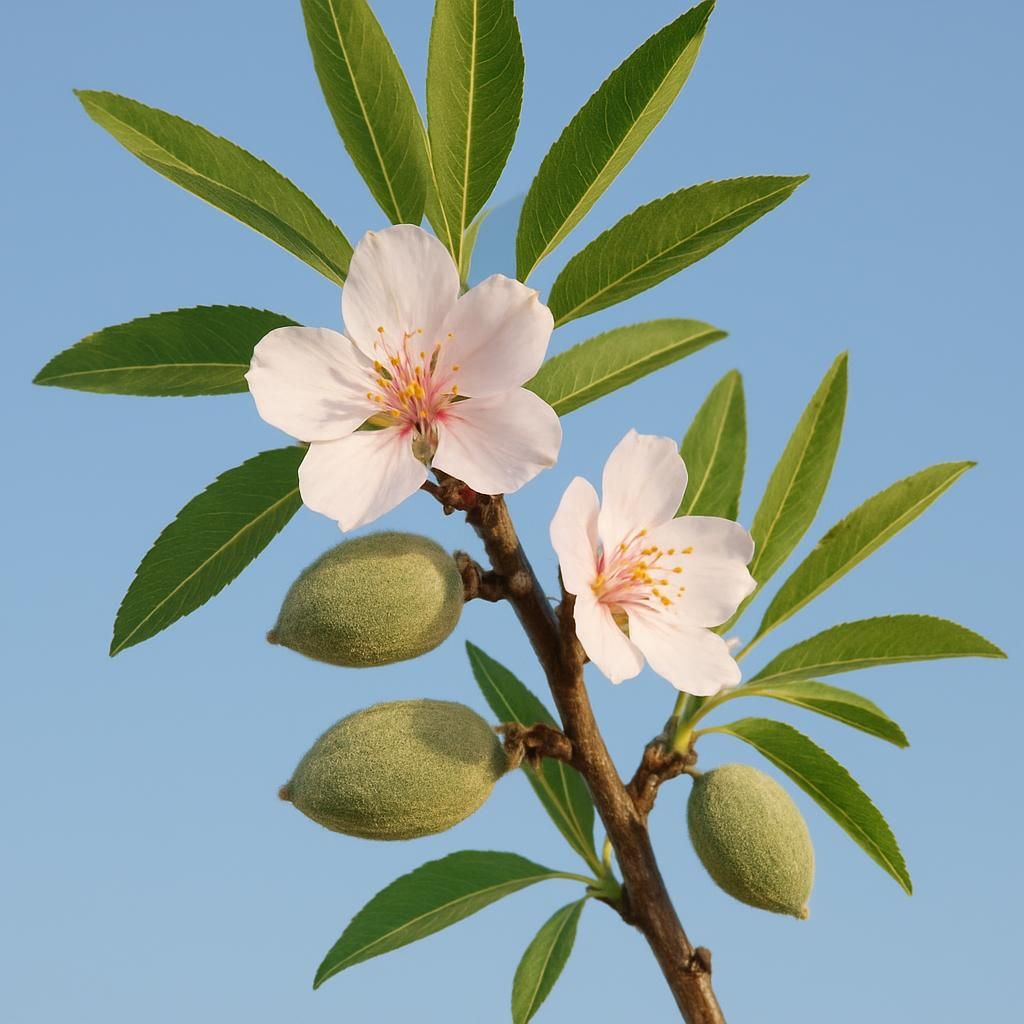
Introduction to Almond (All-in-One)
Almond (All-in-One) is a self-fertile variety of sweet almond (Prunus dulcis) developed for regions where cross-pollinators are limited. It produces medium-sized, high-quality kernels with good flavor and stores exceptionally well. The tree is moderately vigorous with an upright spreading habit, making it suitable for both backyard growers and small-scale commercial operations. Because it blooms later than many standard cultivars, it often escapes damaging spring frosts while still maturing nuts in late summer to early fall.
Botanical Profile of Almond (All-in-One)
Almond (All-in-One) belongs to the Rosaceae family and is botanically classified as a drupe rather than a true nut. The tree reaches 15–20 feet (4.5–6 m) at maturity with a similar spread. Leaves are lanceolate, finely serrated, and bright green. Pale pink to white blossoms appear in early to mid-spring on one-year-old wood. The fruit is an oval drupe whose fleshy hull splits at maturity to reveal a hard shell containing the edible kernel. The cultivar’s self-fertility reduces the need for additional pollenizers, although nearby Almond (crop) plantings can increase yields.
Soil, pH, and Climate Requirements for Almond (All-in-One)
Almond trees demand well-drained, deep soils and full sun. They perform best in USDA zones 7–9 but can succeed in zone 6 with winter protection. The following table summarizes optimal growing conditions:
| Parameter | Ideal Range | Notes |
|---|---|---|
| Soil Type | Sandy loam to loam | Avoid heavy clay or shallow soils |
| Soil pH | 6.0–7.5 | Slightly acidic to neutral |
| Soil Depth | Minimum 4 ft (1.2 m) | Deep roots require good drainage |
| Temperature Range | 35–95 °F (2–35 °C) | Tolerates brief dips to 10 °F (-12 °C) |
| Chill Hours | 300–500 hours below 45 °F (7 °C) | Ensures uniform bloom and nut set |
| Annual Rainfall | 15–25 in (380–635 mm) | Supplemental irrigation required |
| Sun Exposure | Full sun (minimum 6–8 hours) | Critical for kernel quality |
Step-by-Step Planting & Propagation
- Site Selection: Choose a south- or west-facing slope with excellent air drainage to minimize frost pockets.
- Soil Testing: Conduct a comprehensive soil test six months before planting and amend based on results.
- Planting Window: Plant bare-root trees in late fall or early spring while dormant. Container-grown trees can be planted year-round in mild climates.
- Hole Preparation: Dig holes twice as wide and as deep as the root ball. Backfill with native soil amended with 10–15% well-aged compost.
- Spacing: Space trees 18–22 ft (5.5–6.7 m) apart in rows 20–24 ft (6–7.3 m) wide to allow machinery access.
- Planting Depth: Set the graft union 2–3 in (5–8 cm) above soil level.
- Initial Irrigation: Water thoroughly after planting and apply 3–4 in (8–10 cm) of organic mulch, keeping it 6 in (15 cm) away from the trunk.
Care & Maintenance regimes for Almond (All-in-One)
Consistent irrigation, balanced nutrition, and annual pruning are essential for sustained productivity. The following table outlines recommended schedules:
| Season | Watering Schedule | Fertilizer Application | Pruning Schedule |
|---|---|---|---|
| Late Winter | Deep soak every 3–4 weeks if no rain | Apply 1 lb (0.45 kg) balanced 10-10-10 per tree | Remove dead, diseased, and crossing branches |
| Spring | Increase to every 10–14 days | Side-dress with 0.5 lb (0.23 kg) nitrogen | Light heading cuts to shape young trees |
| Summer | Weekly deep irrigation (1–1.5 in) | Foliar micronutrients if deficiency symptoms | Remove water sprouts and suckers |
| Fall | Reduce frequency after harvest | Apply compost or aged manure | Structural pruning after leaf drop |
Pests, Diseases & Organic Management
Common threats include Navel orangeworm, peach twig borer, and spider mites. Monitor with pheromone traps and release beneficial insects such as Trichogramma wasps. For fungal issues like hull rot and shot hole, maintain good orchard sanitation and apply copper-based sprays during dormancy. Cultural practices such as timely irrigation cutoff and hull removal reduce overwintering pest populations.
Harvesting, Curing & Optimal Storage
Almonds are ready when hulls split and kernels reach 5–6% moisture. Shake or pole-pick clusters and allow nuts to dry on tarps for 2–3 days. Cure indoors at 60–70 °F (15–21 °C) with good airflow until kernels rattle inside shells. Store in-shell nuts in cool, dry conditions (below 50 °F / 10 °C and 65% RH) for up to 12 months. Shelled kernels keep best in vacuum-sealed bags in the freezer.
Companion Planting for Almond (All-in-One)
Low-growing legumes such as Clover (crop) and Hairy vetch (crop) improve soil nitrogen and attract beneficial insects. Aromatic herbs including Rosemary (crop) and Thyme (crop) deter aphids and mites while providing ground cover. Avoid planting tall vegetables that compete for light or host shared pests like peach twig borer. Rotating cover crops every third year helps break pest cycles and maintains soil structure.
For more insights on building resilient small-farm systems, read The Truth About Weather Patterns and Small Farm Resilience.