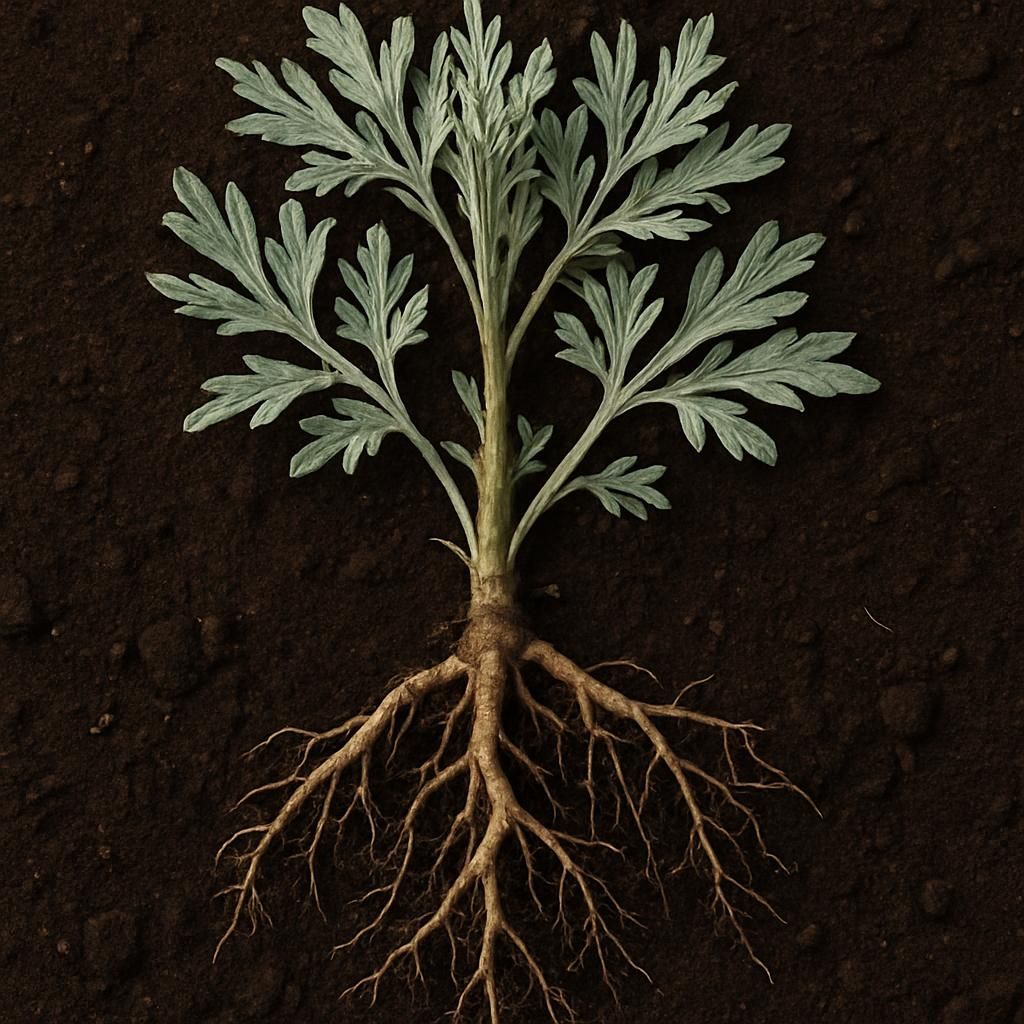
Introduction to Wormwood Root
Wormwood Root (Artemisia absinthium) is a rugged, aromatic perennial in the Asteraceae family that has been cultivated for centuries for its potent bitter principles and insect-repellent properties. The plant produces deeply lobed, silver-green foliage and small yellow flower heads, while its thick, fibrous roots concentrate the highest levels of thujone and absinthin. Professional growers value wormwood root for both commercial essential-oil extraction and organic pest-management applications.
Historically used in absinthe production and herbal bitters, the root also serves as a natural nematicide and soil amendment in permaculture systems. Because of its allelopathic nature, wormwood can suppress certain weeds and soil-borne pathogens when rotated or interplanted correctly. With proper site selection and minimal inputs, established plantings can remain productive for five to eight years.
This definitive growing guide covers every phase from soil preparation through harvest and storage, delivering practical, research-backed recommendations for both small-scale market gardeners and larger specialty-herb operations.
Botanical Profile of Wormwood Root
Artemisia absinthium is a woody-based herbaceous perennial that reaches 60–120 cm in height at maturity. Its alternate, silvery-gray leaves are covered in fine glandular hairs that exude a strong, camphor-like aroma. The plant produces numerous small, drooping capitula containing fertile disc florets and sterile ray florets.
The root system consists of a central taproot with numerous lateral feeder roots that store bitter sesquiterpene lactones. These compounds increase in concentration during the second and third years of growth, making older roots the preferred harvest material. The species is diploid (2n = 18) and readily hybridizes with other Artemisia species, so seed-grown plants may show variable bitterness and morphology.
Wormwood is winter-hardy to USDA zone 4 and can survive temperatures as low as −20 °C when dormant. It is drought-deciduous in arid climates but retains foliage in moist, temperate regions. Flowering occurs from July to September in the northern hemisphere, with seed set completing by late autumn.
Soil, pH, and Climate Requirements for Wormwood Root
Wormwood Root demands sharply drained, low-fertility soils. Heavy clays or waterlogged sites quickly lead to root rot and decline. The species performs best in Mediterranean-type climates with hot, dry summers and cool winters.
| Parameter | Ideal Range | Notes |
|---|---|---|
| Soil Texture | Sandy loam to loam | Avoid compacted or high-clay soils |
| Soil pH | 6.0–7.5 | Tolerates slightly alkaline conditions |
| Organic Matter | 1–3 % | Excessive fertility reduces root bitterness |
| Drainage | Excellent | Raised beds or slopes recommended |
| Annual Rainfall | 300–600 mm | Supplemental irrigation only during establishment |
| Temperature Range | −20 °C to 35 °C | Full sun exposure required |
| USDA Hardiness Zones | 4–9 | Mulch crowns in zone 4 winters |
Site selection should prioritize south-facing slopes with at least six hours of direct sunlight. In regions with heavy winter rainfall, install French drains or plant on 20–30 cm raised beds to prevent anaerobic conditions around the crown.
Step-by-Step Planting & Propagation
Wormwood Root is most reliably propagated by root division or semi-hardwood cuttings; seed germination is erratic and produces variable chemotypes.
- Site Preparation (Autumn prior to planting): Clear all perennial weeds and incorporate 2–3 cm of well-rotted compost only if soil organic matter is below 1 %. Avoid fresh manure.
- Root Division (Early Spring): Lift three- to four-year-old plants before new growth emerges. Divide the crown into sections each containing at least two buds and a 10 cm root segment. Dust cut surfaces with agricultural sulfur.
- Cutting Propagation (Late Spring): Take 8–10 cm tip cuttings from non-flowering shoots. Remove lower leaves, dip in 0.3 % IBA rooting hormone, and insert into a 1:1 perlite-sand mix under intermittent mist. Roots form in 14–21 days.
- Transplanting: Set divisions or rooted cuttings 45–60 cm apart in rows 90 cm wide. Firm soil around each plant and water thoroughly once.
- Seed Option (if required): Cold-stratify seed at 4 °C for 30 days. Sow shallowly in flats; expect 40–60 % germination at 18–22 °C. Transplant seedlings at the two-true-leaf stage.
Establishment irrigation should maintain even moisture for the first six weeks; thereafter, reduce frequency to encourage deep rooting.
Care & Maintenance regimes for Wormwood Root
Mature wormwood stands require minimal intervention. Over-fertilization and excessive irrigation are the most common causes of reduced root quality.
| Growth Stage | Irrigation Schedule | Fertilizer Program | Pruning / Cultural Practice |
|---|---|---|---|
| Establishment (Year 1) | 25 mm/week until roots reach 20 cm | None; side-dress with 5 kg/ha rock phosphate if tissue test shows P < 15 ppm | Pinch growing tips at 30 cm to encourage bushiness |
| Vegetative (Years 2–3) | Deep water every 10–14 days only during prolonged drought | Top-dress 20 kg/ha potassium sulfate in early spring | Cut back 30 % of top growth after flowering to reduce self-seeding |
| Mature Stands (Year 4+) | Withhold irrigation; rely on rainfall | No additional fertilizer | Divide crowns every 4–5 years in early spring |
Weed control is best achieved with a 5 cm layer of coarse gravel mulch that also reflects heat onto the foliage, increasing essential-oil concentration. Avoid plastic mulch, which can trap moisture against the crown.
Pests, Diseases & Organic Management
Wormwood’s high thujone content renders it naturally resistant to most herbivores, yet a few specialist pests and pathogens can still appear.
- Aphids (/wiki/aphids): Occasional colonies on tender spring growth. Dislodge with strong water sprays or release green lacewing larvae.
- Spider mites (/wiki/spider-mites): Favored by hot, dusty conditions. Maintain overhead sprinkler cooling and predatory mite releases (Phytoseiulus persimilis).
- Root-knot nematodes (/wiki/root-knot-nematodes): Rare in well-drained soils; rotate with Marigold every four years.
- Powdery mildew (/wiki/powdery-mildew): Appears under high humidity. Improve airflow by spacing plants farther apart and apply potassium bicarbonate sprays at first sign.
- Root rot (/wiki/root-rot): Caused by Phytophthora or Pythium in waterlogged sites. Prevention through drainage is the only effective control.
Scout weekly during spring flush and again after summer rains. Because wormwood is allelopathic, avoid planting near Tomato or Potato to prevent cross-contamination of shared soil pathogens.
Harvesting, Curing & Optimal Storage
Peak root bitterness and essential-oil content occur in the third and fourth years just before flowering. Harvest on a dry, sunny morning when soil is friable.
- Timing: Late spring (May–June) in temperate zones; lift entire plants or trench alongside rows to remove lateral roots without killing the crown.
- Washing: Gently hose off soil; do not soak. Trim foliage 5 cm above crown for replanting stock.
- Drying: Spread roots in single layers on screen racks in a shaded, well-ventilated barn at 25–30 °C. Turn daily; drying is complete when roots snap cleanly (moisture < 10 %).
- Curing: Store in paper-lined crates for 14 days to equalize moisture and mellow harsh volatiles.
- Storage: Vacuum-seal or place in food-grade buckets with oxygen absorbers. Keep at 15 °C or below; viability for distillation remains high for 18 months.
Expected dry-root yield from a mature stand is 800–1200 kg/ha. Roots destined for pharmaceutical use should be tested for thujone content (> 0.3 % w/w typical).
Companion Planting for Wormwood Root
Wormwood’s volatile oils inhibit many soil-borne fungi and nematodes, making it an excellent border or sacrificial crop. Compatible pairings include:
- Carrot – repels carrot fly when planted in alternating rows.
- Cabbage – reduces cabbageworm pressure.
- Thyme – shares similar cultural requirements and aromatic synergy.
- Yarrow – improves essential-oil concentration in neighboring herbs.
Avoid planting near legumes or solanaceous crops, as wormwood can stunt their growth through allelopathy. In rotation, follow wormwood with heavy feeders such as Corn to take advantage of residual soil conditioning.
Integrate wormwood root into biodiversity strips or hedgerows to provide year-round habitat for beneficial insects while generating a high-value specialty crop.