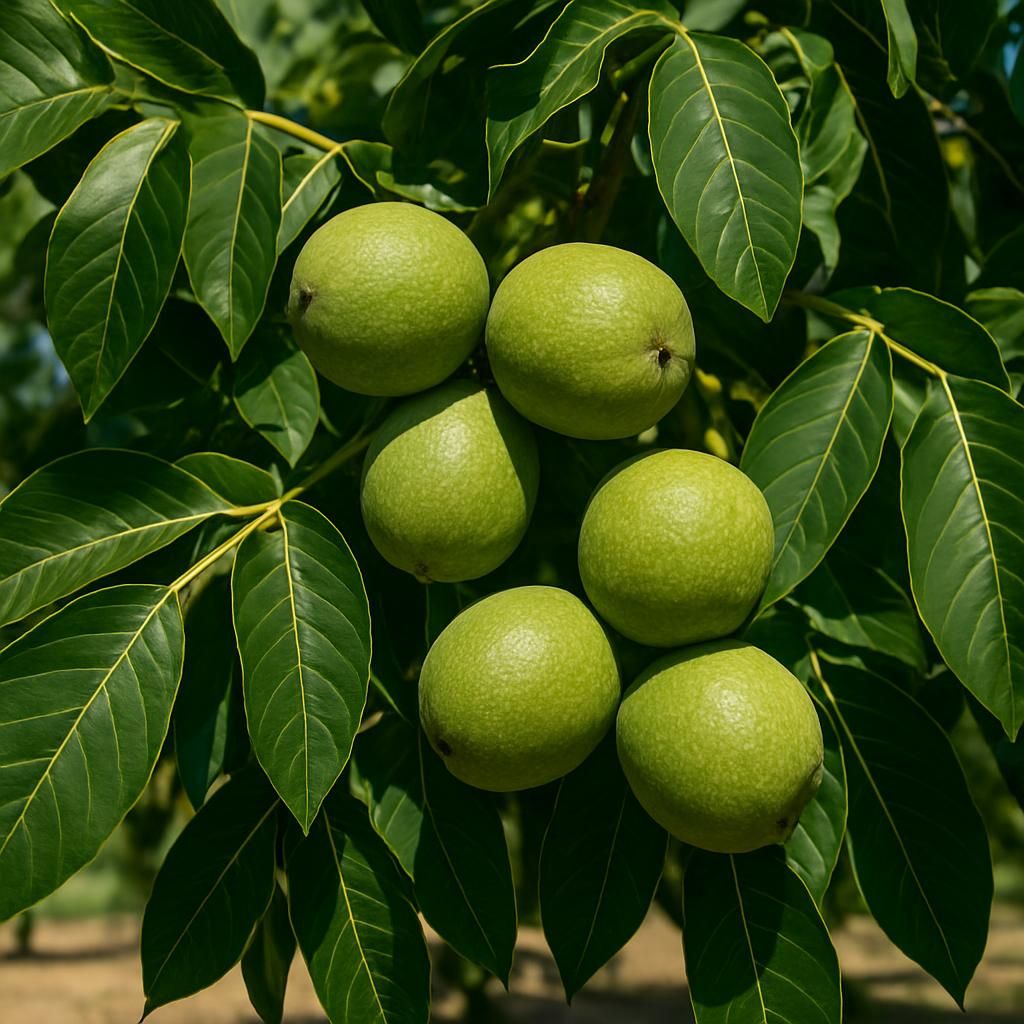
Introduction to Walnut (English - Howard)
English walnut (Juglans regia) 'Howard' is a modern California-bred cultivar valued for its heavy bearing, early harvest, and high-quality kernels. Growers select Howard for its large nut size, thin shells, and moderate vigor that suits both commercial orchards and smaller plantings. The variety shows good resistance to certain diseases while delivering reliable annual production when properly managed.
Botanical Profile of Walnut (English - Howard)
Howard belongs to the Juglandaceae family and produces large, compound leaves with 5–9 leaflets. Trees reach 40–60 feet at maturity with a broad, spreading canopy. Male catkins appear in early spring followed by female flowers that develop into husked nuts containing a single edible seed. The cultivar exhibits strong apical dominance and forms a straight central leader when trained properly.
Soil, pH, and Climate Requirements for Walnut (English - Howard)
Howard walnuts thrive in deep, well-drained loamy soils with high fertility. They perform best in Mediterranean climates with hot, dry summers and cool, wet winters. Avoid frost pockets and areas with poor air drainage.
| Parameter | Ideal Range | Notes |
|---|---|---|
| Soil Type | Deep loam to sandy loam | Minimum 4–6 ft rooting depth |
| Soil pH | 6.0–7.5 | Slightly acidic to neutral |
| Annual Rainfall | 20–35 inches | Supplemental irrigation required |
| Temperature Range | -10°F to 105°F | Protect young trees from late spring frost |
| Chill Hours | 700–1,000 hours | Below 45°F needed for uniform bud break |
| USDA Zones | 5–9 | Best in zones 7–9 for commercial yields |
Step-by-Step Planting & Propagation
Plant bare-root or container-grown Howard trees in late winter or early spring when soils are workable. Choose certified disease-free nursery stock grafted onto Paradox or Northern California Black rootstock for vigor and soil-borne disease resistance. Dig holes twice as wide as the root ball and set trees at the same depth as the nursery line. Space trees 30–40 feet apart in rows 40–50 feet wide for commercial orchards. Water thoroughly after planting and apply 3–4 inches of organic mulch, keeping it away from the trunk. Stake young trees in windy areas.
Care & Maintenance regimes for Walnut (English - Howard)
Consistent irrigation, balanced nutrition, and annual pruning are essential for high-quality Howard walnut production. Young trees require more frequent watering while mature orchards benefit from regulated deficit irrigation strategies.
| Season | Water Schedule | Fertilizer Application | Pruning Schedule |
|---|---|---|---|
| Spring | 1–1.5 inches per week | 0.5–1 lb N per tree at bud swell | Structural training of young trees |
| Summer | Deep irrigation every 10–14 days | Side-dress 0.5 lb N after shell hardening | Remove water sprouts and suckers |
| Fall | Reduce to encourage dormancy | Apply 1–2 lbs potassium and micronutrients | Light corrective pruning only |
| Winter | Minimal; maintain soil moisture | Broadcast compost or aged manure | Dormant pruning for structure |
Pests, Diseases & Organic Management
Howard walnuts face pressure from Walnut blight, Walnut husk fly, and Walnut aphid. Monitor for codling moth damage and apply mating disruption or organic sprays at peak flight periods. Practice sanitation by removing fallen husks and mummies. Use kaolin clay or spinosad-based products for organic control of husk fly. Maintain good airflow through pruning to reduce blight incidence. Beneficial insects such as lacewings and parasitic wasps help suppress aphid populations.
Harvesting, Curing & Optimal Storage
Howard nuts are typically ready for harvest in early to mid-September in California. Shake or knock trees when 80% of hulls have split and nuts begin to drop. Collect promptly to avoid mold and animal damage. Remove hulls within 24 hours and wash nuts in clean water. Dry kernels to 8% moisture using forced-air dryers at 100–110°F. Store in-shell nuts at 32–40°F with 60–65% relative humidity for up to 12 months. Shelled kernels keep best when vacuum-packed and frozen.
Companion Planting for Walnut (English - Howard)
Walnuts produce juglone, which inhibits many plants. Compatible companions include Garlic, Onion, and certain grasses that tolerate juglone. Avoid planting tomatoes, peppers, and potatoes near young trees. Clover as a cover crop improves soil nitrogen while tolerating juglone. Nasturtium can serve as a trap crop for aphids on orchard edges. Maintain a 10–15 foot buffer of tolerant species around mature Howard trees.