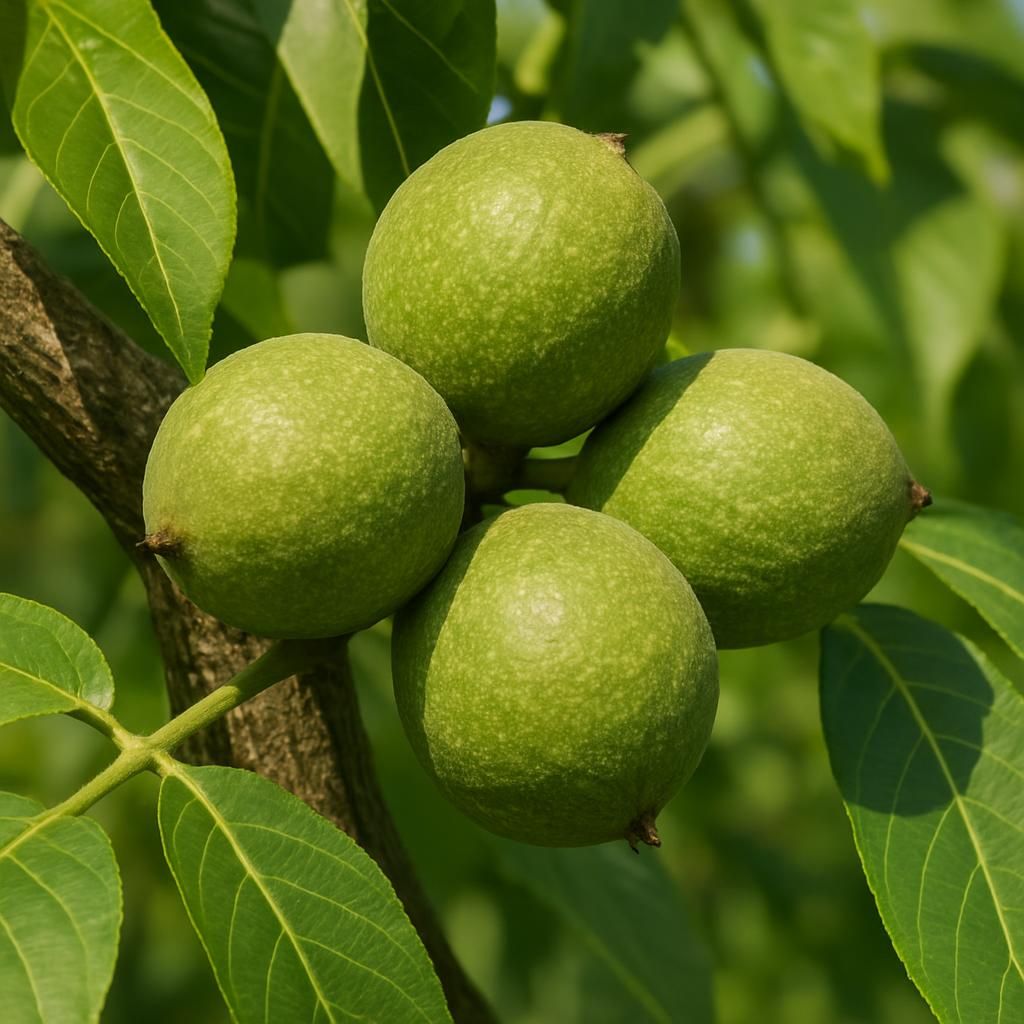
Introduction to Walnut (Black - Emma Kay)
The Black Walnut (Black - Emma Kay) cultivar represents one of the most promising selections within the Juglans nigra species for both commercial nut production and timber value. Developed for superior kernel quality and shell thinness, 'Emma Kay' trees produce large, dark nuts with kernels that are easy to extract and possess a rich, distinctive flavor sought after by gourmet markets and bakers. This cultivar offers growers a reliable performer that matures earlier than many wild black walnuts while maintaining the species' renowned hardiness and longevity.
Black walnuts in general, including the Emma Kay selection, are native to eastern North America and have been cultivated for centuries for both their edible nuts and valuable dark wood. The 'Emma Kay' variety stands out due to its consistent bearing habit, high percentage of kernel to shell, and resistance to common fungal issues that plague other selections. Its upright growth habit and strong branching structure make it well-suited for both high-density plantings and traditional orchard layouts.
Establishing a successful Walnut orchard with the Emma Kay cultivar requires careful attention to soil depth, drainage, and long-term spacing considerations. While the trees are slow to begin commercial production compared to many fruit crops, mature specimens can remain productive for over a century, providing generations of returns. This guide delivers professional-grade, practical advice for planting, maintaining, and harvesting Black Walnut (Black - Emma Kay) trees.
Botanical Profile of Walnut (Black - Emma Kay)
Juglans nigra 'Emma Kay' belongs to the Juglandaceae family and exhibits the classic characteristics of the eastern black walnut species with notable improvements in nut quality. The trees are deciduous, reaching heights of 50–80 feet at maturity with a spread of 40–60 feet. The trunk develops a straight, cylindrical form with dark, deeply furrowed bark. Leaves are alternate and pinnately compound, typically 12–24 inches long with 15–23 lanceolate leaflets that turn bright yellow in autumn.
Male flowers appear as catkins in spring, while female flowers are inconspicuous and wind-pollinated. The fruit is a large drupe with a thick green husk that splits at maturity to reveal a hard, corrugated shell. The 'Emma Kay' selection is distinguished by its relatively thin shell and high kernel fill, often exceeding 30% kernel recovery compared to 20–25% in unselected seedlings. The kernels are light-colored, flavorful, and contain high levels of omega-3 fatty acids and antioxidants.
The root system is deep and extensive, with a prominent taproot that makes transplanting difficult after the first year. Like other black walnuts, 'Emma Kay' produces juglone, a natural allelopathic compound that can inhibit the growth of certain neighboring plants. Understanding this botanical trait is essential when planning orchard layouts and companion planting strategies.
Soil, pH, and Climate Requirements for Walnut (Black - Emma Kay)
Black Walnut (Black - Emma Kay) demands deep, fertile, well-drained soils with good moisture-holding capacity. The species performs best on loamy or silt loam soils but can tolerate clay loams if drainage is adequate. Avoid shallow soils, compacted sites, or areas with a high water table. The ideal soil pH ranges from slightly acidic to neutral.
| Parameter | Ideal Range | Notes |
|---|---|---|
| Soil Type | Deep loam or silt loam | Avoid heavy clay without drainage improvement |
| Soil pH | 6.0 – 7.5 | Optimal around 6.5 |
| Soil Depth | Minimum 4–6 feet | Critical for taproot development |
| Drainage | Excellent | Standing water for >48 hours is fatal |
| Organic Matter | 3–5% | Improves moisture retention and fertility |
| USDA Hardiness Zones | 5–9 | Performs well across most temperate regions |
| Annual Rainfall | 30–50 inches | Supplemental irrigation beneficial in dry years |
| Temperature Range | -20°F to 95°F | Late spring frosts can damage catkins |
Site selection should prioritize south- or west-facing slopes with good air drainage to reduce frost risk during bloom. Elevation above 1,000 feet may shorten the growing season in northern latitudes. Soil testing for macro- and micronutrients, including zinc and boron, is recommended prior to planting.
Step-by-Step Planting & Propagation
Propagation of 'Emma Kay' is achieved through grafting onto seedling black walnut rootstock or by planting named grafted nursery trees. Seed propagation will not produce true-to-type trees. Purchase certified disease-free, one- or two-year-old grafted whips from reputable nurseries.
- Conduct a soil test and amend based on results 6–12 months before planting.
- Choose a site with full sun (minimum 8 hours) and protection from strong winds.
- Dig planting holes 2–3 times wider than the root ball and as deep as the root system.
- Space trees 40–50 feet apart in rows 50–60 feet apart for standard orchards; high-density plantings may use 30 × 40 feet initially with later thinning.
- Set the graft union 2–3 inches above soil level and backfill with native soil.
- Water thoroughly and apply a 3–4 inch layer of organic mulch, keeping it 6 inches from the trunk.
- Stake young trees if necessary and install tree guards to protect against rodent damage.
- Irrigate weekly during the first two growing seasons to establish roots.
Planting is best done in early spring while trees are dormant, or in late fall in regions with mild winters. Avoid planting during periods of extreme heat or frozen ground.
Care & Maintenance regimes for Walnut (Black - Emma Kay)
Young black walnut trees require consistent attention during the first five years to develop strong structure and root systems. Mature trees need less frequent intervention but benefit from annual monitoring of nutrition, pests, and pruning.
| Task | Frequency | Details |
|---|---|---|
| Watering (Years 1–3) | Weekly during dry periods | 10–15 gallons per tree; deep soak to encourage taproot growth |
| Watering (Mature) | As needed during drought | 1 inch per week equivalent during nut fill |
| Fertilizer (Young) | Early spring & mid-summer | 0.5–1 lb of 10-10-10 per year of tree age, split applications |
| Fertilizer (Mature) | Early spring | Soil test-based; typical 2–4 lbs nitrogen per tree |
| Pruning (Formative) | Dormant season, years 1–4 | Develop central leader; remove crossing or weak branches |
| Pruning (Maintenance) | Late winter | Thin canopy for light penetration; remove dead or diseased wood |
| Mulching | Annual renewal | Maintain 3–4 inch organic layer in 4–6 ft radius |
| Weed Control | Ongoing | Maintain 4–6 ft weed-free zone around trunk |
Monitor leaf color and annual shoot growth to adjust fertility programs. Avoid excessive nitrogen, which promotes vegetative growth at the expense of nut production. Boron and zinc foliar sprays may be beneficial in deficient soils during bloom and early nut development.
Pests, Diseases & Organic Management
Black Walnut (Black - Emma Kay) faces pressure from several key pests and diseases. The most significant include Walnut husk fly, Walnut aphid, and Walnut blight caused by Xanthomonas arboricola pv. juglandis. Codling moth and navel orangeworm can also damage nuts in some regions.
Organic management begins with cultural practices: maintaining orchard sanitation by removing fallen husks and debris, using pheromone traps for monitoring, and encouraging beneficial insects through diverse ground covers. Kaolin clay sprays can deter husk flies and aphids. Copper-based fungicides applied at bud swell and petal fall help suppress walnut blight. For severe aphid infestations, insecticidal soaps or horticultural oils provide effective control without harming beneficial populations.
Regular scouting is essential. Thresholds for intervention are generally low for husk fly because even light infestations can render nuts unmarketable. Installing exclusion netting or using bait stations can reduce reliance on chemical controls in organic systems.
Harvesting, Curing & Optimal Storage
Black walnuts ripen in September–October when the husk begins to split and the nut falls naturally or can be knocked from the tree. Collect nuts promptly to prevent mold and animal predation. Remove the green husk within 24–48 hours using a corn sheller, pressure washer, or mechanical huller.
Wash the nuts thoroughly and spread them in a single layer on screens in a well-ventilated, shaded area. Allow to dry for 2–4 weeks until the kernel snaps cleanly when bent. Target moisture content is approximately 8%. Once cured, store nuts in breathable bags or bins at 32–40°F with 60–70% relative humidity. Properly cured and stored black walnuts retain quality for 1–2 years. For longer storage, vacuum sealing and freezing is recommended.
Companion Planting for Walnut (Black - Emma Kay)
Juglone tolerance is a critical consideration when selecting companion species. While many plants are sensitive to this allelopathic compound, several species thrive near black walnuts. Clover and other legumes improve soil nitrogen and tolerate juglone well. Garlic and Onion are also compatible and may help deter certain pests.
Avoid planting tomatoes, peppers, potatoes, and members of the Solanaceae family within the drip line of mature trees. Blueberries and raspberries are generally sensitive and should be sited at least 50 feet away. Establishing a diverse ground cover of juglone-tolerant grasses and legumes between tree rows supports beneficial insects and improves orchard biodiversity without competing excessively with the walnut trees.
Careful planning of understory plantings can enhance soil health, reduce erosion, and provide additional income streams such as hay or grazing in silvopasture systems.