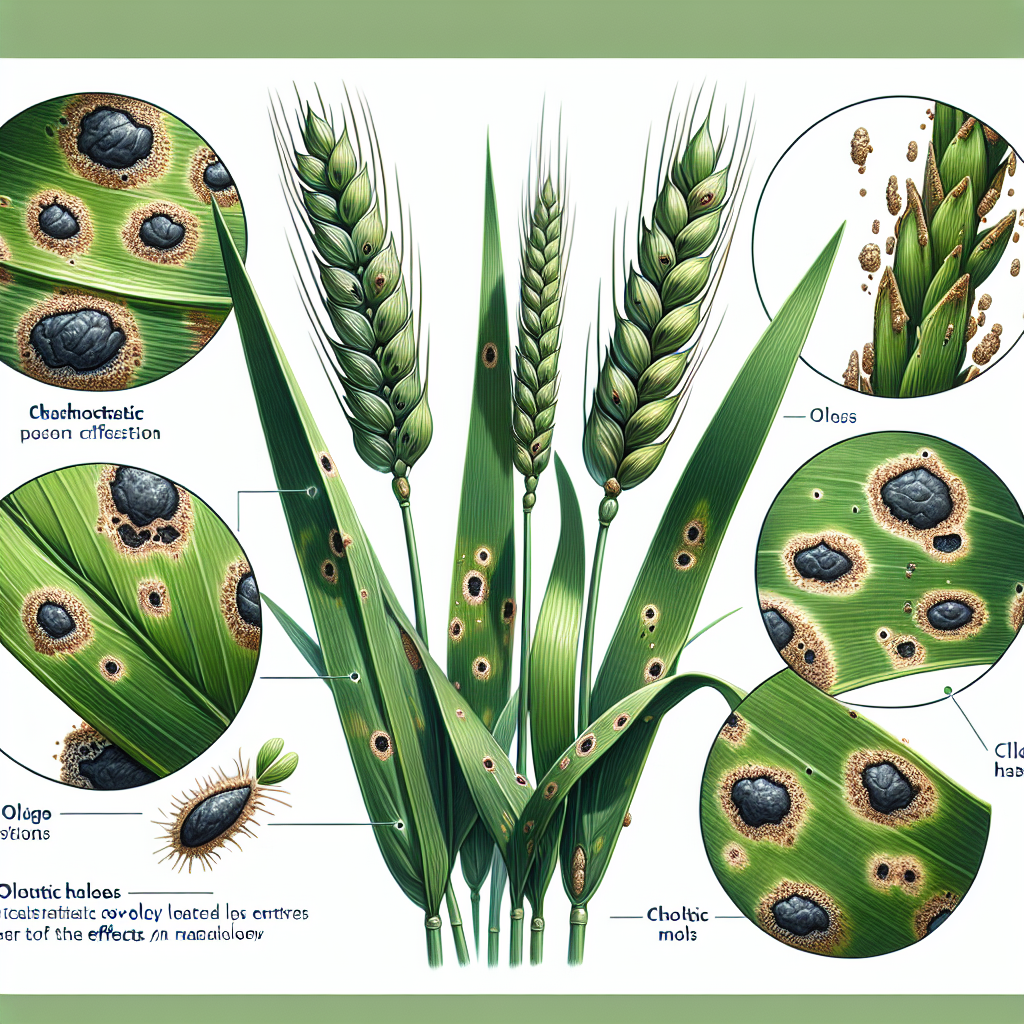
Introduction to spot blotch
Spot blotch, caused by the fungal pathogen Cochliobolus sativus (imperfect stage: Bipolaris sorokiniana), stands as one of the most pervasive and economically damaging diseases in small grain production worldwide. This necrotrophic fungus targets cereal crops, particularly in humid, warm environments, where it can devastate yields by 20-50% or more in severe epidemics. First identified in the late 19th century, spot blotch has become increasingly problematic due to the adoption of shorter-season, high-yielding wheat varieties that are often susceptible. In regions like the Indo-Gangetic Plains of South Asia, North America's Great Plains, and parts of East Africa, it poses a constant threat to food security and farmer livelihoods.
The disease's impact extends beyond direct yield loss; infected plants exhibit reduced photosynthesis, poor grain filling, and lower grain quality, including shriveled kernels and reduced test weight. Small-scale farmers, who often lack access to advanced diagnostics or chemical controls, suffer disproportionately. Understanding spot blotch is crucial for implementing integrated disease management strategies that minimize losses while promoting sustainable agriculture. This guide provides comprehensive diagnostics, lifecycle insights, and practical organic and preventive measures tailored for wheat growers. For more on affected crops, see our detailed entry on Wheat (crop).
Identifying Symptoms & Damage
Early detection is key to mitigating spot blotch damage. Symptoms typically appear on the lower leaves during tillering (Feekes growth stage 3-5), progressing upward as the season advances. Initial signs include small, water-soaked lesions (1-3 mm) with a chlorotic halo, often rectangular due to leaf vein confinement. These evolve into tan to dark brown spots with grayish centers and darker margins, sometimes featuring concentric rings resembling a 'target' or 'eye spot.' Under humid conditions, lesions produce olive-black spore masses visible as fuzz on the surface.
As spots coalesce into blotches covering 20-50% of the leaf area, leaves senesce prematurely, turning from green to straw-yellow. Flag leaves are particularly vulnerable; infection here drastically reduces grain fill. Severe cases lead to 'dead heart' symptoms where the entire plant dies. Yield losses correlate with disease severity: 10% flag leaf infection can cut yields by 8-10%, escalating to 40% loss at 50% severity.
Differentiate spot blotch from look-alikes like Septoria leaf spot (smaller pycnidia, no concentric rings), tan spot (more uniform tan color), or leaf rust (pustules). Use a 10x hand lens to confirm Bipolaris conidia—curved, 5-7 septate, brown spores. Damage assessment: scout 20-30 plants per field quadrant, rating severity as % leaf area affected. Thresholds for action: 5-10% lower leaf severity at tillering or 20% flag leaf at heading. For small farms, check out this Soil Health Mastery blog post for foundational prevention.
Lifecycle and Progression of spot blotch
Cochliobolus sativus completes its lifecycle in 7-14 days under optimal conditions (25-30°C, 90-100% RH). Primary inoculum survives as stromata or conidia in infected crop residue, soil, or seeds. Conidia germinate in free water (6+ hours), penetrating via stomata or direct hyphal growth. Incubation lasts 48-72 hours, with symptoms visible after 4-5 days. Sporulation occurs at night with dew, dispersing spores via wind or rain splash up to 1-2 meters.
The pathogen is polycyclic, producing 5-10 cycles per season. Seedborne transmission infects seedlings, causing root rot and seedling blight. Residue from previous crops serves as the main inoculum source, with survival up to 2-3 years. In no-till systems, surface residue amplifies risk. Progression follows a sigmoid curve: slow buildup pre-anthesis, explosive post-heading under humid conditions. Dormant mycelium reactivates in spring, favored by cool, moist weather.
Management targets lifecycle weak points: residue decomposition, seed treatment, and canopy microclimate alteration. Understanding this progression enables precise timing of interventions, reducing epidemic peaks.
Environmental Triggers & Risk Factors
Spot blotch thrives in warm (20-30°C), humid (85%+ RH) conditions with frequent leaf wetness (>12 hours/day). Night temperatures >18°C prolong dew, boosting sporulation. Moderate nitrogen fertilization enhances susceptibility by promoting dense canopies that trap moisture. Susceptible varieties like 'Sonalika' or 'Kalyan Sona' amplify epidemics.
Key risk factors: continuous wheat cropping, poor residue management, late sowing (prolongs humid tillering), high plant density (>350 plants/m²), and irrigation without drainage. Clay soils retain moisture, worsening conditions. Global warming extends favorable windows, shifting epidemics northward. Monitor with weather stations: act when 3-day RH >90% and temp 22-28°C coincide with early boot stage.
Organic Control & Treatment Plans
Organic management emphasizes cultural, biological, and resistant variety approaches. 1. Resistant Cultivars: Plant moderately resistant varieties like 'K 9107' or 'WH 711' (check local extension lists). Rotate with non-hosts like corn or soybeans every 2-3 years.
2. Cultural Practices: Sow early (November in northern hemispheres) for dry tillering. Space at 20-22 cm rows, 75 kg/ha seed rate. Bury residue via tillage or accelerate decay with Trichoderma mulches. Apply silicon (50-100 kg/ha potassium silicate) at tillering for cell wall fortification.
3. Biological Controls: Seed-treat with Trichoderma harzianum or Pseudomonas fluorescens (10 g/kg seed). Foliar sprays of Bacillus subtilis (2-5 kg/ha) at flag leaf emergence suppress sporulation 40-60%. Compost teas with composted manure reduce severity by 25%.
4. Organic Fungicides: Neem oil (5 ml/L) or copper oxychloride (2-3 g/L) at 10-20% severity, max 2 apps. Potassium bicarbonate (5 g/L) curbs spore germination.
Integrated Plan: Scout weekly; apply bioagent at 5% severity, cultural adjustments ongoing. Expect 30-50% reduction vs. untreated.
Preventing spot blotch in the Future
Long-term prevention builds resilient systems. Crop Rotation: 2-3 years with barley, legumes, or brassicas breaks residue cycle. Residue Management: Shred and incorporate stubble; use cover crops like clover to outcompete pathogen. Variety Selection: Use index-based choices (e.g., CIMMYT's SB index: spot blotch severity under stress).
Field Hygiene: Deep plow infected residue; rogue seedlings. Nutrition: Balance N (100-120 kg/ha), add Zn (25 kg/ha) and Mn (10 kg/ha) for resistance. Forecasting: Use models like Wheat Disease Predictor for spray timing. Sanitation: Clean equipment; avoid seed saving from infected fields.
Sustainable IPM reduces incidence 60-80%, cutting chemical reliance. Monitor adjacent fields; buffer zones help.
Crops Most Affected by spot blotch
Primarily impacts cool-season cereals: wheat (50%+ losses in hotspots), barley (up to 40%), and less so oats, rye, triticale. Wheat varieties like spring bread wheat in subtropical zones suffer most. Minor hosts include sorghum, corn, rice under stress. Grasses like couch grass serve as reservoirs. Global hotspots: Bangladesh (40% avg. loss), India, Nepal, USA (southern plains), Argentina, Brazil. In diverse rotations, pair with tolerant Durum Wheat or Hard Red Winter Wheat.