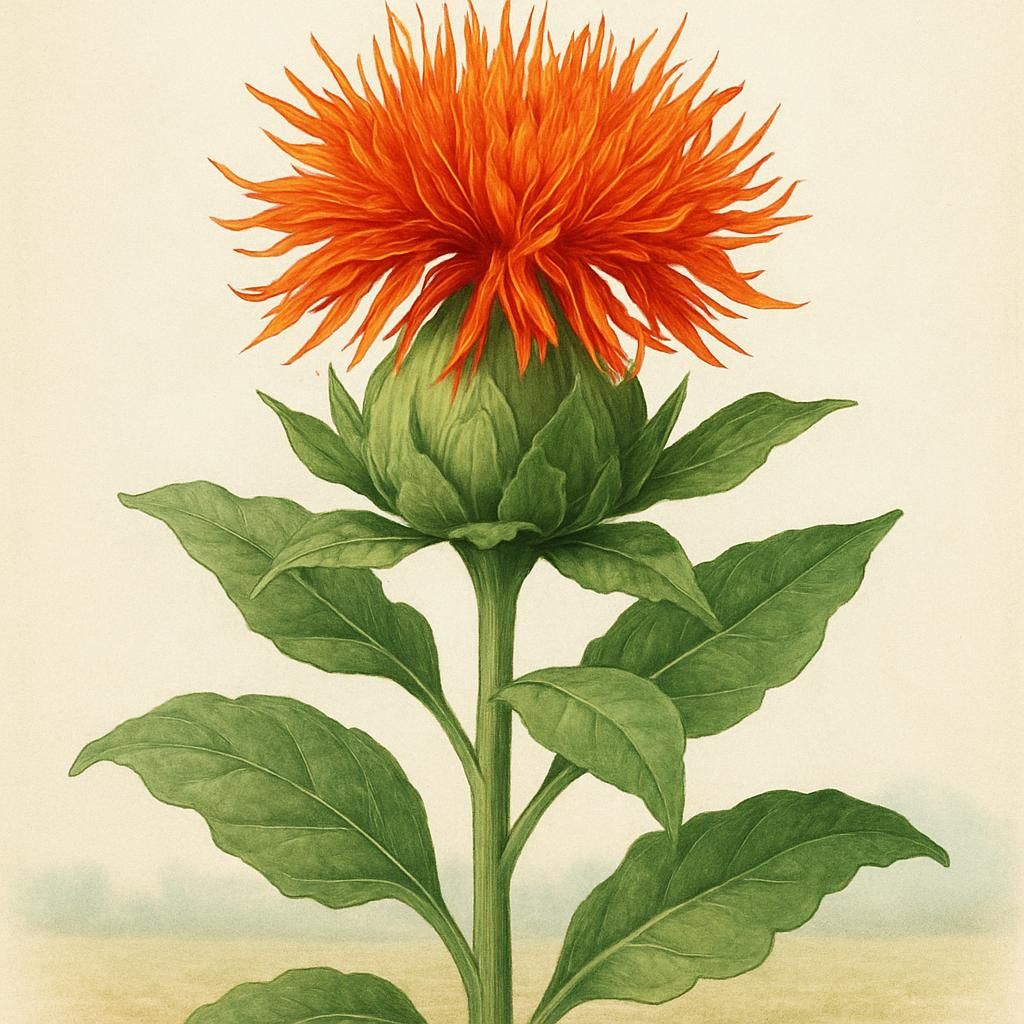
Introduction to Safflower Petals
Safflower (Carthamus tinctorius) has been cultivated for over 4,000 years as a source of natural dyes and later as an oilseed. The dried petals, often called “safflower saffron,” provide a cost-effective substitute for true saffron and are used in teas, rice dishes, cheeses, and textile dyeing. Because the crop is exceptionally drought-tolerant and thrives in marginal soils, it has become popular among small-scale and organic growers seeking low-input, high-value specialty crops.
Modern interest focuses on the petals’ high carthamin content, which delivers stable yellow-to-red hues without synthetic additives. Petals also contain flavonoids with documented anti-inflammatory properties, making them valuable for herbal products. Commercial production is concentrated in India, Mexico, the United States, and parts of Central Asia, but the plant adapts readily to temperate and subtropical climates worldwide.
Botanical Profile of Safflower Petals
Safflower is an annual member of the Asteraceae family. Plants reach 30–150 cm in height with rigid, branching stems and spiny leaves. Flower heads are 2–4 cm across and consist of numerous tubular florets that open sequentially from the periphery inward. Petal color shifts from yellow to orange-red as carthamin accumulates; fully mature heads yield the richest pigment.
The root system is deep and taproot-dominated, conferring excellent drought resistance. Seeds are achenes, white and smooth, containing 30–45 % oil. Petal harvest occurs 30–40 days after flowering begins, when 60–70 % of heads show full color development.
Soil, pH, and Climate Requirements for Safflower Petals
Safflower prefers well-drained sandy loam to loam soils with good structure. It tolerates alkaline conditions and low fertility better than most crops, yet responds positively to moderate organic matter.
| Parameter | Ideal Range | Notes |
|---|---|---|
| Soil Texture | Sandy loam to loam | Avoid heavy clays; raised beds improve drainage |
| Soil pH | 6.0–8.0 | Tolerates up to 8.5 |
| Organic Matter | 2–4 % | Compost or well-rotted manure |
| Temperature Range | 15–32 °C daytime | Frost-sensitive below 5 °C |
| Annual Rainfall | 300–600 mm | Supplemental irrigation in drier zones |
| Growing Season | 120–150 frost-free days | Long-day plant; flowering triggered by photoperiod |
Step-by-Step Planting & Propagation
- Site Selection: Choose a south-facing slope or flat field with full sun and protection from strong winds.
- Soil Preparation: Till to 20 cm depth, incorporate 5–8 t ha⁻¹ compost, and level the seedbed.
- Seed Treatment: Use certified seed treated with a broad-spectrum fungicide or soak in 0.2 % Trichoderma solution for 30 minutes.
- Sowing Time: Plant when soil temperature reaches 10 °C; in temperate zones this is typically 2–3 weeks after the last spring frost.
- Method: Drill seed 2–3 cm deep in rows 45–60 cm apart; intra-row spacing 10–15 cm. Seeding rate 12–18 kg ha⁻¹.
- Irrigation: Provide a light pre-sowing irrigation if soil is dry; avoid waterlogging.
Care & Maintenance regimes for Safflower Petals
Safflower requires minimal intervention once established, but timely weed control and balanced nutrition maximize petal yield and color intensity.
| Growth Stage | Water Schedule | Fertilizer (NPK or organic equivalent) | Pruning / Other Tasks |
|---|---|---|---|
| Germination–30 DAS | Light irrigation every 7–10 days | 20 kg N ha⁻¹ at 20 DAS | Weed control; thin to final spacing |
| Vegetative (30–60 DAS) | 25–30 mm every 12–14 days | 15 kg N + 20 kg P₂O₅ ha⁻¹ at 40 DAS | Remove basal suckers if present |
| Flowering (60–90 DAS) | Reduce to 20 mm; avoid overhead spray | Foliar 1 % potassium sulfate at 70 DAS | Monitor for lodging; stake if needed |
| Petal Harvest | Withhold water 7 days before harvest | None | Cut heads at 80 % color maturity |
Pests, Diseases & Organic Management
Major insect pests include Aphids, Thrips, and Helicoverpa species. Use yellow sticky traps and neem-based sprays at threshold levels. Spider mites may appear during hot, dry periods; overhead misting and predatory mites provide control.
Diseases are primarily fungal: Alternaria leaf spot, Fusarium wilt, and root rot. Practice 3–4 year crop rotation, avoid overhead irrigation, and apply Trichoderma harzianum seed treatment. Resistant varieties such as ‘Gila’ and ‘Saffire’ reduce disease pressure.
Harvesting, Curing & Optimal Storage
Harvest begins when 60–70 % of heads display full petal coloration, usually 110–130 days after sowing. Cut entire heads with 10 cm stem, then dry in shaded, well-ventilated areas at 30–35 °C for 5–7 days. Petals are stripped mechanically or by hand once moisture drops below 10 %. Store in airtight, light-proof containers at 15 °C and 40–50 % RH; shelf life exceeds 18 months under these conditions.
Companion Planting for Safflower Petals
Safflower pairs well with Clover and Marigold to suppress nematodes and attract beneficial insects. Avoid planting near Sunflower to reduce shared pest pressure. Intercropping with Chickpeas improves nitrogen availability and land-use efficiency.