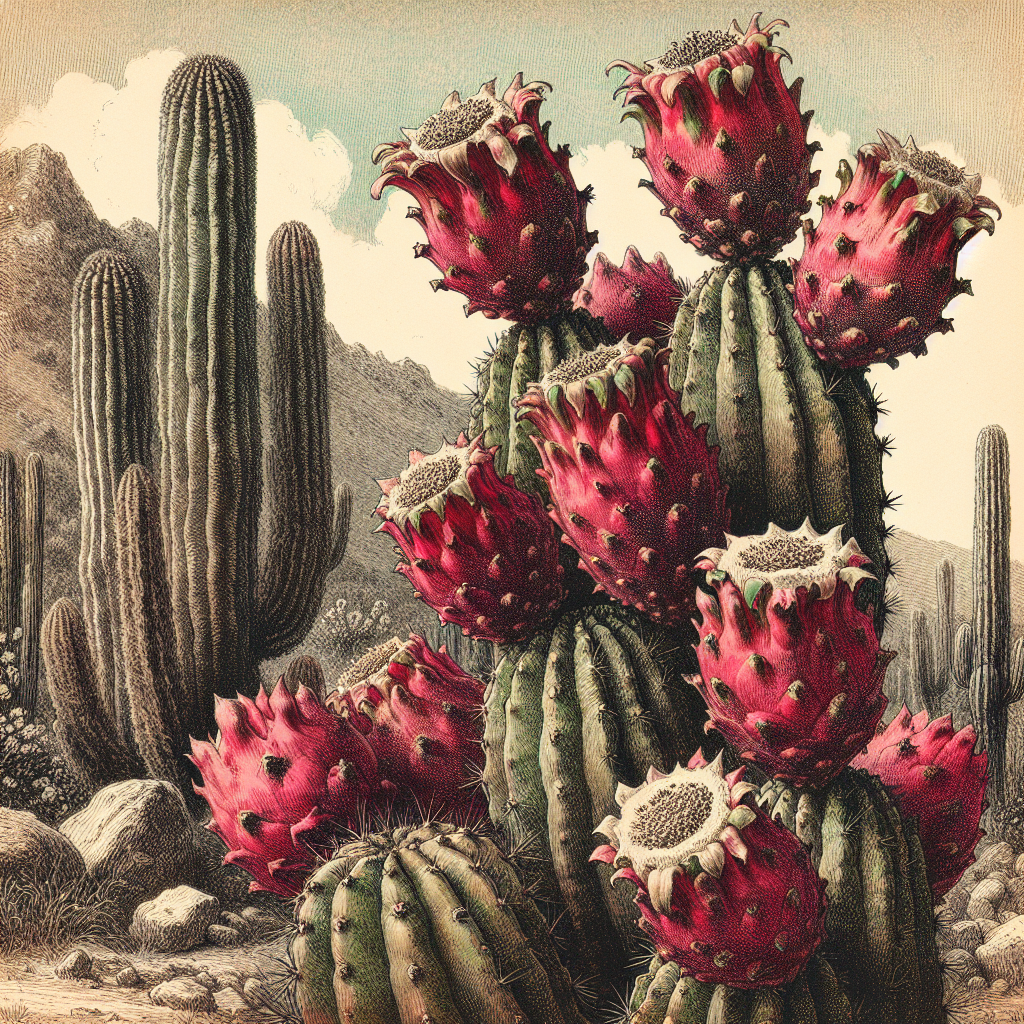
Introduction to Pitaya (Stenocereus thurberi)
Pitaya from Stenocereus thurberi, commonly called organ pipe cactus or pitaya de mayo, represents a cornerstone of arid-zone agriculture. Native to the Sonoran Desert spanning Mexico and the southwestern United States, this cactus thrives in harsh environments where traditional crops fail. Its thick, ribbed stems store water efficiently, enabling fruit production during extended dry spells. Fruits emerge vibrant red or yellow exteriors encasing sweet, white flesh studded with tiny black seeds, delivering a kiwi-like flavor with melon undertones. Nutritionally, pitaya boasts high antioxidant levels, vitamin C, and fiber, positioning it as a superfruit in health markets.
Commercially, S. thurberi supports sustainable farming due to low input requirements. Unlike water-intensive dragon fruit, it demands no irrigation in native ranges, yielding 5-10 tons per hectare under optimal conditions. Small farms benefit from its perennial nature, producing for 20-50 years from a single planting. Challenges include slow juvenile growth and bird predation, but organic methods mitigate these effectively. This guide equips growers with professional strategies for propagation, care, and harvest, maximizing profitability in semi-arid zones. For small farms battling heatwaves, check Why Summer Heatwaves Are Silently Killing Small Farm Yields - And 7 Organic Strategies to Fight Back.
Botanical Profile of Pitaya (Stenocereus thurberi)
Stenocereus thurberi belongs to the Cactaceae family, subfamily Cactoideae, characterized by columnar growth up to 7 meters tall and 30 cm diameter. Stems feature 5-9 pronounced ribs with small, spine-tipped areoles spaced 2-3 cm apart. Spines measure 1-3 mm, grayish, not aggressive like related species. Roots form extensive shallow networks for capturing scant rainfall.
Flowers bloom nocturnally from April to June, measuring 8-10 cm long, white with pinkish tinges, pollinated by bats and moths. Each flower yields one fruit after 30-45 days. Fruits weigh 50-150 grams, oval, with thin, removable skin. Pulp is translucent white, mildly sweet (12-18° Brix), with crunch from 2000+ seeds per fruit. Unlike Hylocereus pitayas, S. thurberi fruits ripen in late spring, aligning with low market competition.
Growth is slow initially (10-20 cm/year) accelerating post-maturity at 50 cm/year. Plants reach fruiting age in 5-8 years from seed, 2-4 from cuttings. Dioecious reproduction requires 1 male per 10-20 females for pollination. Hybrids with S. queretaroensis enhance fruit size. In cultivation, spacing at 3x4 meters optimizes light and airflow, supporting 800 plants/hectare.
Soil, pH, and Climate Requirements for Pitaya (Stenocereus thurberi)
Pitaya (S. thurberi) excels in well-drained, sandy-loam soils mimicking Sonoran Desert caliches. Ideal texture: 60-80% sand, 10-20% silt, <10% clay to prevent waterlogging. Organic matter at 1-2% suffices; excessive fertility promotes weak, rot-prone stems. pH range 6.5-8.5, tolerating high salinity (EC up to 4 dS/m) and calcium carbonates >20%.
Prepare soil by tilling 30-50 cm deep, incorporating 5-10 tons/ha gypsum if sodic. Avoid heavy clays prone to root rot. Climate demands daytime highs 28-40°C, nights >10°C. Annual rainfall 200-500 mm suffices, concentrated in summer monsoons. Frost tolerance limited to -4°C briefly; protect juveniles below 0°C with row covers.
USDA zones 9b-11 ideal; microclimates extend viability. Full sun (3000+ hours/year) essential—shade reduces fruit set 50%. Windbreaks mitigate desiccation in exposed sites. Drip irrigation supplements dry years at 200-400 mm/season, applied in pulses. Mulch with gravel (5 cm) conserves moisture, suppresses weeds. Test soil annually for P, K deficiencies; micronutrients rarely needed.
Step-by-Step Planting & Propagation
Propagation Methods
Seed propagation: Collect ripe fruits, extract seeds, dry 48 hours. Sow in sterile sand-perlite (1:1) at 25-30°C. Germination 7-14 days, 70-90% rate. Transplant seedlings at 10 cm to 1L pots, harden outdoors after 6 months.
Cuttings superior for uniformity: Select 1-1.5m healthy stems, dry cut ends 2 weeks. Plant 20-30 cm deep in mounds. Rooting 4-8 weeks. Grafting onto S. gummosus rootstock boosts vigor in poor soils.
Site Preparation
Clear site, form 50 cm high x 1m wide mounds spaced 3x4m. Incorporate 2-5 kg compost/mound. Install drip lines (2L/h emitters, 1m spacing).
Planting
Timing: post-frost spring. Dig 50x50x50 cm holes, plant cuttings upright. Male:female ratio 1:15. Water 10-20L initially, withhold 4 weeks to force rooting. Stake tall cuttings. Expect first flowers year 2-3.
Care & Maintenance regimes for Pitaya (Stenocereus thurberi)
Water sparingly: 20-40L/plant monthly first year, reduce to rainfall-dependent. Fertilize annually March with 100g NPK 10-20-20/plant, avoiding excess nitrogen. Prune post-harvest: remove dead arms, thin crowded tops for light penetration. Height control at 3-4m via topping prevents wind topple.
Weed manually or mulch; herbicides risky near roots. Monitor for nutrient lockup in alkaline soils—apply chelated iron if chlorosis appears. Winter: minimal care, natural dormancy. Propagate suckers yearly for expansion. Yields peak years 8-20 at 20-50 fruits/plant.
Pests, Diseases & Organic Management
Primary pests: birds devouring fruits—net entire orchards or use reflective tape. Ants farm scale; disrupt with boric acid baits. Mealybugs controlled by ladybugs, neem oil (2% weekly sprays). Rodents gnaw stems—traps, gravel barriers.
Diseases rare: Phytophthora root rot from overwatering—improve drainage, solarize soil. Anthracnose in humid sites—copper fungicide pre-bloom. For integrated pest management, see Why 90% of Small Farms Fail at Pest Management - And 8 Organic Fixes That Actually Work. Organic priority: beneficial insects, sanitation.
Harvesting, Curing & Optimal Storage
Harvest late May-June when skin colors fully, fruits slightly soft. Twist or clip with shears, avoiding stem wounds. Yields 10-20 kg/plant mature. Handle gently; refrigerate at 10-13°C, 85-90% RH extends shelf life 3-4 weeks. Cure briefly at 20°C for flavor peak.
Postharvest: wash, sort, pack in ventilated crates. Market fresh or process into jams, wines. Dry fruits store 6 months cool/dark.
Companion Planting for Pitaya (Stenocereus thurberi)
Pair with nitrogen-fixers like mesquite or pigeon pea for soil enrichment. Shallow-rooted herbs (thyme) suppress weeds without competition. Avoid water-hungry crops. Interplant agave for windbreaks, nasturtium deters aphids. Learn more in Why Companion Planting Feels Like Guesswork for Small Farms - And How AI Makes It Foolproof.