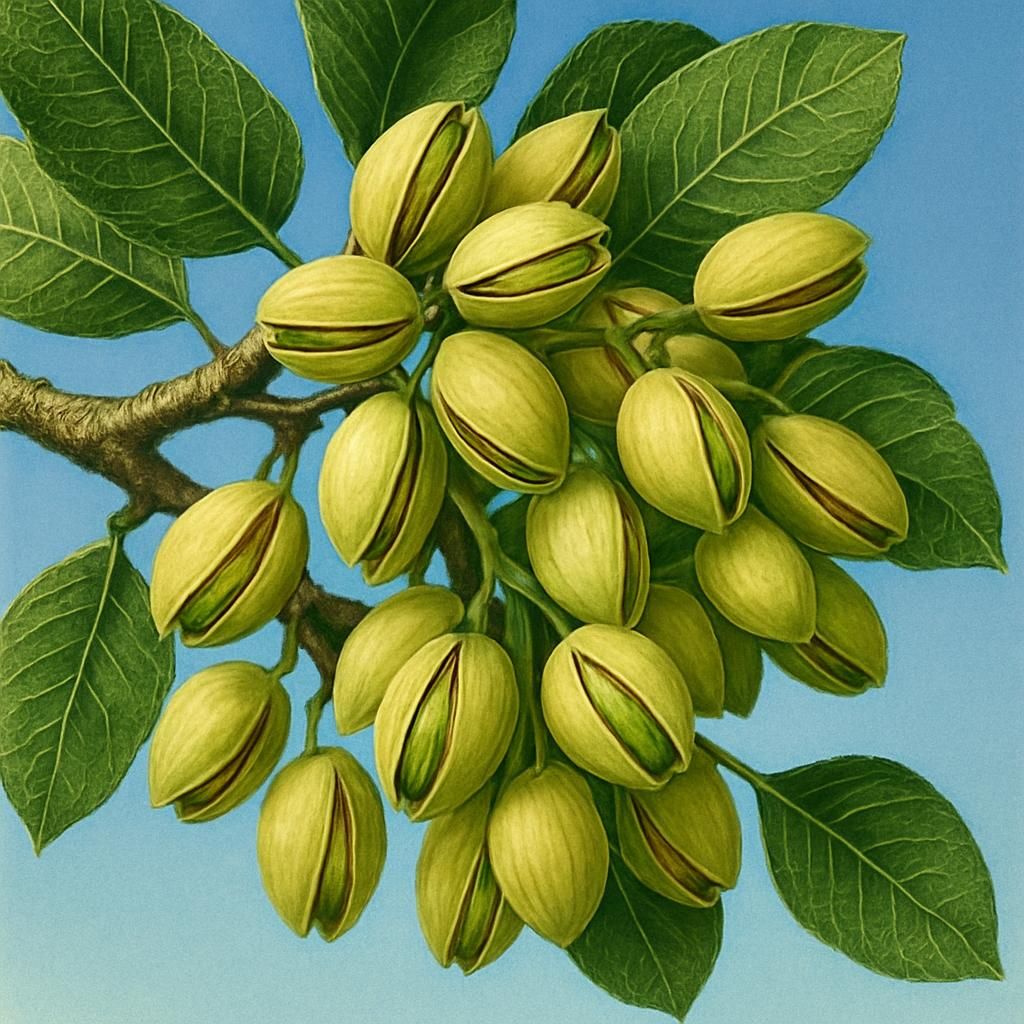
Introduction to Pistachio (Lost Hills)
Pistachio (Lost Hills) is a modern female cultivar developed for California's San Joaquin Valley and similar arid production zones. It delivers large, bright-green kernels with high split rates and strong alternate-bearing resistance when paired with suitable male pollinizers. Commercial growers value its early harvest window that reduces navel orangeworm pressure and allows earlier market entry.
The cultivar performs best under long, hot, dry summers and cool winters that satisfy its 800–1,000 chill-hour requirement. Once established, trees are extremely drought-tolerant yet respond dramatically to precise irrigation and nutrition programs. With proper management, orchards can remain productive for 80–100 years.
Botanical Profile of Pistachio (Lost Hills)
Pistacia vera is a dioecious, deciduous tree in the Anacardiaceae family. 'Lost Hills' produces large, elongated nuts with thin hulls that split cleanly at maturity. Trees reach 15–25 ft (4.5–7.5 m) with an open, vase-shaped canopy when properly pruned. Male pollinizers such as Pistachio (Peters) are required at a ratio of 1:8–1:12.
Soil, pH, and Climate Requirements for Pistachio (Lost Hills)
Pistachios demand deep, well-drained soils with high calcium content. They tolerate moderate salinity but suffer under waterlogging or heavy clay.
| Parameter | Ideal Range | Notes |
|---|---|---|
| Soil Type | Sandy loam to loam | Minimum 4 ft (1.2 m) rooting depth |
| Soil pH | 7.0–8.2 | Slightly alkaline preferred |
| Salinity (EC) | < 4 dS/m | Monitor sodium and boron levels |
| Temperature Range | 35–115 °F (2–46 °C) | Requires 800–1,000 chill hours |
| Annual Rainfall | 8–12 in (200–300 mm) | Supplemental irrigation essential |
| Frost Tolerance | Down to 15 °F (-9 °C) dormant | Late spring frost damages blooms |
Step-by-Step Planting & Propagation
- Select certified, disease-free nursery stock on UCB-1 or PG1 rootstock.
- Pre-plant deep rip to 3–4 ft (0.9–1.2 m) and incorporate 2–4 tons/acre gypsum if sodium levels are elevated.
- Plant bare-root trees in late winter at 15–18 ft (4.5–5.5 m) in-row and 20–22 ft (6–6.7 m) between rows.
- Immediately irrigate to settle soil and eliminate air pockets around roots.
- Stake young trees and install drip irrigation with two emitters per tree.
Grafting is rarely performed in the field; most orchards purchase pre-grafted trees. Male pollinizers should be interplanted at the recommended ratio before year three.
Care & Maintenance regimes for Pistachio (Lost Hills)
Consistent water and nutrient management during the first five years determines long-term productivity.
| Season | Water (gal/tree/day) | Fertilizer (N-P-K) | Pruning Action |
|---|---|---|---|
| Dormant | 0–5 | 0.5 lb N/tree, 0.25 lb P, 1 lb K | Remove dead wood, shape scaffold |
| Bloom–Nut Set | 10–15 | 0.75 lb N, 0.5 lb P, 1.5 lb K | Minimal; tip-prune water shoots |
| Nut Fill | 20–30 | 1 lb N, 0.5 lb P, 2 lb K | Remove crossing branches |
| Post-Harvest | 5–10 | 0.25 lb N only | Heavy structural pruning if needed |
Maintain 4–6 in (10–15 cm) of organic mulch in the tree row to moderate soil temperature and suppress weeds. Monitor leaf nutrient levels annually in July.
Pests, Diseases & Organic Management
Key pests include Navel orangeworm, soft scales, and spider mites. Cultural controls such as early harvest, sanitation of mummy nuts, and mating disruption are highly effective. For mites, release predatory mites and maintain dust-free orchard floors.
Major diseases are Verticillium wilt and Botryosphaeria panicle and shoot blight. Use resistant rootstocks, avoid over-irrigation, and prune for airflow. Copper sprays during dormancy help suppress bacterial canker.
Harvesting, Curing & Optimal Storage
Harvest when hulls split and kernels reach 40–45 % moisture. Shake trees mechanically or by hand in mid-August to early September. Collect nuts within 24 hours to prevent shell staining.
Float hulls in water, then dry at 90–100 °F (32–38 °C) with high airflow until kernel moisture reaches 5–7 %. Store in sealed bins at 32–40 °F (0–4 °C) and < 65 % relative humidity. Properly cured nuts retain quality for 12–18 months.
Companion Planting for Pistachio (Lost Hills)
Interplant nitrogen-fixing cover crops such as clover or hairy vetch in the alleyways during the first three years. These legumes improve soil structure and attract beneficial insects. Avoid planting shallow-rooted vegetables directly under the drip line once trees reach bearing age.