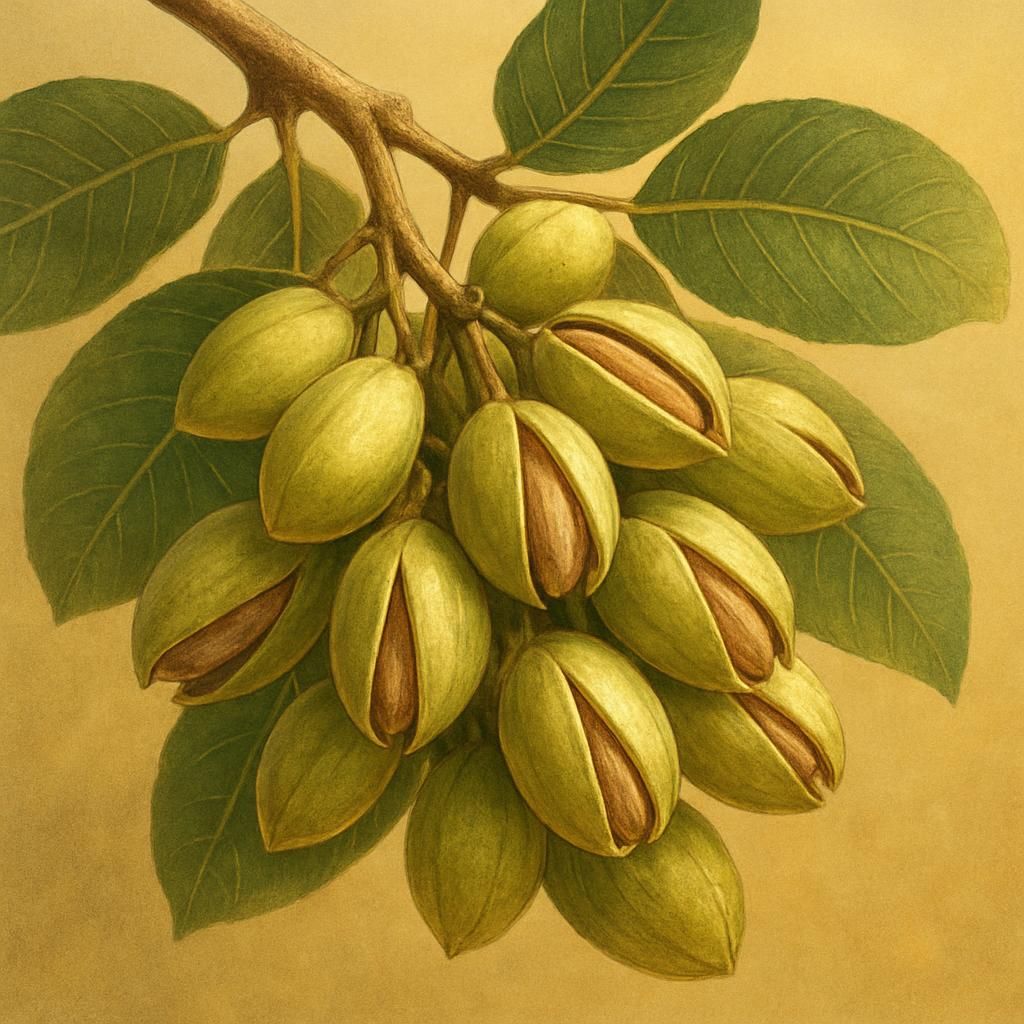
Introduction to Pistachio (Kerman)
The Kerman pistachio cultivar dominates global commercial plantings because of its large kernel size, high split percentage, and consistent productivity when pollinated by the Peters male. Originating from selections made in California in the 1920s, Kerman quickly became the industry standard across arid and semi-arid regions. Successful orchards require careful attention to irrigation scheduling, male-to-female ratios, and long-term pruning to maintain light penetration and nut quality.
Botanical Profile of Pistachio (Kerman)
Pistacia vera is a dioecious, deciduous small tree in the Anacardiaceae family. Female Kerman trees produce terminal panicles of small, apetalous flowers that develop into drupes. The edible portion is the seed inside a dehiscent hull. Trees reach 4–6 m at maturity with a spreading canopy and deep taproot system that confers excellent drought tolerance once established.
Soil, pH, and Climate Requirements for Pistachio (Kerman)
Kerman pistachios thrive in deep, well-drained sandy loam to loam soils with low salinity. The following table summarizes ideal growing conditions:
| Parameter | Ideal Range | Notes |
|---|---|---|
| Soil Texture | Sandy loam to loam | Avoid heavy clays and shallow soils |
| Soil pH | 7.0–8.0 | Tolerates mildly alkaline conditions |
| Soil Salinity (EC) | < 4 dS/m | Sensitive above 6 dS/m |
| Annual Rainfall | 200–400 mm supplemental irrigation | Requires 900–1100 mm total water equivalent |
| Temperature Range | −10 °C to 45 °C | Requires 800–1000 chilling hours |
| Growing Season | 180–220 frost-free days | Hot, dry summers essential for nut quality |
Step-by-Step Planting & Propagation
- Select certified, disease-free Kerman scions grafted onto UCB-1 or PG1 rootstocks.
- Plant in late winter or early spring when soil temperatures exceed 10 °C.
- Space trees 5–6 m within rows and 6–7 m between rows (approximately 25–30 trees/ha).
- Dig planting holes twice the width of the root ball and backfill with native soil amended with aged compost.
- Install drip irrigation emitters immediately after planting and apply 10 L water per tree.
- Stake young trees and protect trunks with white latex paint or guards to prevent sunburn.
Care & Maintenance regimes for Pistachio (Kerman)
The following table outlines seasonal water, fertilizer, and pruning schedules:
| Season | Irrigation (L/tree/week) | Fertilizer (kg N-P-K/tree) | Pruning Action |
|---|---|---|---|
| Spring | 40–60 | 0.5–0.75 kg 15-15-15 + micronutrients | Remove dead wood; tip prune leaders |
| Summer | 80–120 | 0.3 kg potassium sulfate | Minimal; only water sprouts |
| Autumn | 30–50 | 0.25 kg zinc sulfate foliar | Light thinning for light penetration |
| Winter | 10–20 dormant | Apply 20 kg well-rotted manure | Structural pruning every 3–4 years |
Pests, Diseases & Organic Management
Major insect threats include Navel orangeworm and soft scales. Implement mating disruption and sanitation to reduce overwintering populations. Fungal issues such as Botryosphaeria panicle and shoot blight are managed with dormant copper sprays and resistant rootstocks. Regular monitoring and beneficial insect releases maintain orchard biodiversity.
Harvesting, Curing & Optimal Storage
Harvest when hulls begin to split and kernels reach 40–45 % moisture (late August–early September in California). Shake trees mechanically or by hand and collect on tarps within 24 hours. Float hulls in water to remove debris, then dry nuts to 5–6 % moisture using forced-air dryers at 32–38 °C. Store in sealed containers at 0–4 °C and <65 % RH for up to 18 months.
Companion Planting for Pistachio (Kerman)
Interplant rows with Clover or Hairy vetch to fix nitrogen and improve soil structure. Aromatic herbs such as Rosemary and Thyme deter insect pests while providing ground cover. Avoid planting alternate hosts of navel orangeworm such as Almond or Walnut in adjacent blocks.