Introduction to Pistachio (Golden Hills)
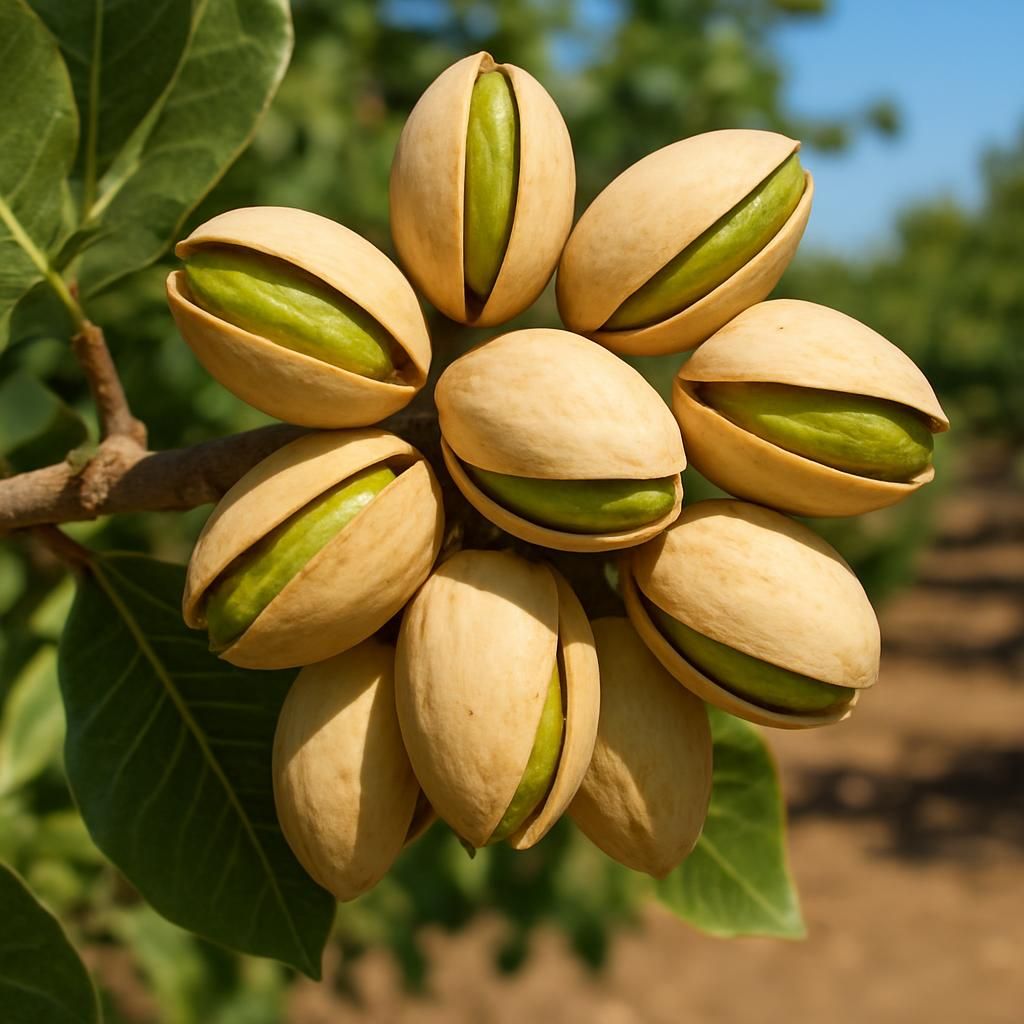
Pistachio (Golden Hills) is a modern female cultivar developed by the University of California for commercial orchards seeking earlier harvests and higher split percentages than traditional varieties. It produces large, bright-green kernels with thin shells that split cleanly, making it highly desirable for both in-shell and kernel markets. The variety was released to address grower demand for improved yield consistency and earlier maturity in regions where harvest timing affects market premiums. Pistachio orchards planted with Golden Hills benefit from its strong alternate-bearing resistance and reliable performance when paired with compatible male pollinizers.
Botanical Profile of Pistachio (Golden Hills)
Golden Hills belongs to the Anacardiaceae family and is a deciduous, dioecious tree that can reach 20–30 feet in height with a spreading canopy. Female trees produce clusters of drupes that ripen from green to beige as the hull splits, revealing the characteristic cream-colored shell. The cultivar exhibits vigorous growth, moderate chilling requirement (approximately 800–1,000 hours below 45 °F), and demonstrates excellent kernel-to-shell ratio. Leaves are pinnately compound with 3–5 leaflets, and the tree exhibits strong resistance to several common fungal issues when properly managed.
Soil, pH, and Climate Requirements for Pistachio (Golden Hills)
Golden Hills pistachios thrive in deep, well-drained sandy loam to loam soils with good aeration. They are highly sensitive to waterlogging and perform poorly in heavy clay or saline conditions without proper amendments. The trees require long, hot summers (above 90 °F) and cold winters to satisfy chilling needs, making Mediterranean and arid climates ideal.
| Parameter | Ideal Range | Notes |
|---|---|---|
| Soil Type | Sandy loam to loam | Excellent drainage critical |
| Soil pH | 7.0 – 8.0 | Slightly alkaline preferred |
| Soil Depth | > 4 ft | Deep rooting profile required |
| Annual Rainfall | 8 – 12 inches (supplemental irrigation) | Arid conditions with irrigation |
| Summer Temperature | 90 – 105 °F daytime | Essential for kernel development |
| Winter Chilling | 800 – 1,000 hours below 45 °F | Required for uniform bloom |
| USDA Hardiness Zones | 7b – 10 | Avoid frost pockets during bloom |
Step-by-Step Planting & Propagation
- Select certified disease-free nursery stock of Golden Hills females and compatible male pollinizers (Peters or Famoso) at a 1:8 to 1:12 male-to-female ratio.
- Conduct soil tests and amend with gypsum or sulfur if pH or salinity is outside the ideal range shown in the table above.
- Dig planting holes 2–3 times wider than the root ball and at least 3 ft deep; backfill with native soil mixed with aged compost.
- Plant bare-root or container trees in late winter to early spring when soil temperatures exceed 50 °F.
- Space trees 18–20 ft apart within rows and 20–22 ft between rows to allow mechanical harvesting equipment access.
- Immediately irrigate to settle soil and apply a 3–4 inch organic mulch ring, keeping mulch 6 inches from the trunk.
- Stake young trees and install drip irrigation lines with two emitters per tree initially.
Care & Maintenance regimes for Pistachio (Golden Hills)
Proper irrigation, nutrition, and pruning are essential for sustained high yields. Golden Hills responds well to regulated deficit irrigation during hull split to enhance kernel quality. Fertilizer programs should be based on annual leaf tissue analysis rather than fixed schedules.
| Season | Water Schedule | Fertilizer (per mature tree) | Pruning Action |
|---|---|---|---|
| Spring | 2–3 deep irrigations (April–May) | 1–1.5 lb N, 0.5 lb P, 1.5 lb K | Remove dead wood; shape scaffold branches |
| Summer | Regulated deficit (June–July); resume full irrigation at hull split | 0.5 lb N sidedress; boron foliar if deficient | Light hedging to maintain light penetration |
| Fall | Reduce irrigation after harvest | Maintenance K and micronutrients | Remove water sprouts; open canopy |
| Winter | Dormant irrigation if rainfall < 6 in | Soil-applied compost or manure | Dormant pruning; remove crossing limbs |
Pests, Diseases & Organic Management
Golden Hills pistachios face pressure from Navel orangeworm, Spider mites, and occasional Scale insects. Cultural practices such as winter sanitation (removing mummies) and early harvest timing significantly reduce navel orangeworm damage. For organic control, apply Bacillus thuringiensis products at hull split and release predatory mites when spider mite thresholds are reached. Phytophthora root rot can be prevented by maintaining excellent drainage and avoiding over-irrigation. Regular monitoring and threshold-based interventions keep pesticide use minimal.
Harvesting, Curing & Optimal Storage
Golden Hills typically reaches commercial maturity in late August to early September in California’s Central Valley—approximately 7–10 days earlier than Kerman. Harvest when 80–90 % of hulls have split; mechanical shaking is standard. Immediately transport nuts to a hulling facility to prevent staining. After hulling, dry kernels to 5–6 % moisture using forced-air dryers at 100–110 °F. Store in-shell pistachios at 32–40 °F and 65–70 % relative humidity for up to 12 months. For longer storage, vacuum-seal or use nitrogen-flushed packaging to preserve color and flavor.
Companion Planting for Pistachio (Golden Hills)
While pistachios are typically grown in monoculture, inter-row cover crops such as Clover or Hairy vetch improve soil structure and nitrogen levels between young trees. Aromatic herbs like Rosemary and Thyme planted along orchard borders can deter certain insect pests. Avoid planting shallow-rooted vegetables directly under the canopy once trees mature, as competition for water and nutrients increases. Strategic companion planting enhances biodiversity without compromising the primary pistachio crop.