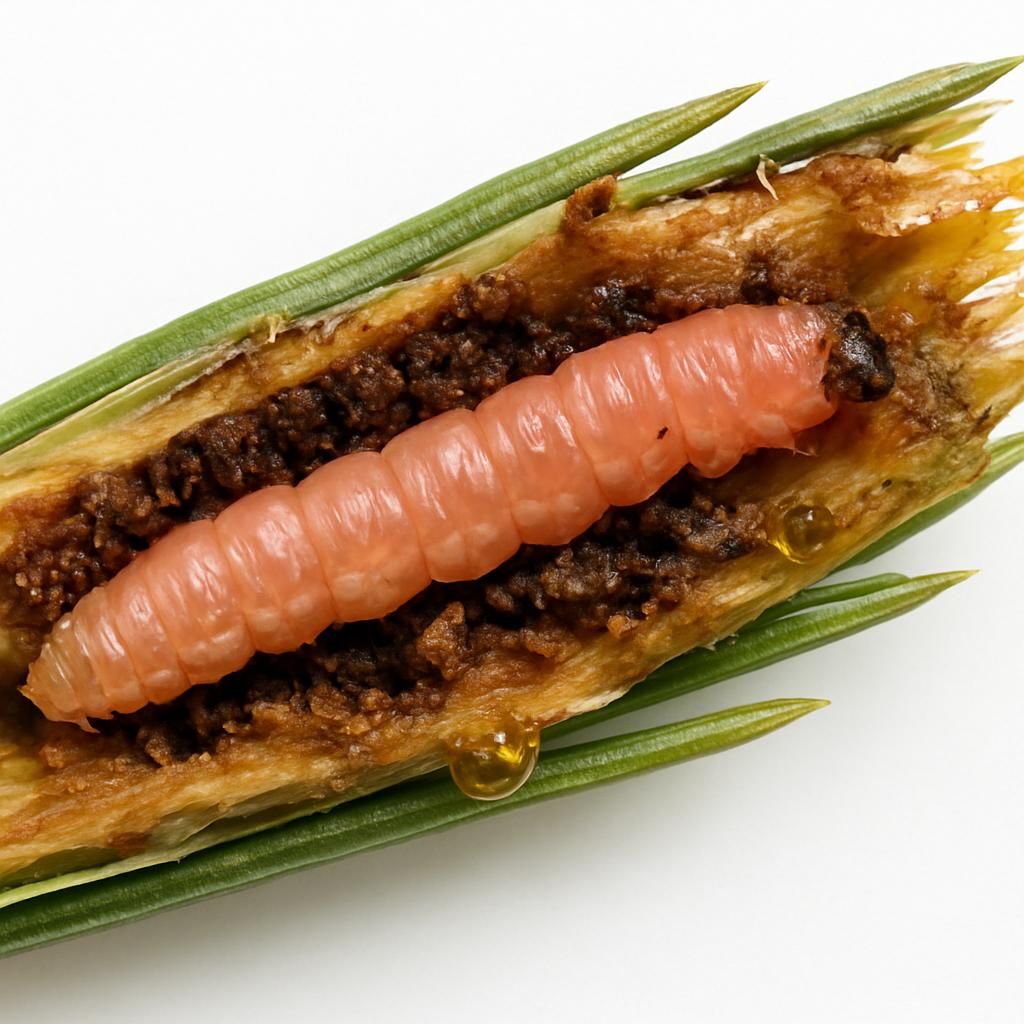
Introduction to pine tip moth
Pine tip moths in the genus Rhyacionia are among the most economically important shoot-infesting pests of young pine stands in North America and parts of Europe. These small tortricid moths lay eggs on pine needles or buds; the resulting larvae bore into and destroy the growing tips of both terminal and lateral shoots. Repeated attacks deform leaders, reduce height growth, and lower timber quality in commercial plantations. The primary North American species include the Nantucket pine tip moth (Rhyacionia frustrana), pitch pine tip moth (R. rigidana), and subtropical pine tip moth (R. subtropica). Early identification and integrated management are critical because damage occurs before visible defoliation and can persist across multiple generations each year.
Identifying Symptoms & Damage
The earliest visible sign of pine tip moth attack is browning and wilting of new terminal growth, often accompanied by resin droplets or frass at the base of the affected shoot. Larval feeding severs vascular tissue inside the bud, causing the shoot to die back and creating a characteristic “flagged” appearance. In severe infestations, multiple lateral shoots compete to become the new leader, resulting in forked or bushy crowns and permanent stem crooks. Close inspection reveals small (3–8 mm) cream-to-pink larvae or pupae inside hollowed buds. Damage is most evident from late spring through midsummer when new flushes are succulent. Distinguishing tip moth injury from other shoot pests such as weevils or borers requires noting the absence of large galleries and the presence of fine frass and silk within the bud.
Lifecycle and Progression of pine tip moth (MUST INCLUDE A MARKDOWN TABLE OF LIFECYCLE STAGES)
Pine tip moths complete two to five generations annually depending on latitude and species. Overwintering occurs as pupae inside damaged shoots or in the duff. Spring-emerging adults mate within hours of eclosion and females lay 20–60 eggs singly on needles near expanding buds. Larvae hatch in 5–10 days and immediately bore into succulent tissue. Pupation takes place inside the shoot after 2–4 weeks of feeding. The table below summarizes the typical developmental timeline for Rhyacionia frustrana in the southeastern United States.
| Stage | Duration (days) | Key Characteristics | Optimal Temperature (°C) |\n|-------------|-----------------|----------------------------------------------|--------------------------| | Egg | 5–10 | Translucent, laid on needles near buds | 20–28 | | Larva | 14–28 | Cream to pink, bores into shoot tip | 18–30 | | Pupa | 7–14 | Brown pupa inside hollow shoot or duff | 15–26 | | Adult | 5–10 | Small gray-brown moth, 6–9 mm wingspan | 18–29 |
Environmental Triggers & Risk Factors
Warm spring temperatures (above 15 °C) accelerate adult emergence and synchronize egg hatch with pine bud flush, increasing infestation severity. Drought stress reduces tree resin flow and natural resistance, allowing higher larval survival. Plantations established on sandy, low-fertility sites or with wide initial spacing experience greater tip moth pressure because of slower growth and reduced shading. Proximity to mature pine stands serves as a reservoir for overwintering pupae. Repeated short-rotation plantings without rotation or sanitation heighten cumulative damage. Monitoring degree-day accumulations beginning at 100–150 base-7 °C helps predict peak flight periods for precise spray timing.
Organic Control & Treatment Plans (MUST INCLUDE A MARKDOWN TABLE OF TREATMENT OPTIONS AND FREQUENCIES)
An integrated organic program emphasizes cultural sanitation, biological agents, and targeted botanical insecticides. Remove and destroy infested shoots during dormant pruning to reduce overwintering pupae. Conserve natural enemies by avoiding broad-spectrum sprays; encourage parasitoid wasps (e.g., Orgilus spp.) through floral borders. Apply Bacillus thuringiensis var. kurstaki (Btk) or spinosad when 30–50 % of eggs have hatched, typically at 200–300 degree-days. Horticultural oils and neem-based products provide contact control of young larvae but require thorough coverage of expanding terminals. The table below outlines practical organic treatment windows and reapplication intervals.
| Treatment Option | Active Ingredient | Application Window | Frequency / Notes |
|---|---|---|---|
| Shoot sanitation | Manual removal | Dormant season (Dec–Feb) | Once annually; destroy prunings |
| Btk spray | Bacillus thuringiensis kurstaki | 200–300 DD post-budbreak | 2–3 applications at 7–10 day intervals |
| Spinosad | Spinosad | Egg hatch to early larval stage | Up to 3 sprays per generation; respect PHI |
| Neem oil | Azadirachtin | Early larval stage | Weekly for 2–3 weeks during peak flight |
| Parasitoid conservation | Floral strips & reduced tillage | Year-round | Maintain 5–10 % non-crop habitat |
Preventing pine tip moth in the Future
Long-term prevention starts with site selection and planting design. Choose vigorous, regionally adapted pine species and provenances that flush later or exhibit higher resin production. Maintain optimal stocking density (1.5–2.0 m spacing) to encourage early crown closure and shading of lower branches. Implement a three-year rotation of pine with non-host species such as oak or sweetgum on high-risk sites. Apply balanced fertilization based on soil tests to promote rapid height growth that outpaces larval damage. Monitor adult flights with pheromone traps beginning in early spring and maintain records to refine degree-day models. Avoid late-summer shearing that stimulates tender regrowth attractive to the final generation. Healthy, unstressed trees combined with timely sanitation remain the foundation of sustainable tip moth management.
Crops Most Affected by pine tip moth
While pine tip moths are conifer specialists, the most severely impacted species include loblolly pine (Pinus taeda), slash pine (P. elliottii), shortleaf pine (P. echinata), and Virginia pine (P. virginiana). In Christmas tree plantations, Scotch pine (P. sylvestris) and white pine (P. strobus) suffer significant quality loss. Damage is negligible on broadleaf species such as tomato or avocado but can occur on ornamental pines in landscapes adjacent to commercial stands.