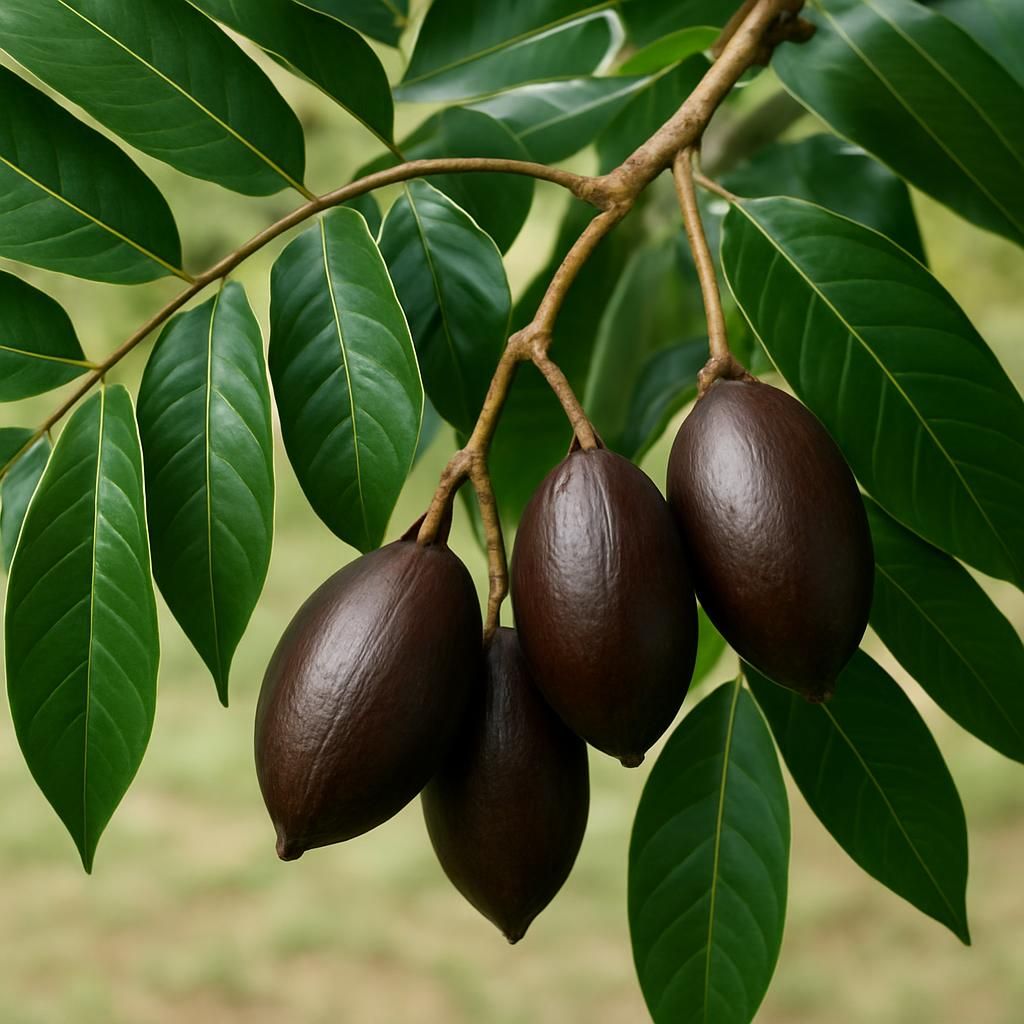
Introduction to Pili Nut (Canarium ovatum)
Pili Nut (Canarium ovatum) is a premium tropical nut species native to the Philippines and parts of Southeast Asia. The tree is valued for its exceptionally high-quality kernels that are rich in healthy fats, protein, and antioxidants. Commercial growers appreciate its long productive lifespan, often exceeding 80 years, and its ability to thrive on marginal lands unsuitable for many other crops.
The pili nut industry has expanded beyond the Philippines into parts of Indonesia, Malaysia, and Pacific islands where similar humid tropical conditions exist. The kernels are consumed roasted, candied, or pressed into high-grade culinary oils. Demand continues to rise in health-food markets and gourmet confectionery sectors worldwide.
Botanical Profile of Pili Nut (Canarium ovatum)
Canarium ovatum belongs to the Burseraceae family and is a large, evergreen, dioecious tree that can reach 20–35 meters in height with a straight trunk and spreading crown. Leaves are pinnately compound, glossy, and leathery. Small, pale-yellow flowers appear in axillary panicles, followed by ovoid drupes containing a hard, woody shell that encases the edible kernel.
Male and female trees are required for pollination, with only female trees bearing fruit. Trees begin flowering at 5–7 years from seed but reach full commercial production around year 10–12. The species exhibits strong apical dominance and a deep taproot system that confers excellent drought tolerance once established.
Soil, pH, and Climate Requirements for Pili Nut (Canarium ovatum)
Pili Nut performs best on well-drained, fertile loams but tolerates sandy and clay-loam soils provided drainage is excellent. The species is sensitive to waterlogging, which quickly leads to Phytophthora root rot.
| Parameter | Ideal Range | Notes |
|---|---|---|
| Soil Type | Loam to sandy loam | Deep, well-drained profiles preferred |
| Soil pH | 5.5 – 7.0 | Slightly acidic to neutral |
| Temperature | 22 – 32 °C (day) | Frost sensitive below 10 °C |
| Annual Rainfall | 1,800 – 3,500 mm | Even distribution or supplemental irrigation |
| Altitude | 0 – 600 m | Best nut quality at lower elevations |
| Relative Humidity | 70 – 90 % | High humidity supports flowering and nut set |
Step-by-Step Planting & Propagation
- Site Selection & Preparation: Choose a sunny, wind-protected location with deep, well-drained soil. Clear competing vegetation and incorporate 20–30 kg well-rotted manure per planting hole.
- Propagation Method: Fresh seeds germinate in 4–8 weeks when sown in individual polybags. Grafting onto seedling rootstocks using the cleft or side-wedge method at 6–12 months improves uniformity and earlier bearing.
- Planting Density: Space grafted trees 10 m × 10 m (100 trees/ha). Seedling orchards may use 12 m × 12 m to accommodate larger crowns.
- Planting Time: Plant at the onset of the rainy season. Dig holes 60 cm × 60 cm × 60 cm and backfill with topsoil mixed with compost.
- Irrigation at Establishment: Provide 20–30 L water per tree twice weekly for the first 6 months until roots are established.
Care & Maintenance regimes for Pili Nut (Canarium ovatum)
Regular attention to water, nutrition, and canopy management ensures consistent high-quality yields. Mulching with organic materials conserves moisture and suppresses weeds.
| Operation | Frequency | Details |
|---|---|---|
| Watering (Young) | 2× weekly, 20–40 L/tree | Reduce to rainfall supplementation after year 3 |
| Watering (Mature) | Every 10–14 days in dry season | Maintain soil moisture at 60–70 % field capacity |
| Fertilizer | Year 1: 200 g 14-14-14 quarterly | Increase to 2–3 kg/tree/year by year 5; split into 3–4 applications |
| Pruning | Annual after harvest | Remove dead wood, water sprouts, and crossing branches; maintain 3–4 m height for easy harvest |
Pests, Diseases & Organic Management
Common pests include scale insects, mealybugs, and nut weevils. Regular monitoring and releases of predatory beetles and parasitic wasps provide effective biological control. Anthracnose and Phytophthora are the primary diseases; copper-based sprays and improved drainage reduce incidence.
Cultural practices such as sanitation, removal of fallen nuts, and maintaining good airflow through pruning significantly lower pest pressure. Neem oil and insecticidal soaps offer additional organic options when populations exceed thresholds.
Harvesting, Curing & Optimal Storage
Mature pili nuts are harvested when the husk turns from green to dark purple and begins to split. Collect fallen nuts daily to avoid mold and animal damage. Remove the fleshy husk immediately and sun-dry the nuts in their shells for 5–7 days until moisture content reaches 8–10 %.
Store cured nuts in breathable sacks or ventilated bins at 10–15 °C and <65 % relative humidity. Properly cured kernels retain quality for 12–18 months. Vacuum-sealing extends shelf life beyond two years.
Companion Planting for Pili Nut (Canarium ovatum)
Interplanting with nitrogen-fixing species such as Gliricidia and pigeon pea improves soil fertility and provides light shade for young trees. Low-growing Thai Basil and marigold repel insects and attract pollinators. Avoid planting heavy feeders like corn or banana too close, as they compete for nutrients and water.