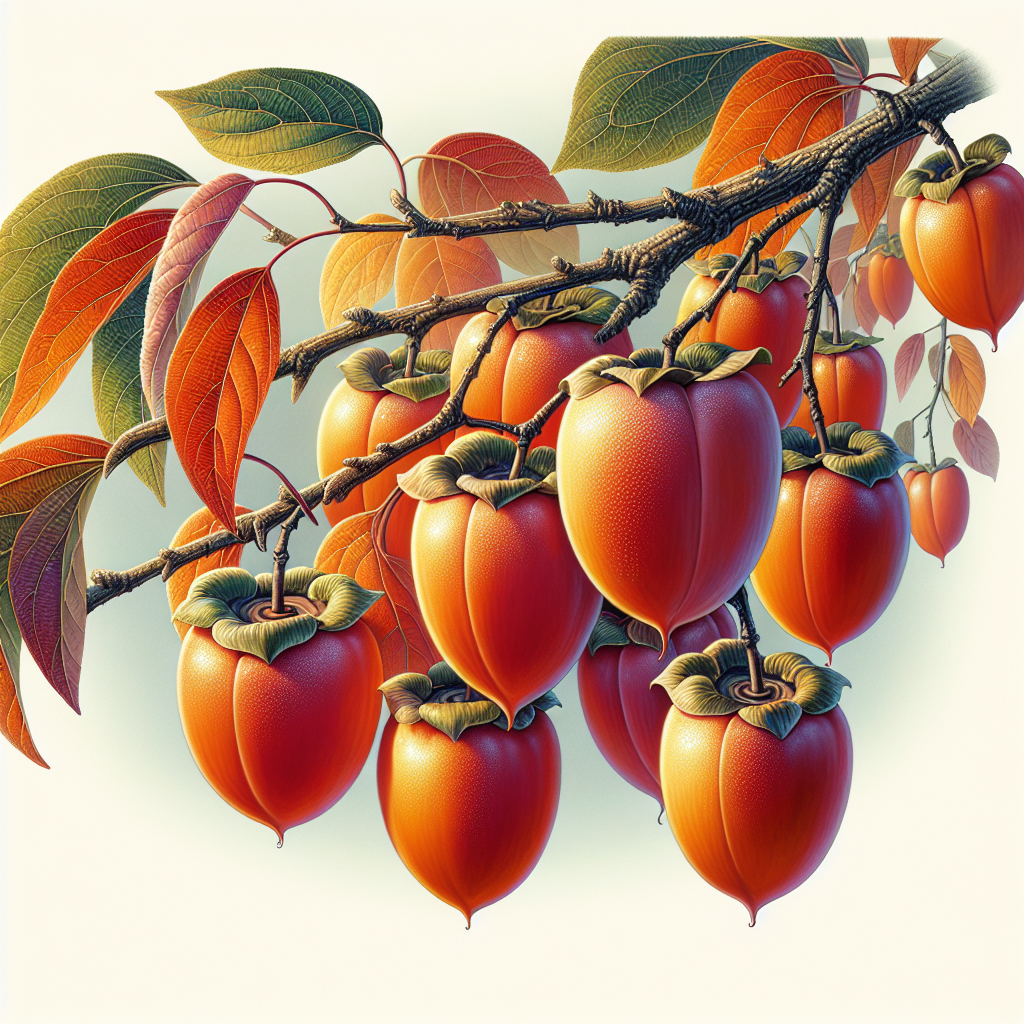
Introduction to Persimmon (Saijo)
Persimmon (Saijo), or Diospyros kaki 'Saijo', stands out as one of the finest Japanese persimmon cultivars for growers seeking exceptional flavor and adaptability. Originating from Japan, this astringent variety—though it ripens to non-astringent sweetness—delivers fruits that are small to medium-sized, perfectly round to slightly elongated, and renowned for their rich, honeyed taste with notes of apricot and brown sugar. Unlike its relative Persimmon (Fuyu), Saijo requires full softening for optimal edibility but rewards patient growers with superior dessert quality.
What makes Saijo particularly appealing for small-scale agriculture is its vigor, disease resistance, and cold tolerance down to USDA Zone 7 (-10°F). Trees reach 15-25 feet at maturity, producing heavy crops after 4-5 years, with yields of 100-200 fruits per mature tree. The glossy green leaves turn brilliant orange-red in fall, adding ornamental value. Nutritionally, Saijo persimmons are packed with vitamins A and C, antioxidants, and fiber, making them a profitable crop for fresh markets, u-pick operations, or value-added products like persimmon puree and leather. This guide provides professional-grade cultivation strategies to maximize your Saijo harvest.
Botanical Profile of Persimmon (Saijo)
Saijo belongs to the Ebenaceae family, a deciduous dioecious tree (separate male and female plants) native to East Asia. Female trees produce fruit, while male pollinators are needed for seed set, though Saijo is partially parthenocarpic, setting some seedless fruit without pollination. Leaves are elliptical, 4-7 inches long, leathery, and turn vibrant crimson in autumn. Flowers are small, greenish-yellow, appearing in late spring.
Fruits are 1.5-2.5 inches in diameter, oblate to acorn-shaped, with deep orange skin and translucent, amber flesh when fully ripe. Unlike astringent types like Persimmon (Hachiya), Saijo's tannins break down naturally at maturity, yielding jelly-like texture without off-flavors. Bloom time is May-June, with harvest in October-November. Root system is deep and fibrous, moderately drought-tolerant once established. Saijo is self-fruitful to a degree but benefits from cross-pollination with varieties like Fuyu or Hyakume. Wood is dense and attractive for crafts, adding secondary value.
Soil, pH, and Climate Requirements for Persimmon (Saijo)
Saijo persimmons thrive in well-drained, loamy soils rich in organic matter, with pH 6.0-7.5. Avoid heavy clays prone to waterlogging, which invite root rot. Incorporate 4-6 inches of compost pre-planting to enhance tilth and nutrient retention. Test soil annually; amend acidic soils with lime and alkaline ones with sulfur. Mulch with 3-4 inches of wood chips or straw to suppress weeds, retain moisture, and moderate soil temperatures.
Optimal climate is temperate with 800-1200 chill hours, summers to 95°F, and winters not exceeding 0°F. Saijo excels in Zones 7-9, tolerating brief dips to Zone 6b. It requires 200-300 frost-free days post-bloom. Full sun (8+ hours) is essential for fruit color and sweetness; partial shade reduces yields by 30-50%. Wind protection prevents desiccation; plant in sheltered sites or use windbreaks. Irrigation: 1-2 inches weekly during establishment and fruit swell, drip systems preferred to minimize foliar wetting. For heatwave resilience, see Why Summer Heatwaves Are Silently Killing Small Farm Yields - And 7 Organic Strategies to Fight Back.
Step-by-Step Planting & Propagation
Propagation: Saijo is typically grafted onto D. kaki or D. virginiana rootstocks for vigor and nematode resistance. Seed propagation is unreliable due to variability. Softwood cuttings (June-July) root at 60-70% under mist with IBA hormone. For home growers: collect ripe fruit, extract seeds, stratify 90 days at 40°F, sow in spring.
Site Selection: Choose south-facing slopes for air drainage and warmth. Space trees 15-20 feet apart (20x20 for dwarfs). Dig holes 2x root ball width, 18 inches deep.
Planting (Dormant Season, Late Winter): 1. Soak bare-root trees 4-6 hours. 2. Trim damaged roots, spread horizontally. 3. Plant graft union 4 inches above soil. 4. Backfill with native soil + 30% compost, no fertilizer. 5. Water deeply, mulch 4-foot radius. 6. Stake if needed. For container plants, same process post-potting out.
Pollination: Plant 1 male pollinator per 8-10 females, or rely on partial parthenocarpy. Expect first fruit year 3-4.
Care & Maintenance regimes for Persimmon (Saijo)
Watering: Deep soak weekly first 2 years; mature trees drought-tolerant but irrigate during June-August fruit sizing for larger fruits (+20% size).
Fertilization: Spring: 1 lb 10-10-10 per year of age (max 8 lbs). Foliar calcium post-harvest prevents cracking. Avoid excess nitrogen to prevent vegetative overgrowth.
Pruning: Dormant season, open-center system. Remove suckers, water sprouts, crossing branches. Thin fruitlets to 6-inch spacing for jumbo size. Annual pruning maintains 10-12 ft height.
Training: Central leader or modified open vase. Tie young branches to stakes.
Winter Protection: Zone 7: mulch roots thickly. Wrap trunks in burlap if <5 years old.
Soil Management: Annual compost top-dress; cover crops like clover suppress weeds.
Pests, Diseases & Organic Management
Pests: Monitor for aphids (hose off, neem oil), scale insects (hort oil dormant spray), and mealybugs (alcohol swabs). Birds love ripe fruit—net trees. Deer browse young trees; use fencing.
Diseases: Anthracnose causes leaf spot/fruit rot—prune for airflow, copper fungicide spring. Phytophthora root rot in wet soils—improve drainage. Powdery mildew rare; milk spray if needed. Saijo shows strong resistance to fungal issues.
Organic IPM: Beneficial insects (ladybugs), row covers early season. Kaolin clay deters beetles. Learn more in Why 90% of Small Farms Fail at Pest Management - And 8 Organic Fixes That Actually Work. Scout weekly; intervene early.
Harvesting, Curing & Optimal Storage
Harvest late October when fruits soften slightly, shoulders yellow-orange, leaves drop. Clip with 1-inch stem to avoid calyx tear. Yield: 50-100 lbs/tree mature.
Curing Astringent Fruit: Place in single layer boxes with ethylene source (apples/bananas) at 70-80°F, 85% humidity, 7-14 days until translucent/jelly-like. Do not refrigerate pre-ripe.
Storage: Ripe: 32-40°F, 90-95% RH, 1-2 months. Fresh market: color-break stage. Process into jam, bread, or dry slices (140°F dehydrator 8-12 hours).
Post-Harvest: Clean debris, prune lightly to promote next year's buds.
Companion Planting for Persimmon (Saijo)
Saijo pairs well with nitrogen-fixers like clover or guava understory. Avoid walnuts (juglone toxicity). Beneficials: comfrey for mulch, garlic for pest repulsion, yarrow attracts pollinators. Legumes like peas improve soil. Tall companions: dwarf apples above, herbs below. Space-aware planting boosts biodiversity, reduces pests. Detailed strategies in Why Companion Planting Feels Like Guesswork for Small Farms - And How AI Makes It Foolproof.