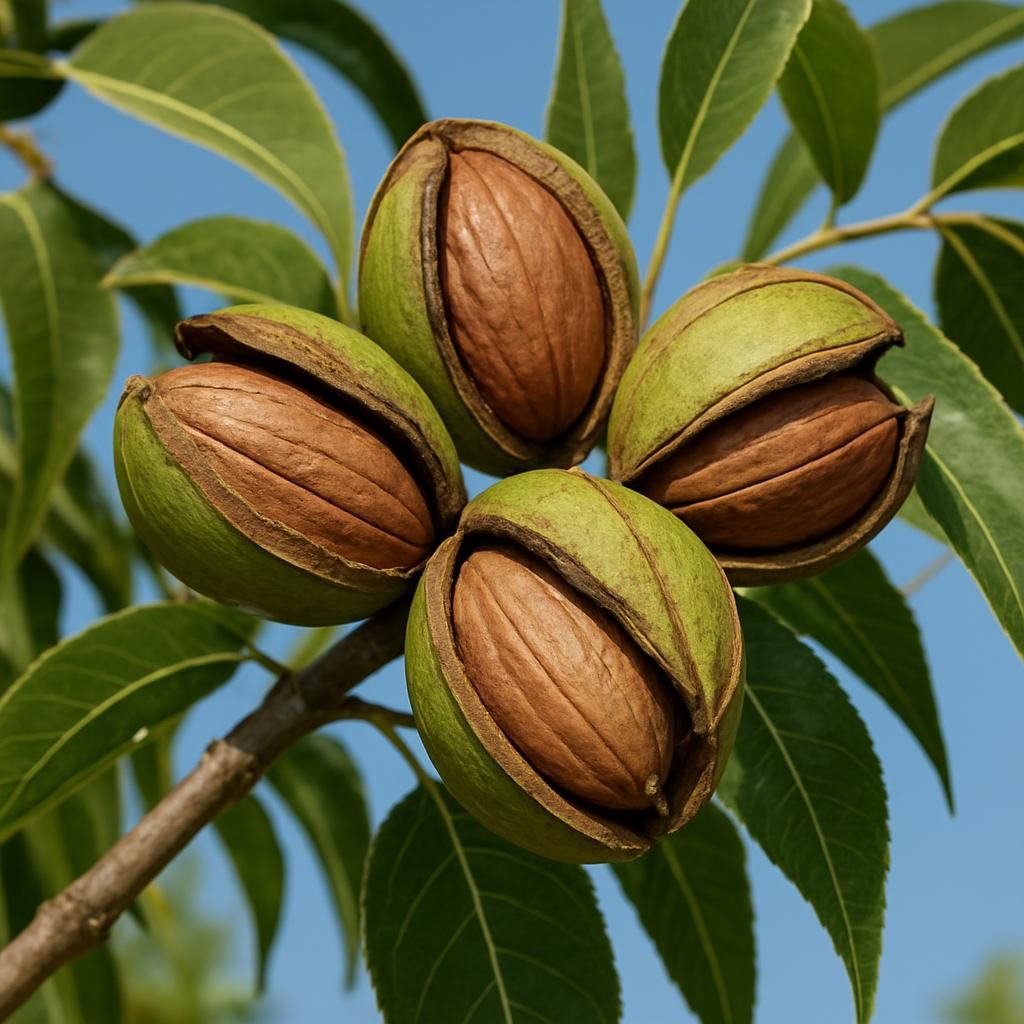
Introduction to Pecan (Stuart)
The Stuart pecan cultivar (Carya illinoinensis 'Stuart') has been a cornerstone of commercial orchards since its introduction in the early 20th century. Known for large, thin-shelled nuts with excellent kernel quality, Stuart trees deliver consistent yields when properly managed. This guide provides professional-grade advice on establishing and maintaining productive Stuart pecan orchards.
Botanical Profile of Pecan (Stuart)
Stuart is a vigorous, upright-growing pecan tree that reaches 70–100 feet at maturity with a broad, rounded canopy. The alternate, pinnately compound leaves feature 9–17 lanceolate leaflets. As a monoecious species, Stuart produces separate male catkins and female flowers on the same tree, with pollination occurring primarily by wind. The nuts are large (typically 40–50 nuts per pound), oblong, with a smooth, light-brown shell and high-quality kernels that store well.
Soil, pH, and Climate Requirements for Pecan (Stuart)
Stuart pecans perform best in deep, well-drained soils with good water-holding capacity. The following table outlines ideal growing conditions:
| Parameter | Ideal Range/Value | Notes |
|---|---|---|
| Soil Type | Loamy sand to sandy loam | Deep profiles (>4 ft) preferred |
| Soil pH | 6.0–7.0 | Slightly acidic to neutral |
| USDA Zones | 7a–9b | Requires 200–250 frost-free days |
| Temperature Range | 75–95°F (growing season) | Cold hardiness to –10°F when dormant |
| Annual Rainfall | 40–60 inches | Supplemental irrigation essential in dry periods |
| Sun Exposure | Full sun (minimum 8 hours) | Critical for nut fill and quality |
Step-by-Step Planting & Propagation
- Select certified, disease-free Stuart nursery trees grafted onto vigorous rootstocks.
- Plant during dormancy (December–February) in holes twice as wide as the root ball and at the same depth as the nursery line.
- Space trees 40–50 feet apart in rows 50–60 feet wide for commercial orchards.
- Backfill with native soil amended with aged compost; avoid fresh manure.
- Water thoroughly after planting and apply a 3–4 inch layer of organic mulch, keeping it 6 inches from the trunk.
- Stake young trees in windy sites and install tree guards to prevent rodent damage.
Care & Maintenance regimes for Pecan (Stuart)
Consistent irrigation, targeted nutrition, and timely pruning are essential for high yields. The table below summarizes recommended schedules:
| Season | Watering Schedule | Fertilizer Application | Pruning Schedule |
|---|---|---|---|
| Spring | 1–1.5 inches/week; increase during bloom | 1–2 lbs N/tree at bud break; zinc foliar spray | Remove dead/diseased wood; shape young trees |
| Summer | 1.5–2 inches/week during nut fill | Split N applications; boron if deficiency | Light summer tipping of vigorous shoots |
| Fall | Reduce to encourage hardening off | Apply potassium and phosphorus based on soil test | Remove crossing branches; open canopy |
| Winter | Maintain soil moisture if dry | Soil test and lime if pH <6.0 | Dormant pruning; remove water sprouts |
Pests, Diseases & Organic Management
Stuart pecans face pressure from pecan scab, pecan nut casebearer, black pecan aphids, and hickory shuckworm. Monitor with pheromone traps and degree-day models. Apply horticultural oils and approved organic fungicides during critical infection windows. Maintain orchard sanitation by removing fallen shucks and leaves. Encourage beneficial insects through flowering understory plantings.
Harvesting, Curing & Optimal Storage
Harvest when shucks split naturally (typically October–November). Collect nuts promptly to avoid weather damage and wildlife loss. Air-dry or use forced-air dryers at 90–100°F until kernel moisture reaches 4–5%. Store in-shell nuts at 32–40°F and 60–70% relative humidity for up to 12 months. For longer storage, vacuum-seal or freeze shelled kernels.
Companion Planting for Pecan (Stuart)
Leguminous cover crops such as clover and hairy vetch fix nitrogen and improve soil structure. Interplanting with thyme and rosemary can deter certain insect pests. Avoid planting shallow-rooted vegetables directly under mature trees to prevent competition for water and nutrients. Tall, wind-sensitive crops should be placed on the leeward side of the orchard.
Stuart Pecan trees reward careful management with decades of high-quality nut production.