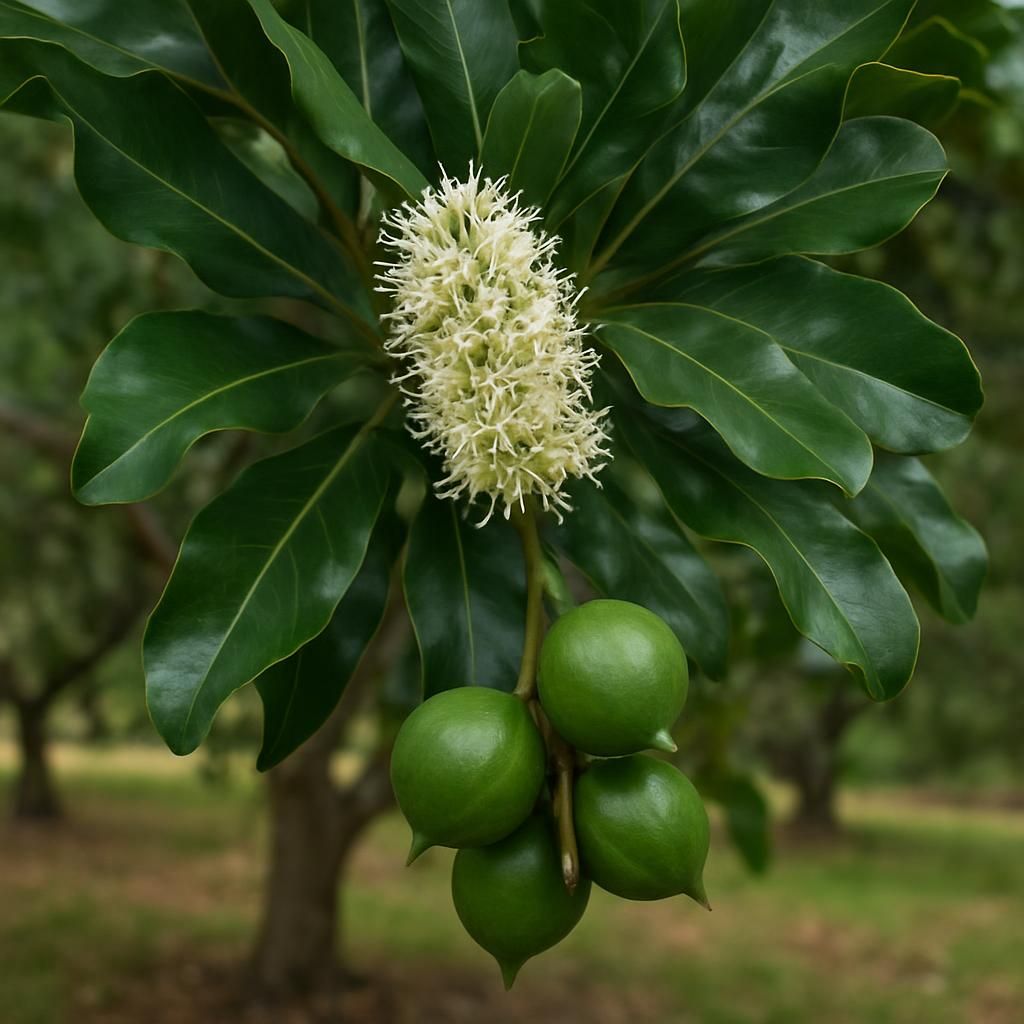
Introduction to Macadamia (Mauka)
Macadamia (Mauka) is a high-value subtropical nut crop prized for its rich, buttery kernels and exceptional oil content. Developed as a hybrid of Macadamia species, the Mauka cultivar combines superior kernel quality with improved adaptability to marginal subtropical soils. Commercial growers appreciate its long productive life of 40–60 years and strong market demand for both raw and roasted products. With proper management, orchards can achieve sustainable yields of 15–25 kg of nut-in-shell per tree at maturity.
Botanical Profile of Macadamia (Mauka)
The Mauka hybrid exhibits an upright growth habit reaching 10–15 m at maturity with a dense canopy of glossy, dark-green leaves. It produces racemes of small creamy-white flowers that develop into woody follicles containing one or two spherical kernels. The hybrid vigor of Mauka results in earlier bearing (4–5 years) and larger kernel recovery (38–45%) than many standard cultivars. Trees are partially self-fertile but benefit from cross-pollination with compatible varieties such as Beaumont or Nelmac.
Soil, pH, and Climate Requirements for Macadamia (Mauka)
Macadamia (Mauka) thrives in deep, well-drained soils with moderate fertility. Avoid heavy clays and waterlogged sites. The following table summarizes ideal growing conditions:
| Parameter | Ideal Range | Notes |
|---|---|---|
| Soil Type | Sandy loam to clay loam | Minimum 1.5 m rooting depth |
| Soil pH | 5.5 – 6.5 | Slightly acidic; correct with lime if <5.0 |
| Temperature | 16–30 °C daytime | Frost below –2 °C damages young trees |
| Annual Rainfall | 1,000–2,000 mm | Supplemental irrigation essential in dry periods |
| Altitude | 0–800 m | Best quality kernels below 600 m |
| Wind Tolerance | Moderate | Windbreaks recommended in exposed sites |
Step-by-Step Planting & Propagation
- Site Selection: Choose north- or east-facing slopes with good air drainage to minimize frost risk.
- Soil Preparation: Conduct deep ripping to 60 cm and incorporate 20–30 t/ha well-rotted compost.
- Spacing: Plant at 7 × 7 m (204 trees/ha) for mechanical harvesting or 6 × 8 m for hand harvest.
- Propagation: Use grafted seedlings on vigorous rootstocks (e.g., Beaumont Macadamia) for uniform orchards.
- Planting: Dig 60 cm holes, place trees at the same depth as the nursery, backfill, and water immediately. Install drip irrigation at planting.
Care & Maintenance regimes for Macadamia (Mauka)
Consistent water and nutrient management are critical during the first five years. The table below outlines recommended schedules:
| Growth Stage | Irrigation (mm/week) | Fertilizer (N-P-K) | Pruning Frequency |
|---|---|---|---|
| Year 1–2 | 25–35 | 200 g/tree 15-5-12 quarterly | Formative: 2× per year |
| Year 3–5 | 20–30 | 400 g/tree 15-5-12 biannual | Structural: once annually |
| Mature (Year 6+) | 15–25 | 1.5–2 kg/tree 12-4-16 annual | Maintenance: post-harvest |
Mulch with 10–15 cm organic material to conserve moisture and suppress weeds. Monitor leaf nutrient levels annually and adjust programs accordingly.
Pests, Diseases & Organic Management
Key pests include Macadamia nut borer, scale insects, and thrips. Regular monitoring with pheromone traps allows timely intervention. Organic options include neem oil sprays, predatory mites, and trunk banding. Diseases such as Phytophthora root rot and anthracnose are managed through improved drainage, resistant rootstocks, and copper-based sprays during flowering. Maintain orchard hygiene by removing fallen nuts and pruning dead wood.
Harvesting, Curing & Optimal Storage
Harvest when the husk splits naturally, typically March–June in subtropical regions. Collect fallen nuts daily to minimize mold. Dry nuts-in-shell to 10% moisture within 48 hours using forced-air dryers at 30–35 °C. Cure at ambient temperature for 3–4 weeks to develop flavor. Store in sealed containers at 4–10 °C and <60% RH for up to 12 months without quality loss.
Companion Planting for Macadamia (Mauka)
Interplant with nitrogen-fixing legumes such as pigeon pea or hairy vetch to improve soil fertility. Low-growing herbs including thyme and rosemary deter insect pests while providing ground cover. Avoid tall competitive species within the dripline. Strategic use of marigold borders reduces nematode pressure and enhances beneficial insect populations.