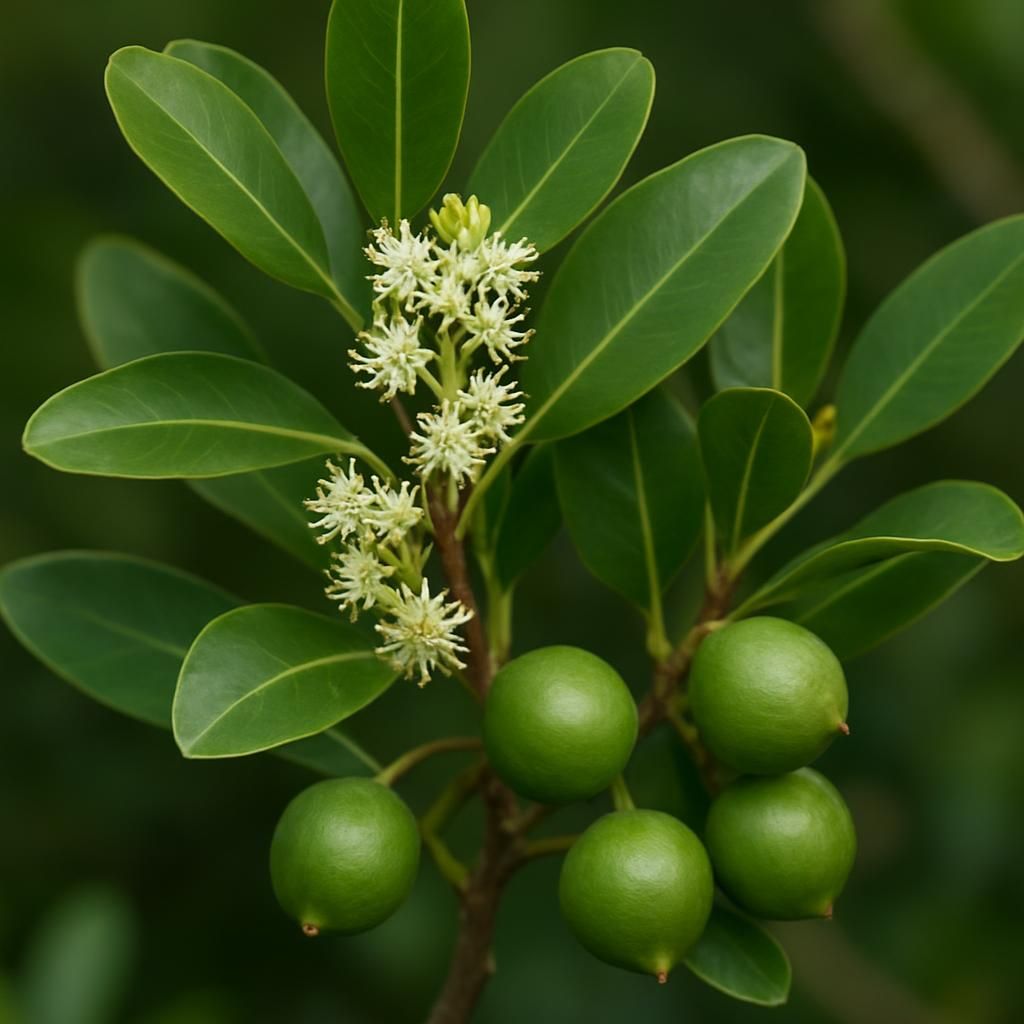
Introduction to Macadamia (Dwarf)
The Dwarf Macadamia brings the rich, buttery flavor of premium macadamia nuts into smaller spaces. Bred from Macadamia parent stock, these compact trees reach just 4–6 meters, making them perfect for home gardens, urban orchards, and intensive small-farm systems. They maintain the same high oil content and crunchy texture as their larger relatives while requiring less pruning and offering earlier bearing. Dwarf cultivars are increasingly popular among growers seeking sustainable, high-value nut crops without the footprint of standard varieties.
Botanical Profile of Macadamia (Dwarf)
Dwarf Macadamia belongs to the Proteaceae family. It features glossy, dark-green, lanceolate leaves and produces racemes of small, creamy-white flowers that attract pollinators. The nuts develop inside a hard, woody shell surrounded by a green husk that splits at maturity. Trees exhibit a naturally rounded canopy and have a moderate growth rate. Dwarf selections typically begin bearing at 3–4 years and reach peak production between years 7–12. The compact stature allows higher planting densities while still delivering commercial yields of 15–25 kg of in-shell nuts per mature tree.
Soil, pH, and Climate Requirements for Macadamia (Dwarf)
Dwarf Macadamia performs best in well-drained, deep, fertile soils with good organic matter. It tolerates a range of textures but suffers in heavy clay or waterlogged conditions. The species prefers subtropical to warm temperate climates with mild winters and protection from strong winds.
| Parameter | Ideal Range | Notes |
|---|---|---|
| Soil Type | Sandy loam to loam | Deep, well-drained profiles preferred |
| Soil pH | 5.5 – 6.5 | Slightly acidic; avoid alkaline soils |
| Temperature Range | 15–30 °C daytime; >0 °C minimum | Protect young trees from frost |
| Annual Rainfall | 1000–2000 mm | Supplemental irrigation required in dry periods |
| Humidity | 60–80 % | Moderate humidity supports flowering |
| Elevation | 0–800 m | Lower elevations reduce wind damage |
| Sun Exposure | Full sun (6–8 hours) | Partial shade reduces nut set |
Step-by-Step Planting & Propagation
- Select a site with full sun and excellent drainage; prepare a 1 m × 1 m planting hole.
- Incorporate well-rotted compost and a balanced slow-release fertilizer into the backfill.
- Plant grafted dwarf seedlings at the same depth as the nursery container; stake young trees.
- Space trees 4–5 m apart in rows 5–6 m wide for optimal light penetration.
- Water thoroughly after planting and apply a 5–10 cm layer of organic mulch, keeping mulch away from the trunk.
- Propagation is best achieved by grafting onto seedling rootstocks of Macadamia integrifolia for disease resistance and vigor.
Care & Maintenance regimes for Macadamia (Dwarf)
Consistent irrigation, targeted nutrition, and annual pruning keep dwarf macadamias productive and structurally sound.
| Season | Watering Schedule | Fertilizer Application | Pruning Activity |
|---|---|---|---|
| Spring | 20–30 L/week per tree; increase in heat | Apply NPK 10-5-10 (150 g/tree) + trace elements | Tip prune new growth to encourage branching |
| Summer | 30–40 L/week; monitor soil moisture | Side-dress with potassium sulfate (100 g) | Remove water shoots and crossing branches |
| Autumn | Reduce to 15–20 L/week | Apply organic compost (2–3 kg) around drip line | Light structural pruning post-harvest |
| Winter | Minimal; only during prolonged dry spells | No fertilizer; focus on soil biology | Remove dead or diseased wood |
Mulch annually with wood chips or macadamia husks to conserve moisture and suppress weeds. Monitor leaf nutrient levels every two years and adjust amendments accordingly.
Pests, Diseases & Organic Management
Common challenges include Macadamia nut borer, scale insects, and Phytophthora root rot. Implement integrated pest management: encourage beneficial insects, apply horticultural oils for scale, and use pheromone traps for borers. Maintain well-drained soils and avoid overwatering to prevent root diseases. Regular sanitation—removing fallen nuts and husks—reduces overwintering pest populations.
Harvesting, Curing & Optimal Storage
Harvest when husks begin to split naturally, typically from late autumn through winter. Collect fallen nuts daily to prevent mold and insect damage. Remove husks within 24 hours and dry nuts at 30–35 °C with good airflow until kernel moisture reaches 1.5 %. Store cured nuts in airtight containers at 5–10 °C for up to 12 months. For longer storage, vacuum-seal and freeze at –18 °C.
Companion Planting for Macadamia (Dwarf)
Compatible companions include Clover for nitrogen fixation, Marigold for pest deterrence, and Thyme as a low-growing aromatic groundcover. These pairings improve soil health, attract pollinators, and reduce pest pressure without competing for resources. Avoid planting heavy feeders such as Corn or Tomato within the root zone.